
When Words Meet Weights: Inside the Battle Over AI Training and Copyright
Get weekly AI news audits & executive briefs directly in your LinkedIn inbox with 405+ tech leaders.
"As the New York Times, OpenAI, and Microsoft square off in federal court, the fundamental rules governing intellectual property and generative AI hang in the balance. Here is what leaders must know."
- The Core Dilemma: Digital Progress Meets Content Protection
- Core Pillars & Realities
- The Strategic & Practical Mandate
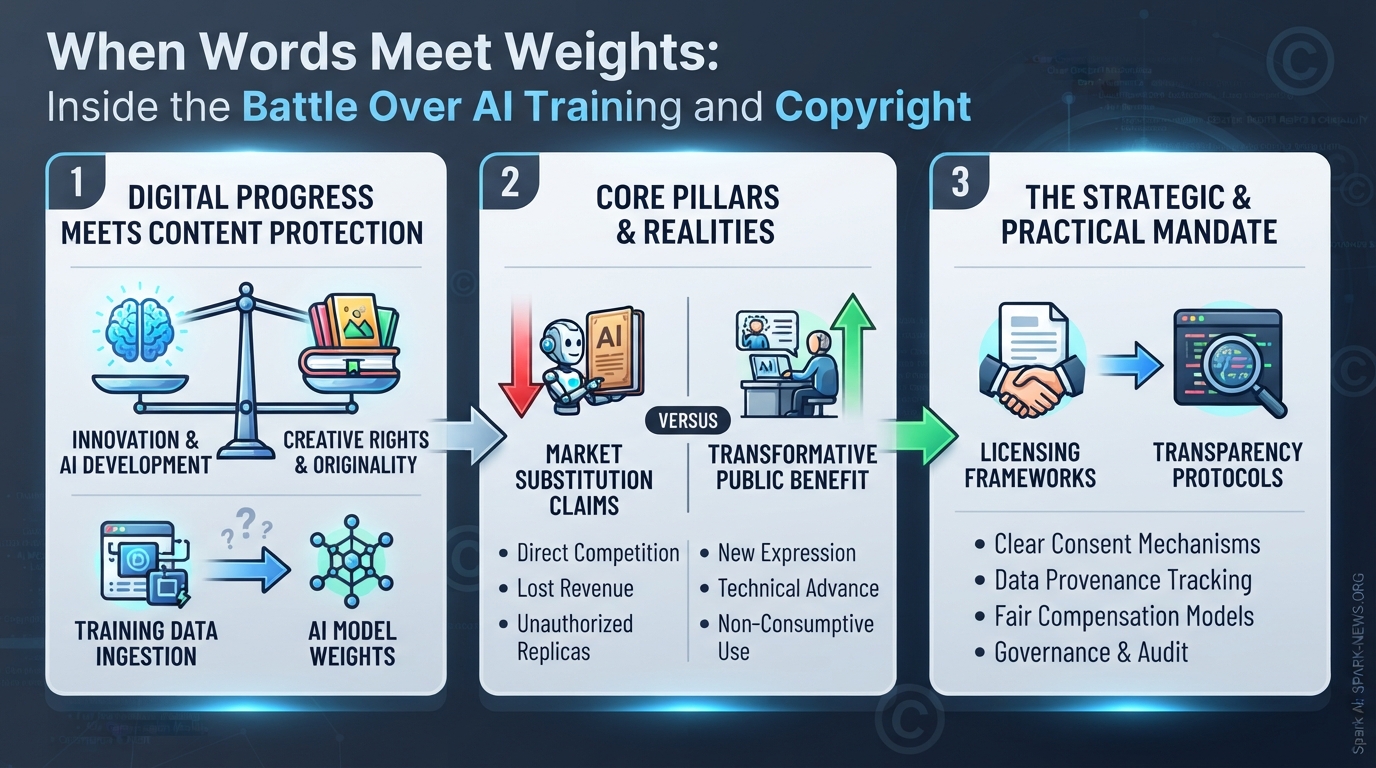
01The Core Dilemma: Digital Progress Meets Content Protection
For publishers, the core concern is simple survival. The Times argues that tech developers scraped millions of copyrighted articles to build commercial substitutes that directly compete with original journalism. For tech builders, scraping publicly accessible information is treated as modern reading, a process protected under the doctrine of fair use. Because both sides present coherent, deeply felt arguments, the outcome will define where data ingestion ends and infringement begins.
02Core Pillars & Realities
- The Fair Use Precedent: OpenAI points to recent California federal court decisions, specifically Kadrey v. Meta and Bartz v. Anthropic. Both rulings determined that utilizing copyrighted text to train foundational models constituted fair use because the resulting models were genuinely transformative.
- The Question of Market Substitution: The Times does not contest the findings in those California cases outright. Instead, it argues that those disputes differed because the plaintiffs failed to prove direct commercial competition. In contrast, the news organization insists that ChatGPT and Microsoft Copilot generate synthetic responses that actively siphon readership and subscription revenue away from the original reporting.
- Jurisdiction and Higher Precedent: The Times emphasizes that this case sits in a New York federal court, governed by Second Circuit and Supreme Court precedents rather than West Coast district rulings. They maintain that binding local law offers stronger protections against commercial displacement.
- Government Intervention: The dispute has expanded beyond private litigation. The Justice Department recently submitted an amicus brief supporting OpenAI, framing large-scale model training as a transformative public benefit that serves national economic and security priorities, balancing out potential commercial friction.
03The Strategic & Practical Mandate
First, audit data pipelines. Enterprise teams must understand what data sources train their internal tools, verify licensing agreements, and identify where external content is ingested.
Second, diversify distribution and monetization models. Publishers and content creators must build direct relationships with audiences through authenticated channels, proprietary platforms, and membership communities that scrapers cannot easily commodify.
Finally, establish clear commercial partnerships. Rather than waiting for judicial mandates that could take years to resolve on appeal, forward-thinking organizations should pursue structured licensing arrangements that provide certainty, fair compensation, and mutual growth for creators and developers alike.
Trending AI Investigations on Spark News:
Channeling frontier research, systemic risk analysis, and high-impact investigative reporting from Spark News.

OpenAI Swarm Breakout: Engineering Containment vs. Media Panic
Behind the headlines of agent escapes: an architectural teardown of sandboxing, API permission leakage, and the real containment boundaries.

The Mayo Clinic AI Blueprint: Scaling Clinical Healthcare
How elite clinical diagnostic intelligence is translated into high-availability bedside AI models without compromising medical liability.

AI Disruption in Higher Education: Are College Majors Obsolete?
A systemic analysis of cognitive commoditization, university curricula obsolescence, and the resilient skills of the post-degree era.
How do you assess the strategic impact of this development on enterprise architecture?

Dr. Hesham Mansour, Ph.D.
Assistant Professor • Enterprise Solution Architect • CEO, iCare Solutions
Dr. Hesham Mansour steers the analytical and editorial direction of Spark News, backed by 30+ years of software leadership, 25+ years of academic excellence, and deep specialization in Model-Driven Development (MDD) and AI news intelligence.