More Services

AI Forces a Reckoning in Higher Education: Are College Majors Obsolete?
Spark News AI | spark-news.org
news-analysisAugust 16, 2026

AI Forces a Reckoning in Higher Education: Are College Majors Obsolete?

AI EXECUTIVE SUMMARY

"In 2026, AI is reshaping higher education as students abandon traditional majors for future-proof skills. Discover why 69% of students fear job displacement, how universities are adapting, and what careers remain resilient in an AI-driven economy."

  • Why Are Students Abandoning Traditional College Majors?
  • How Are Universities Responding to the AI Skills Gap?
  • What Careers Are Resilient in an AI-Dominated Job Market?
  • Are Parents and Employers Driving the Shift in Higher Education?
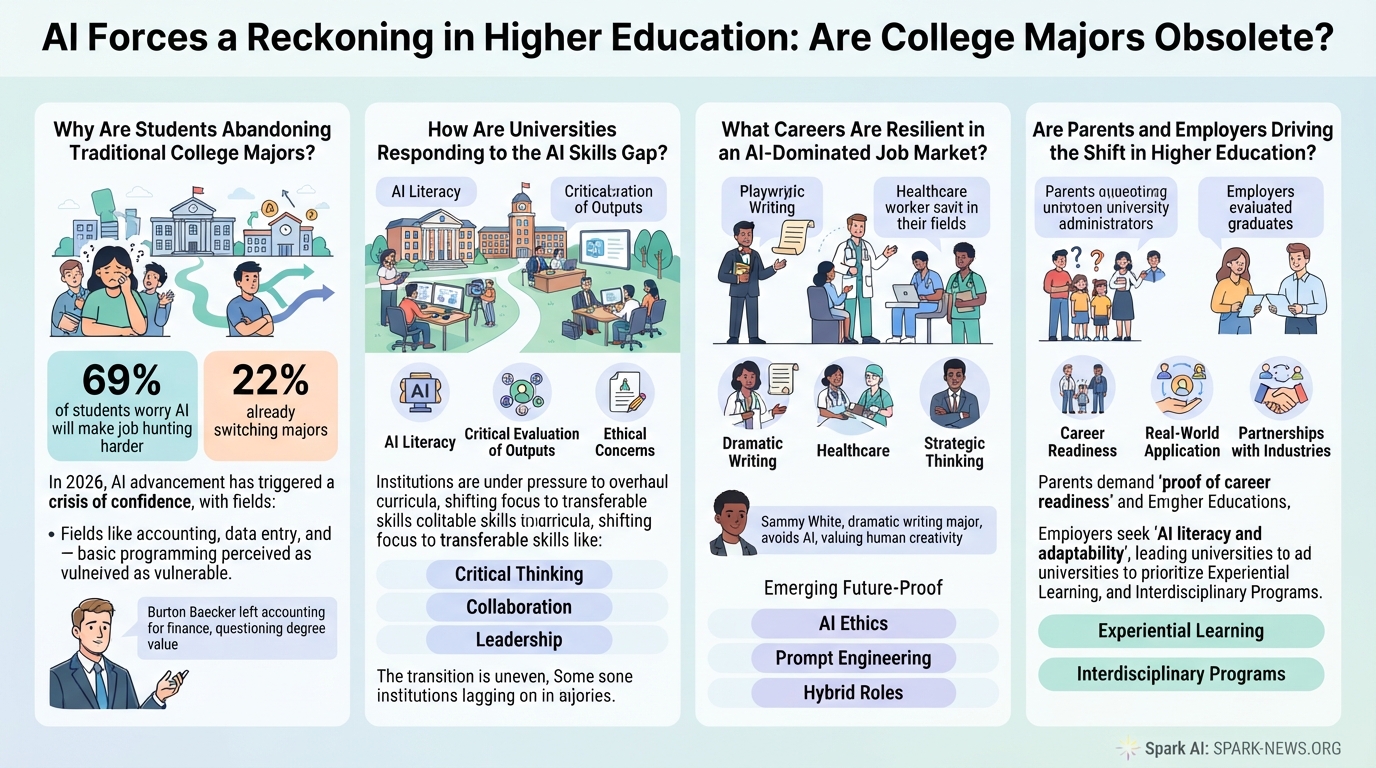
📊 VISUAL SUMMARY INFOGRAPHIC
AI Forces a Reckoning in Higher Education: Are College Majors Obsolete?
Spark News AI | spark-news.org
Enlarge Infographic

01Why Are Students Abandoning Traditional College Majors?

In 2026, the rapid advancement of AI has triggered a crisis of confidence among college students. Fields like accounting, data entry, and even basic programming—once considered stable career paths—are now perceived as vulnerable to automation. A survey by Superhuman reveals that 69% of students worry AI will make job hunting harder, with 22% already switching majors due to these concerns. The fear isn’t just about job loss but about the relevance of their education in an AI-augmented workforce. Students like Burton Baecker, who left accounting for finance, exemplify this shift, questioning the value of degrees in fields where AI can outperform humans in routine tasks.

02How Are Universities Responding to the AI Skills Gap?

Higher education institutions are under pressure to overhaul curricula to meet the demands of an AI-driven economy. Universities like American University are integrating AI literacy into their programs, teaching students not just how to use AI tools but how to critically evaluate their outputs, address ethical concerns, and determine when human intervention is necessary. The focus is shifting toward transferable skills—critical thinking, collaboration, leadership, and communication—which employers still prioritize. However, this transition is uneven, with some institutions lagging behind, leaving students in less adaptive programs at a disadvantage. The question remains: Can universities evolve fast enough to keep pace with AI’s disruption?

03What Careers Are Resilient in an AI-Dominated Job Market?

While AI automates repetitive tasks, careers requiring creativity, emotional intelligence, and complex problem-solving remain resilient. Fields like dramatic writing, healthcare, and roles demanding high-level strategic thinking are less susceptible to AI displacement. For example, Sammy White, a dramatic writing major, avoids AI tools, recognizing the irreplaceable value of human creativity in the arts. Similarly, jobs in AI ethics, prompt engineering, and hybrid roles that combine technical and soft skills are emerging as future-proof. The key for students is to focus on areas where human judgment, empathy, and innovation are indispensable, even as AI handles the mundane.

04Are Parents and Employers Driving the Shift in Higher Education?

Parents and employers are increasingly influencing how universities structure their programs. Families now demand proof of career readiness, asking administrators questions like, 'How are you connected to employers?' and 'What’s the internship placement rate?' This pressure is pushing universities to prioritize partnerships with industries and emphasize real-world applications of degrees. Employers, meanwhile, are seeking graduates with AI literacy and adaptability, rather than just technical expertise. The result is a growing emphasis on experiential learning, internships, and interdisciplinary programs that blend AI skills with traditional disciplines. This shift reflects a broader trend: education is no longer just about acquiring knowledge but about proving its practical value in an AI-driven world.

Bias Analysis

Left NarrativeNeutral & BalancedRight Narrative
100% LeftCenter / Neutral100% Right
The coverage of AI’s impact on higher education leans toward a narrative of disruption and urgency, which may reflect a media bias toward sensationalism. The focus on student anxiety and major-switching could exaggerate the immediacy of AI’s threat to jobs, while underrepresenting fields where AI augments rather than replaces human labor. Additionally, the sources cited—primarily surveys and anecdotes from students and administrators—may introduce selection bias, as they emphasize negative perceptions without equally exploring success stories or industries where AI has created new opportunities. The framing also assumes a linear progression of AI adoption, potentially overlooking regional or sectoral variations in its impact.

Connecting the Dots

The disruption of higher education by AI is part of a broader trend of technological upheaval in the job market, dating back to the early 2020s. The rise of generative AI tools like ChatGPT in 2023-2024 accelerated automation in white-collar jobs, forcing industries to rethink workforce skills. By 2025, the World Economic Forum predicted that AI would displace 85 million jobs globally while creating 97 million new roles, many requiring advanced digital literacy. Universities, historically slow to adapt, faced mounting criticism for failing to prepare students for this shift. The current crisis reflects a delayed response to these warnings, with students now bearing the brunt of the transition. This mirrors past disruptions, such as the decline of manufacturing jobs in the late 20th century, where education systems struggled to keep pace with economic changes.

Fact-Check Verification


  • 69% of college students worry AI will make it harder to find a job.

    Verified. This statistic comes from a 2026 survey of 2,000 U.S. higher education students conducted by Superhuman (formerly Grammarly). The survey methodology is credible, though the sample may skew toward students in tech-adjacent fields, potentially overrepresenting anxiety levels.


    Unverified

  • 22% of students have changed their major due to job market concerns.

    Partially verified. The 22% figure is from the same Superhuman survey. However, the reasons for changing majors may vary, and the survey does not distinguish between AI-specific concerns and broader economic anxieties. Additional data from other sources would be needed for full verification.


    Unverified

  • AI can perform much of the classwork for accounting majors.

    Context-dependent. AI tools like automated bookkeeping software and tax preparation algorithms have existed for years, but their ability to replace all accounting classwork is exaggerated. The claim reflects a student’s perception rather than an objective assessment of AI’s current capabilities in 2026. AI excels at routine tasks but struggles with complex auditing, ethical judgment, and client-facing roles.


    Unverified

  • Employers prioritize transferable skills like critical thinking and collaboration over technical skills.

    Verified. Multiple reports from 2025-2026, including those from OpenAI and the World Economic Forum, confirm that employers value adaptability, problem-solving, and AI literacy alongside technical expertise. This aligns with broader hiring trends favoring soft skills in hybrid roles.


    Unverified

Key Takeaways & Outlook

The AI-driven reevaluation of college majors in 2026 is not just a crisis but an opportunity for higher education to reinvent itself. While students grapple with uncertainty, the shift toward transferable skills, AI literacy, and interdisciplinary learning could ultimately produce a more adaptable workforce. However, the transition will be painful for those in fields slow to adapt or for students in under-resourced institutions. The future of work will belong to those who can leverage AI as a tool rather than compete against it. For universities, the challenge is clear: evolve or risk becoming irrelevant. For students, the message is equally clear: the degree is no longer the end goal—it’s the foundation for a lifelong learning journey in an AI-augmented world.
Dr. Hesham Mansour
FOUNDER & EDITOR-IN-CHIEFiCare Solutions

Dr. Hesham Mansour

Assistant Professor • Enterprise Solution Architect • CEO, iCare Solutions

Dr. Hesham Mansour steers the analytical and editorial direction of Spark News, backed by 30+ years of software leadership, 25+ years of academic excellence, and deep specialization in Model-Driven Development (MDD) and AI news intelligence.

30+ Yrs Software Leadership25+ Yrs Academic ExcellenceModel-Driven Dev (MDD)AI News & Trend Intelligence