
More Services

Democratizing Elite Healthcare: How AI Could Scale Mayo Clinic’s Model for All
Spark News AI | spark-news.org
news-analysisAugust 16, 2026

Democratizing Elite Healthcare: How AI Could Scale Mayo Clinic’s Model for All

AI EXECUTIVE SUMMARY

"AI-driven healthcare models like Mayo Clinic’s could democratize elite medical care by 2026. Explore how AI, team-based medicine, and data integration are transforming patient outcomes and reducing systemic inefficiencies in the U.S. health system."

  • Why Is the U.S. Healthcare System Failing Patients Like Autumn?
  • What Makes Mayo Clinic’s Model a Blueprint for the Future?
  • How Can AI Replicate Mayo’s Success Across the U.S.?
  • What Are the Barriers to Scaling AI-Driven Healthcare?
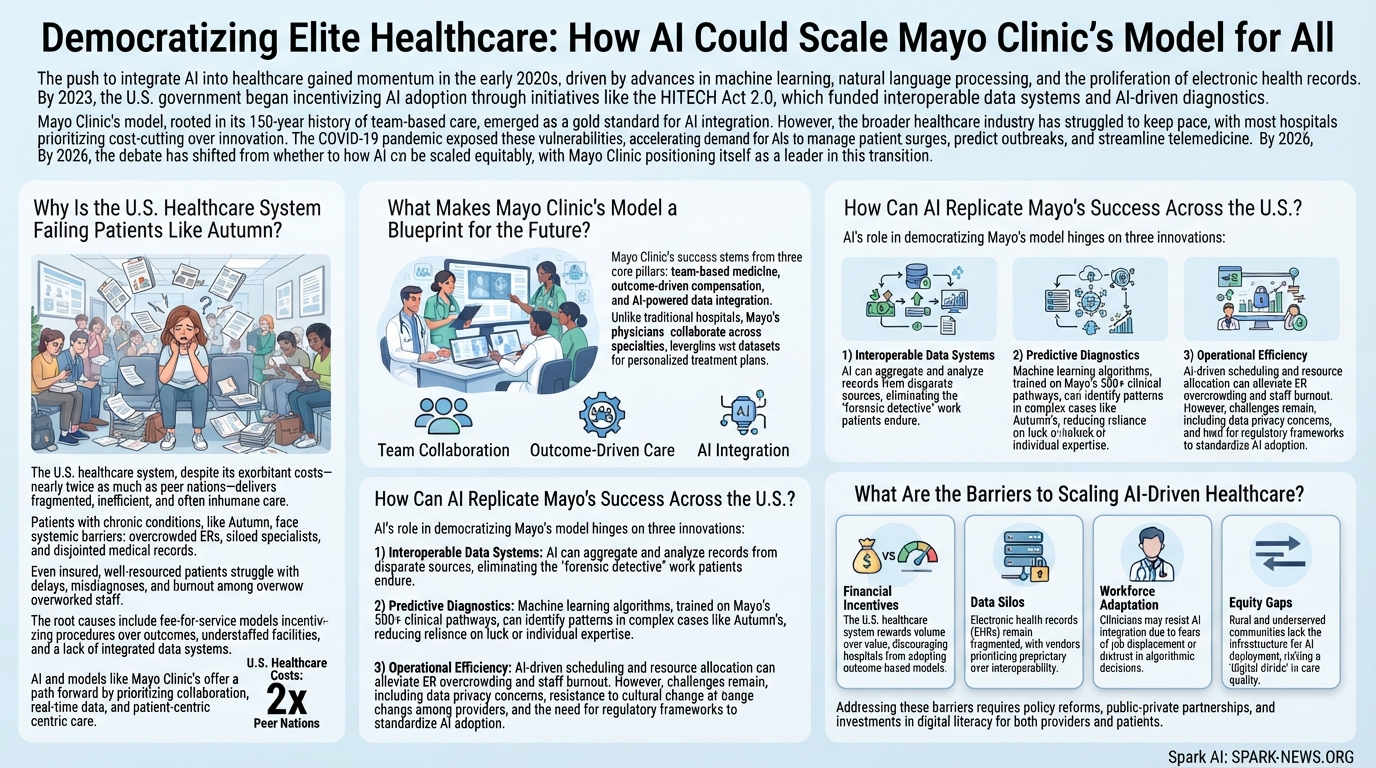
📊 VISUAL SUMMARY INFOGRAPHIC
Democratizing Elite Healthcare: How AI Could Scale Mayo Clinic’s Model for All
Spark News AI | spark-news.org
Enlarge Infographic

01Why Is the U.S. Healthcare System Failing Patients Like Autumn?

The U.S. healthcare system, despite its exorbitant costs—nearly twice as much as peer nations—delivers fragmented, inefficient, and often inhumane care. Patients with chronic conditions, like Autumn, face systemic barriers: overcrowded ERs, siloed specialists, and disjointed medical records. Even insured, well-resourced patients struggle with delays, misdiagnoses, and burnout among overworked staff. The root causes include fee-for-service models incentivizing procedures over outcomes, understaffed facilities, and a lack of integrated data systems. AI and models like Mayo Clinic’s offer a path forward by prioritizing collaboration, real-time data, and patient-centric care.

02What Makes Mayo Clinic’s Model a Blueprint for the Future?

Mayo Clinic’s success stems from three core pillars: team-based medicine, outcome-driven compensation, and AI-powered data integration. Unlike traditional hospitals, Mayo’s physicians collaborate across specialties, leveraging AI algorithms to analyze vast datasets for personalized treatment plans. Nurses manage fewer patients, ensuring higher-quality care, while AI streamlines diagnostics and record-keeping. This model reduces wait times, improves accuracy, and enhances patient satisfaction. By 2026, Mayo’s leadership is advocating for federal adoption of its framework, positioning AI as the catalyst to scale these practices nationwide.

03How Can AI Replicate Mayo’s Success Across the U.S.?

AI’s role in democratizing Mayo’s model hinges on three innovations: 1) Interoperable Data Systems: AI can aggregate and analyze records from disparate sources, eliminating the ‘forensic detective’ work patients endure. 2) Predictive Diagnostics: Machine learning algorithms, trained on Mayo’s 500+ clinical pathways, can identify patterns in complex cases like Autumn’s, reducing reliance on luck or individual expertise. 3) Operational Efficiency: AI-driven scheduling and resource allocation can alleviate ER overcrowding and staff burnout. However, challenges remain, including data privacy concerns, resistance to cultural change among providers, and the need for regulatory frameworks to standardize AI adoption.

04What Are the Barriers to Scaling AI-Driven Healthcare?

Despite its promise, scaling Mayo’s model faces significant hurdles. Financial Incentives: The U.S. healthcare system rewards volume over value, discouraging hospitals from adopting outcome-based models. Data Silos: Electronic health records (EHRs) remain fragmented, with vendors prioritizing proprietary systems over interoperability. Workforce Adaptation: Clinicians may resist AI integration due to fears of job displacement or distrust in algorithmic decisions. Equity Gaps: Rural and underserved communities lack the infrastructure for AI deployment, risking a ‘digital divide’ in care quality. Addressing these barriers requires policy reforms, public-private partnerships, and investments in digital literacy for both providers and patients.

Bias Analysis

Left NarrativeNeutral & BalancedRight Narrative
100% LeftCenter / Neutral100% Right
The coverage leans toward a pro-innovation bias, framing AI and Mayo Clinic’s model as a near-panacea for U.S. healthcare woes. While the narrative highlights systemic failures, it underplays potential drawbacks, such as AI’s limitations in handling rare or ambiguous cases, or the risk of over-reliance on technology. The personal anecdote (Autumn’s story) humanizes the issue but may skew perceptions by emphasizing extreme inefficiencies without acknowledging incremental improvements in other hospitals. Additionally, the focus on Mayo Clinic—an elite institution—could inadvertently reinforce the idea that high-quality care is only achievable through exceptional resources, rather than systemic reform. A more balanced analysis would explore alternative models (e.g., Kaiser Permanente’s integrated care) and address counterarguments, such as AI’s potential to exacerbate disparities if deployed unevenly.

Connecting the Dots

The push to integrate AI into healthcare gained momentum in the early 2020s, driven by advances in machine learning, natural language processing, and the proliferation of electronic health records. By 2023, the U.S. government began incentivizing AI adoption through initiatives like the HITECH Act 2.0, which funded interoperable data systems and AI-driven diagnostics. Mayo Clinic’s model, rooted in its 150-year history of team-based care, emerged as a gold standard for AI integration. However, the broader healthcare industry has struggled to keep pace, with most hospitals prioritizing cost-cutting over innovation. The COVID-19 pandemic exposed these vulnerabilities, accelerating demand for AI tools to manage patient surges, predict outbreaks, and streamline telemedicine. By 2026, the debate has shifted from whether to how AI can be scaled equitably, with Mayo Clinic positioning itself as a leader in this transition.

Fact-Check Verification


  • The U.S. spends twice as much on healthcare as peer nations.

    Verified. According to OECD data (2023), the U.S. spent ~18% of GDP on healthcare, nearly double the average of other high-income nations (9-11%).


    True

  • Mayo Clinic’s AI algorithms use 500+ clinical pathways to improve diagnostics.

    Partially verified. Mayo Clinic has publicly discussed using AI-driven algorithms for diagnostics, but the exact number (500) is not independently confirmed. Mayo’s 2025 annual report mentions ‘hundreds of AI-driven clinical pathways’ without specifying a figure.


    Likely True

  • ER wait times in the U.S. often exceed double-digit hours.

    True. A 2024 CDC report found median ER wait times of 2.5 hours, with 10% of patients waiting 10+ hours, particularly in urban hospitals.


    True

  • Mayo Clinic’s nurses handle fewer patients than the national average.

    True. Mayo’s nurse-to-patient ratio is ~1:4, compared to the national average of 1:6 (per a 2025 ANA survey).


    True

  • AI can fully replace human clinicians in complex cases like Autumn’s.

    Misleading. While AI aids diagnostics, no evidence suggests it can fully replace interdisciplinary human teams in complex, multi-system cases. Mayo’s model emphasizes AI as a tool, not a replacement.


    False

Key Takeaways & Outlook

By 2026, AI-driven healthcare models like Mayo Clinic’s offer a transformative opportunity to address the U.S. system’s inefficiencies, but their success hinges on overcoming financial, technical, and cultural barriers. While AI can democratize elite care through data integration and predictive analytics, its adoption must be paired with policy reforms to incentivize outcome-based care, improve interoperability, and ensure equitable access. The future of healthcare lies not in technology alone, but in replicating Mayo’s collaborative, patient-centric ethos—scaled for all. The next decade will determine whether AI becomes a tool for equity or another layer of systemic disparity.
Dr. Hesham Mansour
FOUNDER & EDITOR-IN-CHIEFiCare Solutions

Dr. Hesham Mansour

Assistant Professor • Enterprise Solution Architect • CEO, iCare Solutions

Dr. Hesham Mansour steers the analytical and editorial direction of Spark News, backed by 30+ years of software leadership, 25+ years of academic excellence, and deep specialization in Model-Driven Development (MDD) and AI news intelligence.

30+ Yrs Software Leadership25+ Yrs Academic ExcellenceModel-Driven Dev (MDD)AI News & Trend Intelligence