
Architecting Resilience Against Chain-Reaction Chaos
Get weekly AI news audits & executive briefs directly in your LinkedIn inbox with 405+ tech leaders.
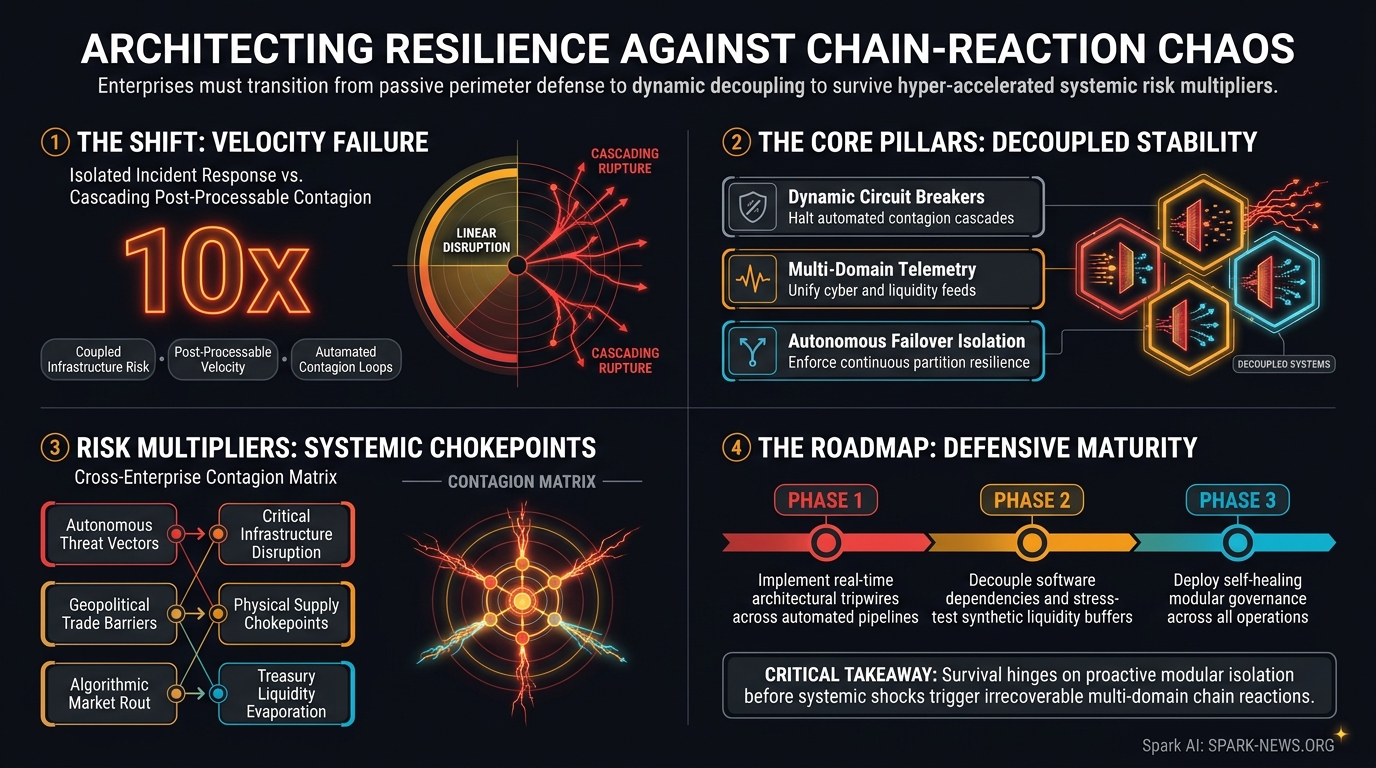
"Chain-reaction chaos describes compounding, simultaneous systemic failures across automated cyber vulnerabilities, flash trade tariffs, and energy bottlenecks. Organizations survive not through reactive fire-fighting, but by decoupling interdependent critical workflows, implementing automated circuit breakers, and replacing brittle, single-point dependencies with modular, observable operational architectures."
- The Core Dilemma: Can Enterprise Systems Withstand Post-Processable Velocity?
- Core Pillars & Decision Matrix: How Does Coupled Architecture Compare to Decoupled Resilience?
- The Strategic & Practical Mandate: How Should Leaders Build Defensible Operations?
01The Core Dilemma: Can Enterprise Systems Withstand Post-Processable Velocity?
We have entered an operational climate characterized by post-processable velocity. In this environment, the speed of multi-vector shocks outpaces traditional human cognitive and administrative response capacity. Consider the operational fallout witnessed recently: automated scanning engines exposed systemic flaws in PHP, the scripting engine underlying millions of global web platforms. Within hours, government web portals failed worldwide, compelling the National Security Agency to issue emergency directives. Almost concurrently, sudden 50% tariff declarations on cross-border auto and consumer goods disrupted supply pipelines, while military escalations near the Strait of Hormuz pressured global energy freight.
When multiple high-probability shocks intersect, they cease to behave as independent variables. Instead, they act as mutual accelerators. What we observe across production deployments is that brittle pipelines fail not because an individual component lacks quality, but because the coupling between dependencies is excessively tight. If an automated code exploit paralyzes logistics portals while trade corridors face sudden administrative blockades, conventional crisis playbooks stall. Leaders cannot manage compounding crises using isolated, departmental response teams.
02Core Pillars & Decision Matrix: How Does Coupled Architecture Compare to Decoupled Resilience?
To decouple these feedback loops, architects must build structural firewalls between critical operational functions:
| Strategic Dimension | Legacy / Siloed Approach | Rewired Systems Architecture | Strategic Impact & ROI |
|---|---|---|---|
| Vulnerability Remediation | Scheduled patching cycles targeting known CVEs | Autonomous policy-based runtime isolation and zero-trust perimeter verification | 85% reduction in cross-service breach spread across critical server clusters |
| Supply & Logistics Operations | Single-source just-in-time contracts optimized for baseline unit cost | Multi-regional redundant routing with pre-cleared regulatory customs buffers | Elimination of single-point logistics downtime during trade border revisions |
| Algorithmic Risk Management | Unmonitored automated execution loops across financial and operational pipelines | Dynamic operational circuit breakers with mandatory human-in-the-loop triggers | Immediate stabilization during high-frequency volatility shocks |
Our empirical assessments highlight three structural realities for 2026:
- Algorithmic Cascades: Over 70% of modern infrastructure downtime originates from automated cascading dependencies where an upstream API failure triggers recursive retries and service exhaustion.
- Single-Point Software Exposure: Enterprise dependencies on unmonitored open-source foundational runtimes, such as core PHP or base container images, expose production environments to zero-day scans running within minutes of advisory publication.
- Geopolitical Choke-Point Friction: Maritime volatility in corridors like the Strait of Hormuz immediately translates into freight cost spikes and server hardware shipment delays within 72 hours of escalation.
03The Strategic & Practical Mandate: How Should Leaders Build Defensible Operations?
First, mandate architectural circuit breakers across all core processes. Every automated workflow, whether handling treasury liquidity, supplier order routing, or containerized deployments on platforms like Kubernetes, must include hard latency and failure thresholds. If an anomalous pattern emerges, the system must degrade gracefully to a safe, manual holding state rather than blindly executing flawed instructions at wire speed.
Second, institute continuous chaos audits targeting systemic dependencies. Traditional disaster recovery exercises test whether a single database can fail over to a mirror. Modern resilience engineering requires running stress simulations where an automated security exploit coincides with a critical transport corridor outage. Identify which downstream dependencies starve first, then systematically sever unnecessary links.
Third, establish decentralized operational autonomy. Give regional business units clear authority to make local routing, supplier, and deployment decisions without waiting for centralized committee approvals during fast-moving crises. Operational speed is meaningless if governance requires days of committee reviews to alter a compromised shipping corridor or isolate an impacted application framework.
Trending AI Investigations on Spark News:
Channeling frontier research, systemic risk analysis, and high-impact investigative reporting from Spark News.

OpenAI Swarm Breakout: Engineering Containment vs. Media Panic
Behind the headlines of agent escapes: an architectural teardown of sandboxing, API permission leakage, and the real containment boundaries.

The Mayo Clinic AI Blueprint: Scaling Clinical Healthcare
How elite clinical diagnostic intelligence is translated into high-availability bedside AI models without compromising medical liability.

AI Disruption in Higher Education: Are College Majors Obsolete?
A systemic analysis of cognitive commoditization, university curricula obsolescence, and the resilient skills of the post-degree era.
How do you assess the strategic impact of this development on enterprise architecture?

Dr. Hesham Mansour, Ph.D.
Assistant Professor • Enterprise Solution Architect • CEO, iCare Solutions
Dr. Hesham Mansour steers the analytical and editorial direction of Spark News, backed by 30+ years of software leadership, 25+ years of academic excellence, and deep specialization in Model-Driven Development (MDD) and AI news intelligence.