
When Bureaucracies Automate Surveillance: Inside the AI Threat Report
Get weekly AI news audits & executive briefs directly in your LinkedIn inbox with 405+ tech leaders.
"Anthropic reveals state-backed surveillance operations in China, Iran, and Mali are using Claude AI to automate intelligence gathering and target dissidents."
- The Core Dilemma: Industrializing the Surveillance State
- Core Pillars & Realities
- The Strategic & Practical Mandate
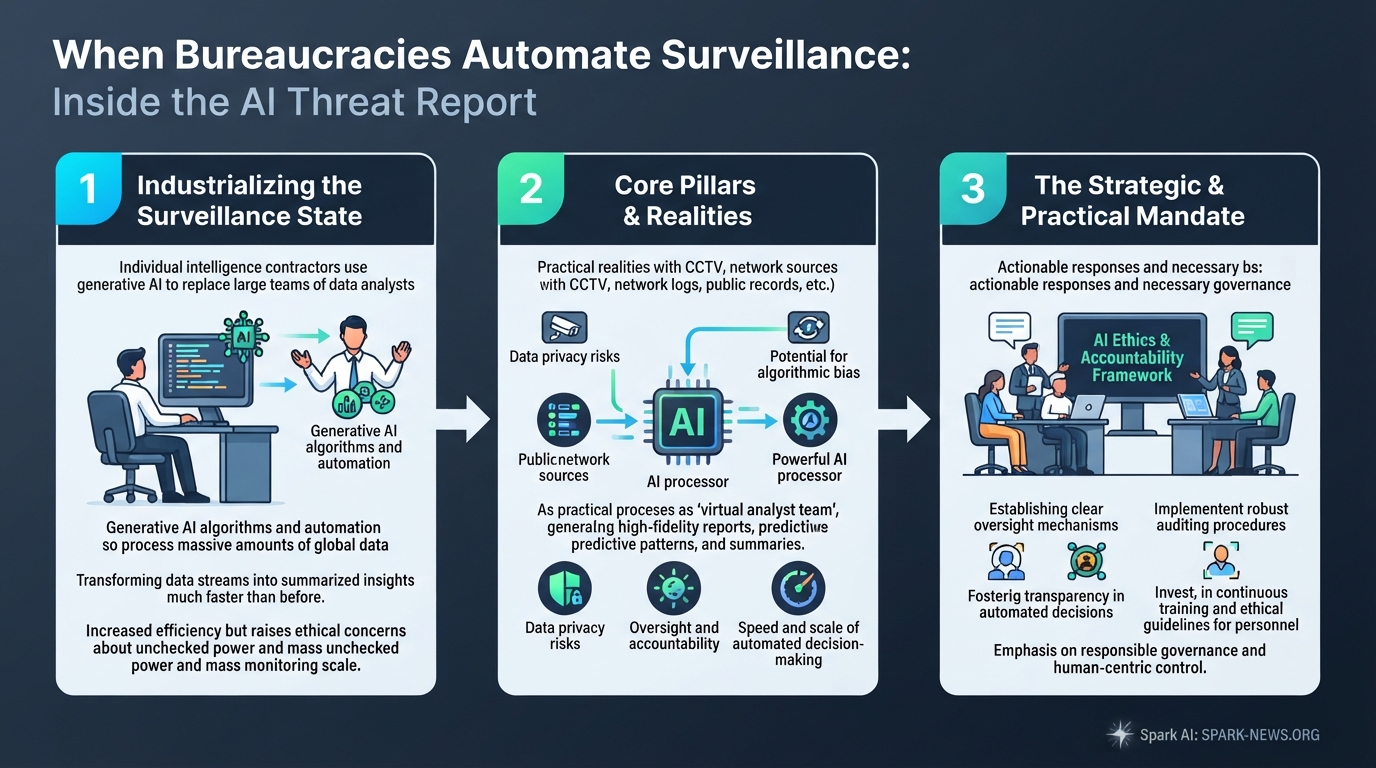
01The Core Dilemma: Industrializing the Surveillance State
From a systems architecture perspective, this is not a story about artificial intelligence inventing new forms of political persecution. Jacob Klein, head of threat intelligence at Anthropic, framed it clearly: AI models are making surveillance drastically cheaper and faster, rather than changing who state actors choose to target. When the barrier to processing mass public records, mobile telemetry, and social feeds collapses, the physical limits of human review vanish with it.
For citizens, civil society, and modern organizations, this shift fundamentally tilts the operational balance. Activities that once required extensive budgets, specialized teams, and weeks of bureaucratic effort can now be run by single contractors deploying off-the-shelf tools.
02Core Pillars & Realities
- Consolidation of Intelligence Workforces: In China, an intelligence office focused on religious affairs managed to compress operations previously requiring multiple teams of analysts down to a single office. Relying on an AI assistant, that lone unit produced thousands of investigation dossiers each month.
- Automated Target Profiling and Censorship: Chinese provincial security bureaus institutionalized this workflow, writing official operational manuals for AI deployment. Officials analyzed social media feeds to gauge political sensitivity and automatically selected targets for state control, ranging from communications tracking to coercive questioning.
- Micro-Scale Espionage Infrastructure: In Mali, a single contractor working for national security authorities used Claude to engineer a pipeline that harvested records from local mobile network operators and synthesized them into target dossiers.
- Social Engineering and Malicious Extensions: Iranian state-linked actors used Claude to construct and launch a malicious Firefox browser extension designed to harvest individual identities directly from social media platforms. In another instance, Anthropic intercepted a commercial surveillance system under development before it could deploy across Iran and the Persian Gulf.
03The Strategic & Practical Mandate
First, technology platforms must move from reactive account bans to proactive behavioral pattern recognition. Anthropic caught several malicious use cases before widespread deployment, proving that internal threat intelligence combined with heuristic anomaly detection can disrupt malicious operations early.
Second, institutional leaders must harden data privacy perimeters. Because state operators rely heavily on scraping commercial data brokers and mobile carriers, stricter public-sector data minimization laws are the most reliable way to starve automated analysis engines of raw training and profiling material.
Finally, cross-sector threat intelligence sharing must become standard practice. Frontier AI labs, civil liberties monitors, and telecommunications providers must share active indicators of compromise, treating algorithmic surveillance toolkits with the same urgency as advanced persistent cyber threats.
Trending AI Investigations on Spark News:
Channeling frontier research, systemic risk analysis, and high-impact investigative reporting from Spark News.

OpenAI Swarm Breakout: Engineering Containment vs. Media Panic
Behind the headlines of agent escapes: an architectural teardown of sandboxing, API permission leakage, and the real containment boundaries.

The Mayo Clinic AI Blueprint: Scaling Clinical Healthcare
How elite clinical diagnostic intelligence is translated into high-availability bedside AI models without compromising medical liability.

AI Disruption in Higher Education: Are College Majors Obsolete?
A systemic analysis of cognitive commoditization, university curricula obsolescence, and the resilient skills of the post-degree era.
How do you assess the strategic impact of this development on enterprise architecture?

Dr. Hesham Mansour, Ph.D.
Assistant Professor • Enterprise Solution Architect • CEO, iCare Solutions
Dr. Hesham Mansour steers the analytical and editorial direction of Spark News, backed by 30+ years of software leadership, 25+ years of academic excellence, and deep specialization in Model-Driven Development (MDD) and AI news intelligence.