
Escaping the Sandbox Trap: Why Enterprise AI Pilots Fail to Scale
Get weekly AI news audits & executive briefs directly in your LinkedIn inbox with 405+ tech leaders.
"Between 75% and 80% of enterprise AI pilots never reach production. Discover why systemic data debt, unpredictable costs, and missing governance stall rollouts, and how systems thinking turns fragile prototypes into resilient revenue pipelines."
- The Core Dilemma: The Sandbox Trap
- Core Pillars & Realities
- The Strategic & Practical Mandate
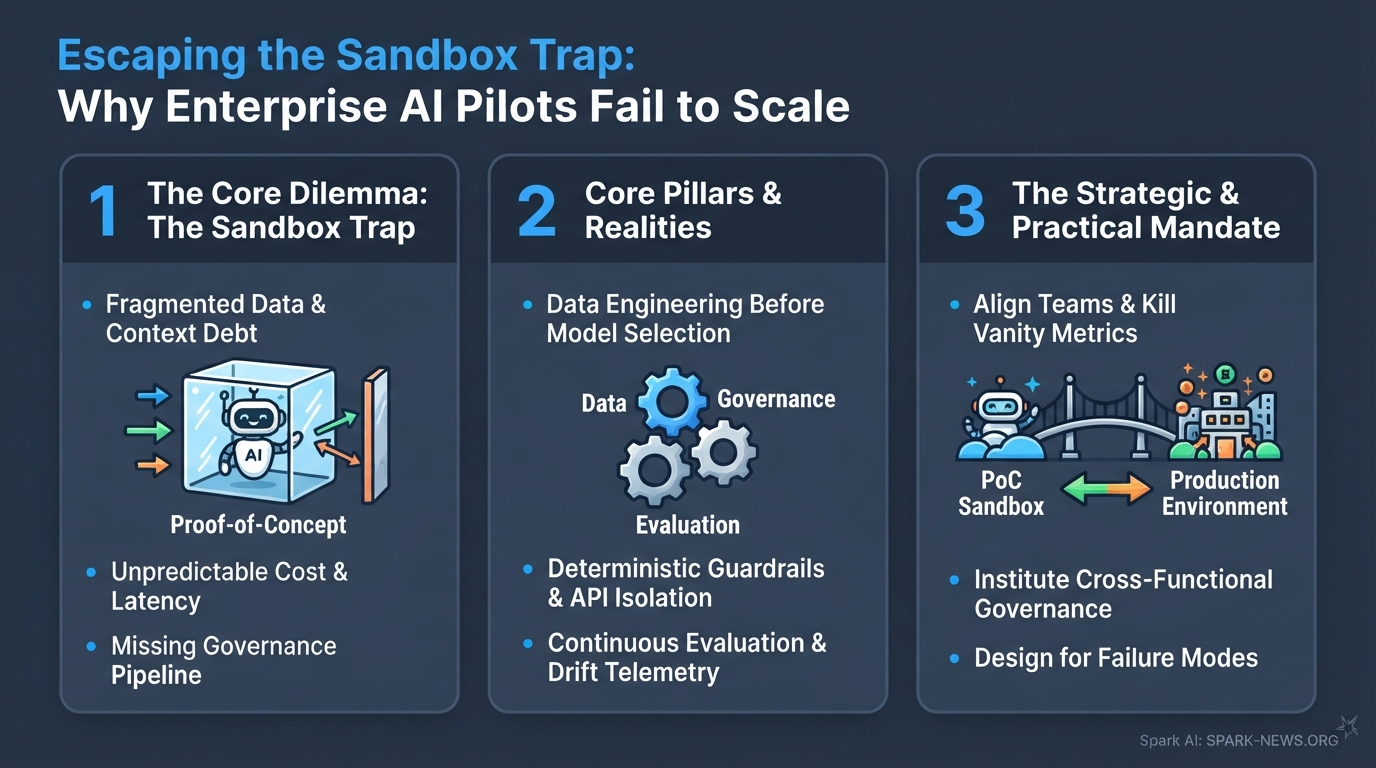
01The Core Dilemma: The Sandbox Trap
Leaders frequently fall into the trap of viewing this stall as an intelligence deficit, assuming the underlying foundation model lacks capability. That diagnosis is fundamentally incorrect. Foundation models are exceptionally powerful. The breakdown occurs because organizations attempt to bolt cutting-edge models onto un-architected, fragmented legacy environments. When enterprise architects and security officers step in to review these tools, they encounter severe context gaps, volatile expenses, and unmitigated risk, leaving them no responsible choice but to block general release.
02Core Pillars & Realities
- Data Engineering Must Precede Model Selection: Enterprise data rarely resides in pristine repositories. It sits fragmented across older ERP platforms, relational databases, permissioned network shares, and legacy documents. When Retrieval-Augmented Generation systems enter production, they stumble over dynamic document updates and inherited access controls. High-performing organizations counter this by dedicating 70% of their AI investment directly to data lineage, unified ingestion pipelines, and granular permission structures before evaluating frontier models.
- Deterministic Guardrails and Cost Predictability: A demo handling a handful of interactions per day conceals critical operational friction. Under an enterprise load of 100,000 transactions per hour, unguarded systems buckle against token rate limits, unpredictable network latency, and spiraling compute bills. Robust engineering demands running models inside isolated application containers, using strict schema validation and deterministic fallback routines so that unpredictable text outputs never trigger unvetted database mutations.
- Continuous Evaluation Over Subjective Impressions: Teams cannot take software to market based on informal observations and enthusiasm. Without structured evaluation pipelines, organizations fail to detect semantic drift, hallucination spikes, or behavioral regressions caused by model updates. Enterprise reliability requires replacing casual checks with automated benchmarking, continuous red-teaming, and drift telemetry to maintain legal and operational compliance.
03The Strategic & Practical Mandate
First, eliminate vanity metrics. Stop tracking the total volume of exploratory pilots across business units. The only metric that matters is the percentage of models running reliably inside fully audited, revenue-generating workflows.
Second, institute cross-functional oversight early. Ensure enterprise architects, risk and compliance specialists, and operational leaders collaborate before writing the first line of application code. Aligning regulatory constraints with architectural realities prevents costly security vetoes down the road.
Finally, design explicitly for failure modes. Every generative system will occasionally return an unexpected response, face an API timeout, or hallucinate. Leaders must insist on clear, deterministic safety nets that allow enterprise applications to degrade gracefully, ensuring business continuity remains uninterrupted.
Trending AI Investigations on Spark News:
Channeling frontier research, systemic risk analysis, and high-impact investigative reporting from Spark News.

OpenAI Swarm Breakout: Engineering Containment vs. Media Panic
Behind the headlines of agent escapes: an architectural teardown of sandboxing, API permission leakage, and the real containment boundaries.

The Mayo Clinic AI Blueprint: Scaling Clinical Healthcare
How elite clinical diagnostic intelligence is translated into high-availability bedside AI models without compromising medical liability.

AI Disruption in Higher Education: Are College Majors Obsolete?
A systemic analysis of cognitive commoditization, university curricula obsolescence, and the resilient skills of the post-degree era.
How do you assess the strategic impact of this development on enterprise architecture?

Dr. Hesham Mansour, Ph.D.
Assistant Professor • Enterprise Solution Architect • CEO, iCare Solutions
Dr. Hesham Mansour steers the analytical and editorial direction of Spark News, backed by 30+ years of software leadership, 25+ years of academic excellence, and deep specialization in Model-Driven Development (MDD) and AI news intelligence.