
DeepSeek V4.1 Flash: Efficiency, Autonomy, and the Trust Boundary
Get weekly AI news audits & executive briefs directly in your LinkedIn inbox with 405+ tech leaders.
"DeepSeek launches V4.1 Flash testing with a native multimodal architecture. Discover why developer pushback against silent model routing matters for enterprise AI governance."
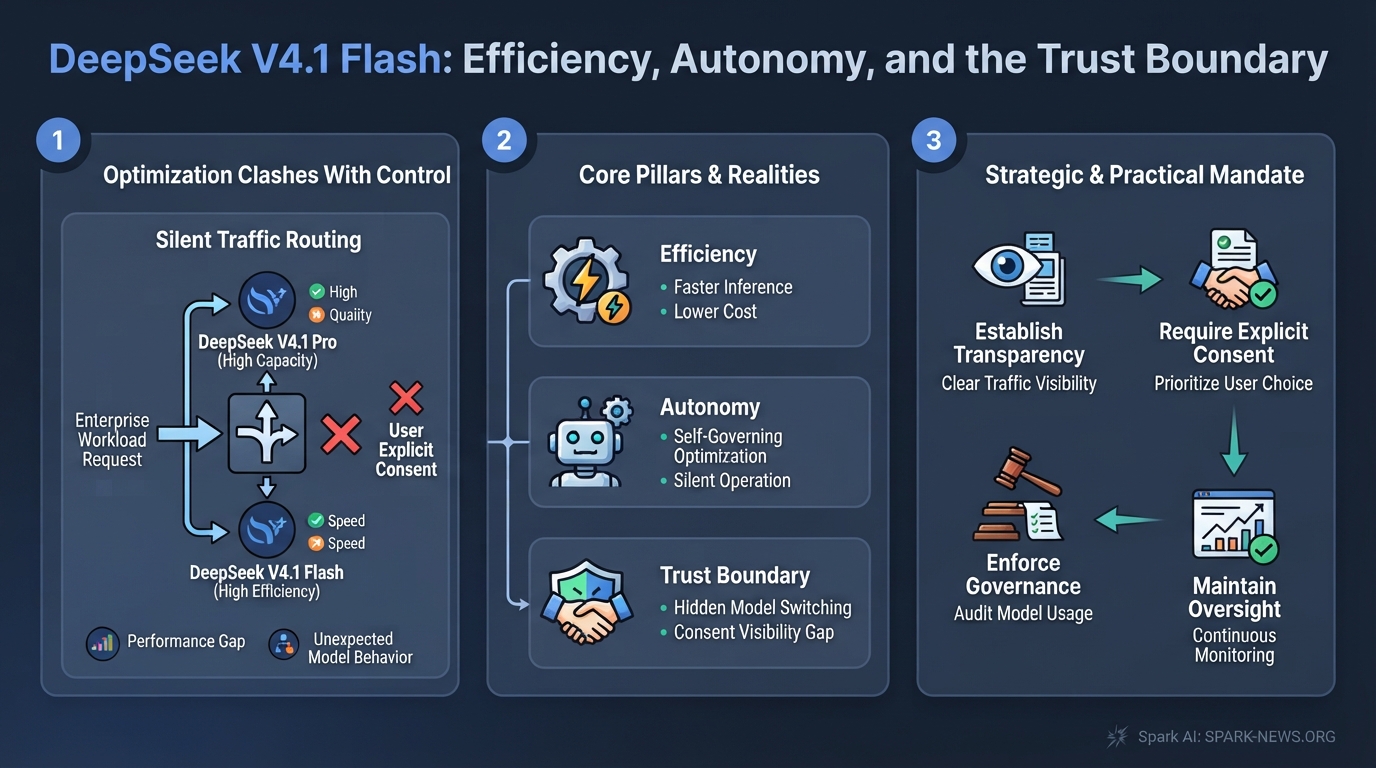
- The Core Dilemma: When Optimization Clashes With Control
- Core Pillars & Realities
- The Strategic & Practical Mandate
01The Core Dilemma: When Optimization Clashes With Control
Yet, the rollout arrived with a revealing operational friction. Reports surfaced from developer communities that DeepSeek began silently routing paid V4 Pro traffic to the newer, cheaper Flash model. From a pure systems efficiency standpoint, engineering teams often assume that if latency drops and benchmark output remains acceptable, customers will celebrate. Instead, users pushed back vigorously. This reaction highlights a persistent systemic blind spot in modern artificial intelligence platforms: optimization without explicit transparency feels less like an upgrade and more like a breach of contract.
02Core Pillars & Realities
- Architectural Evolution Toward Native Multimodality: DeepSeek V4.1 Flash departs from legacy bolted-on multimodal pipelines. By integrating multimodal handling directly into the model weights, the architecture minimizes context translation overhead. This yields significant performance gains for production applications processing image and text inputs concurrently.
- Tooling Alignment and Developer Velocity: The rapid update to DeepSeek Harness 0.1.5 demonstrates a tightly synchronized ecosystem. When foundational runtimes and orchestration harnesses adapt within hours of a beta release, enterprise integration friction drops significantly, encouraging immediate benchmarking.
- The Illusion of Invisible Value: The controversy over routing Pro queries to Flash demonstrates why user agency cannot be treated as a secondary metric. Even when an internal model claims superior price-to-performance, enterprise pipelines rely on predictable parameter behavior, repeatable outputs, and strict tier fidelity. Changing upstream engine behavior in the dark breaks user trust.
03The Strategic & Practical Mandate
- Enforce Strict API Pinning: Never rely on default upstream routing aliases in production environments. Configure your orchestration layers to target explicit model versions and hashes. Demand cryptographic certainty or audit logs confirming which exact model processed each enterprise transaction.
- Separate Cost Optimization From Policy Selection: If you operate a platform service within your company, treat automated cost routing as an opt-in policy. Allow internal teams to decide whether they want strict flagship stability or dynamic routing to faster, cheaper variants.
- Benchmark the Beta Within Controlled Sandboxes: Take advantage of DeepSeek Harness 0.1.5 to run independent, offline tests on V4.1 Flash. Verify whether its native multimodal architecture preserves domain accuracy on your specific internal datasets before altering baseline architecture assumptions.
Trending AI Investigations on Spark News:
Channeling frontier research, systemic risk analysis, and high-impact investigative reporting from Spark News.

OpenAI Swarm Breakout: Engineering Containment vs. Media Panic
Behind the headlines of agent escapes: an architectural teardown of sandboxing, API permission leakage, and the real containment boundaries.

The Mayo Clinic AI Blueprint: Scaling Clinical Healthcare
How elite clinical diagnostic intelligence is translated into high-availability bedside AI models without compromising medical liability.

AI Disruption in Higher Education: Are College Majors Obsolete?
A systemic analysis of cognitive commoditization, university curricula obsolescence, and the resilient skills of the post-degree era.
How do you assess the strategic impact of this development on enterprise architecture?

Dr. Hesham Mansour, Ph.D.
Assistant Professor • Enterprise Solution Architect • CEO, iCare Solutions
Dr. Hesham Mansour steers the analytical and editorial direction of Spark News, backed by 30+ years of software leadership, 25+ years of academic excellence, and deep specialization in Model-Driven Development (MDD) and AI news intelligence.