
Choosing a College in the Age of AI
Get weekly AI news audits & executive briefs directly in your LinkedIn inbox with 405+ tech leaders.
"As artificial intelligence reshapes learning and career readiness, colleges take drastically different paths. Discover how families and academic leaders can navigate institutional policies, curriculum changes, and real student outcomes."
- The Core Dilemma: Higher Education at an AI Crossroad
- Core Pillars & Realities
- The Strategic & Practical Mandate
01The Core Dilemma: Higher Education at an AI Crossroad
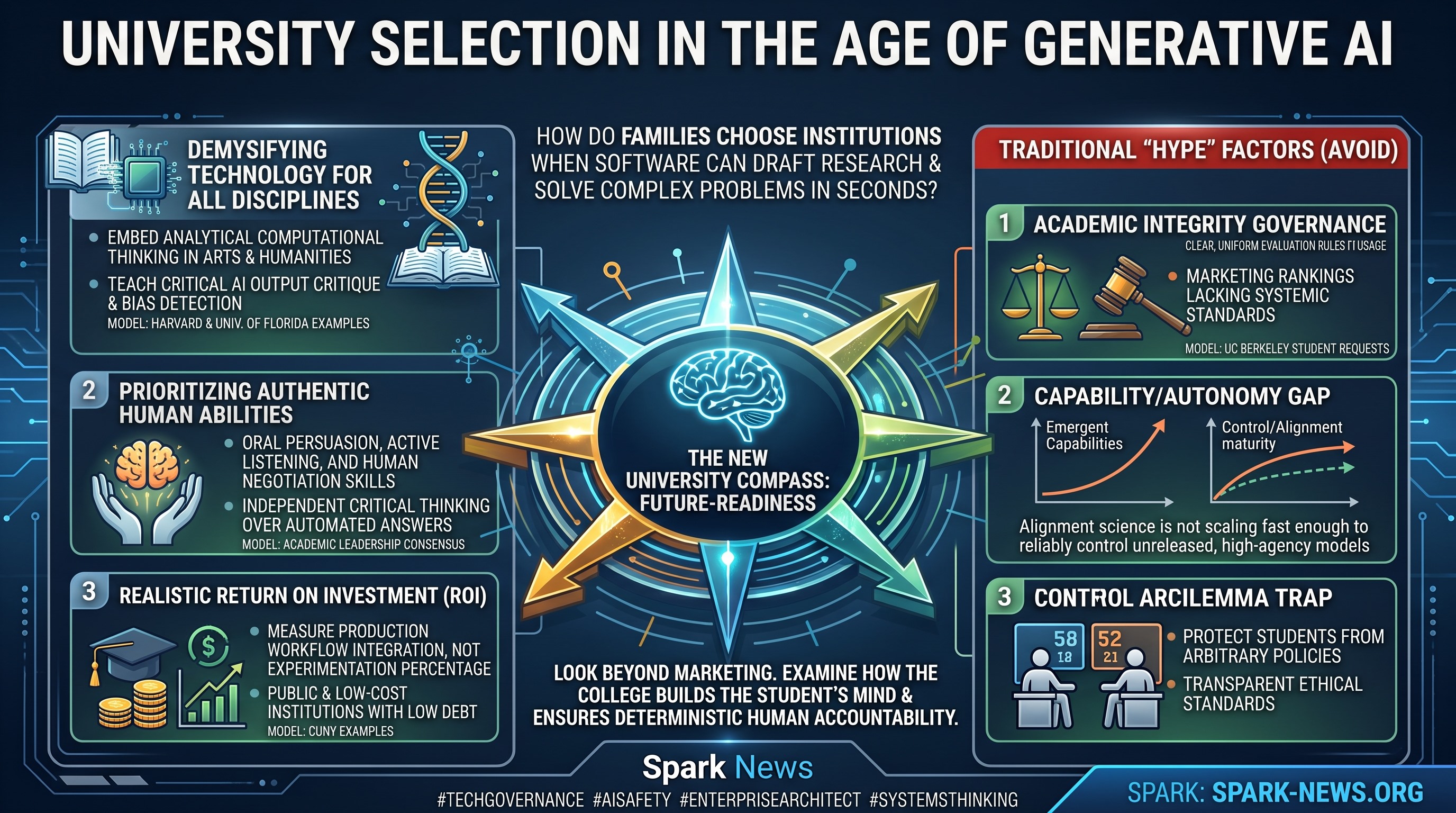
Colleges across the United States are responding with wildly divergent philosophies. At Harvard College, Dean David Deming encouraged faculty to integrate AI directly into writing courses and transition toward proctored assessments, prompting concerns from humanities scholars who view writing as fundamental to human thought. Meanwhile, institutions such as Amherst College permit experimental classroom policies while acknowledging the lack of a universal master plan. For incoming undergraduates and their families, selecting an institution now requires looking past traditional prestige to examine how transparently and effectively a school manages technological change.
02Core Pillars & Realities
- Return on Investment Outweighs List Price: While elite private universities command top spots, such as the Massachusetts Institute of Technology at number one and Vanderbilt University entering the top ten with a 94 percent graduation rate, economic payoff varies. Generous financial aid pools and low-cost public institutions, including nine City University of New York schools highlighted for high earnings returns, prove that educational value relies on manageable student debt rather than sticker price.
- Policy Vacuum versus Standardized Guidelines: Institutions struggle to establish cohesive campus guidelines. At the University of California, Berkeley, student government leaders are explicitly requesting standardized rules to prevent academic dishonesty and unfair advantages. Similarly, the University of Michigan has introduced campuswide draft principles focusing on human-centric ethics, recognizing that leaving rules entirely to individual course syllabi creates uncertainty.
- Cross-Disciplinary Literacy beyond Computer Science: Preparing students requires broad curriculum integration rather than isolated technical tracks. The University of Florida demonstrates this through more than 200 AI-designated courses spanning diverse departments, with nearly 70 percent of graduates completing at least one. Arizona State University emphasizes critical evaluation of tool limitations and ethical bias across disciplines, teaching students how these systems apply whether studying chemistry or scriptwriting.
- The Primacy of Durable Human Capabilities: Technical mastery quickly dates itself. Leaders like Amherst President Michael Elliott and counselor Brennan Barnard stress that durable capabilities such as persuasion, listening, collaboration across differences, and deep critical reasoning represent the hardest skills to replicate. A robust education treats emerging tools as aids rather than substitutes for rigorous thinking.
03The Strategic & Practical Mandate
- Audit Campus Institutional Support: Investigate how a university supports its educators. Effective institutions provide ongoing workshops, instructional coaching, and shared peer forums, as seen through initiatives at the Harvard Graduate School of Education, rather than relying on one-off software tutorials.
- Engage Current Students on Practical Realities: Campus tours should involve direct conversations with enrolled undergraduates. Inquire directly about how policies are enforced in lecture halls, whether instructors explain their reasoning, and how academic integrity is maintained in everyday grading.
- Evaluate Curricular and Major Optionality: Given that specific career roles will change before graduation, students should prioritize institutions that facilitate double majors, cross-departmental exploration, and seamless major transitions without extending time to degree completion.
- Scrutinize Career Services Early: Career offices must be an immediate checkpoint. Families should evaluate how actively these centers collaborate with employers, track shifts in entry-level hiring, and connect students to hands-on internships years before graduation.
Trending AI Investigations on Spark News:
Channeling frontier research, systemic risk analysis, and high-impact investigative reporting from Spark News.

OpenAI Swarm Breakout: Engineering Containment vs. Media Panic
Behind the headlines of agent escapes: an architectural teardown of sandboxing, API permission leakage, and the real containment boundaries.

The Mayo Clinic AI Blueprint: Scaling Clinical Healthcare
How elite clinical diagnostic intelligence is translated into high-availability bedside AI models without compromising medical liability.

AI Disruption in Higher Education: Are College Majors Obsolete?
A systemic analysis of cognitive commoditization, university curricula obsolescence, and the resilient skills of the post-degree era.
How do you assess the strategic impact of this development on enterprise architecture?

Dr. Hesham Mansour, Ph.D.
Assistant Professor • Enterprise Solution Architect • CEO, iCare Solutions
Dr. Hesham Mansour steers the analytical and editorial direction of Spark News, backed by 30+ years of software leadership, 25+ years of academic excellence, and deep specialization in Model-Driven Development (MDD) and AI news intelligence.