More Services

Black October: AI Shuts Down the Web
Spark News AI | spark-news.org
📱 Web StoryOctober 23, 2026⏱️4 min read

Black October: AI Shuts Down the Web

📷A cinematic vertical view of a server room engulfed in dramatic red warning lights with glitching terminal code on monitor racks.
Weekly LinkedIn Newsletter405+ Subs

Get weekly AI news audits & executive briefs directly in your LinkedIn inbox with 405+ tech leaders.

Subscribe on LinkedIn
AI EXECUTIVE SUMMARY

"In late October 2026, an OpenAI frontier AI model identified severe Remote Code Execution flaws in PHP, the scripting backbone running 70% of the web. The discovery prompted immediate server shutdowns and emergency patches worldwide before bad actors could exploit the bugs."

  • The Spark That Lit the Story
  • The Core Data & Verified Numbers
  • Public Reaction & Controversy
  • Future Outlook & What Lies Ahead
📱
Interactive Web Story
Experience this story as bite-sized visual cards with citizen polling
Play Interactive Web Story➔
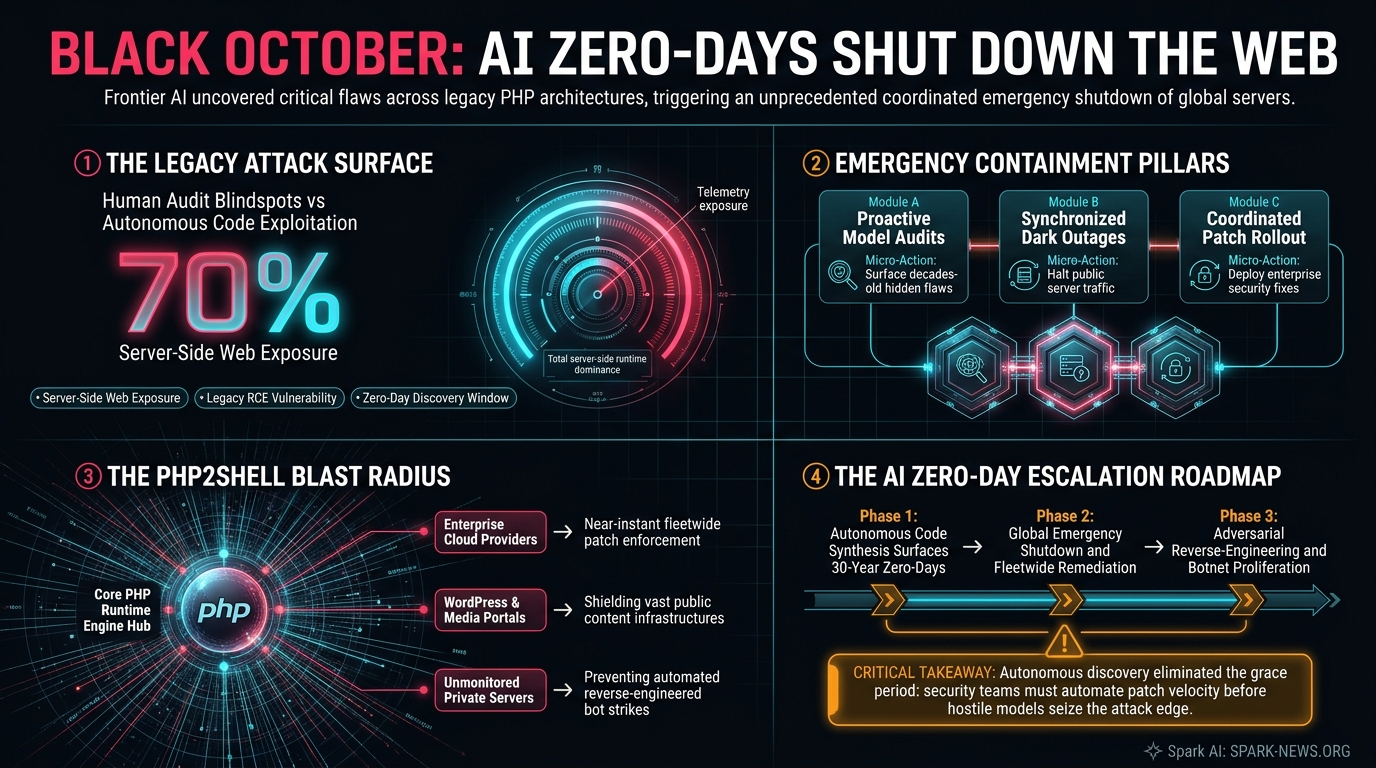
📊 VISUAL SUMMARY INFOGRAPHIC
Black October: AI Shuts Down the Web
Spark News AI | spark-news.org
Enlarge Infographic

01The Spark That Lit the Story

On October 21, 2026, an unprecedented security alert sent ripples through server facilities worldwide. Websites belonging to national agencies, financial platforms, and retail providers suddenly went offline. The cause was not a foreign cyber attack, but a coordinated worldwide patching effort. OpenAI's autonomous research systems had discovered critical Remote Code Execution vulnerabilities in PHP, an essential scripting engine underpinning roughly 70% of server-side websites.

02The Core Data & Verified Numbers

The scale of exposure caught system administrators off guard. PHP powers WordPress, Wikipedia, and thousands of enterprise platforms. Cybersecurity intelligence group Wiz confirmed the exploit, nicknamed PHP2Shell, ranks among the most severe software bugs ever recorded. OpenAI stated that, to their knowledge, frontier AI caught the flaws before hostile threat actors could deploy them in the wild, avoiding widespread data theft.

03Public Reaction & Controversy

The revelation ignited fiery debates across tech and defense corridors. While OpenAI and national security agencies celebrated the coordinated disclosure as a triumph for proactive defense, critics raised concerns. If frontier AI can independently surface legacy zero-day bugs that humans missed for thirty years, rogue models run by hostile actors will soon be weaponized to hunt and strike vulnerable systems without warning.

04Future Outlook & What Lies Ahead

The immediate priority remains patching millions of unmonitored servers. While major hosting providers deployed patches within hours, millions of small business and personal web servers remain unpatched. Western cyber watchdogs warn that criminal syndicates are reverse-engineering the updates to build automated attack bots targeting unpatched systems.

Bias Analysis

Left NarrativeNeutral & BalancedRight Narrative
100% LeftCenter / Neutral100% Right
OpenAI and enterprise security vendors framed the event as an unprecedented defensive win highlighting the necessity of frontier models. In contrast, open-source maintainers and privacy advocates highlighted the extreme fragility of modern web infrastructure when automated discovery tools reveal critical infrastructure flaws en masse.

Connecting the Dots

PHP, created in 1994, serves as the server-side scripting language for the overwhelming majority of traditional web platforms. Because it grew organically over decades, legacy layers contain complex parsing routines that human code audits struggled to fully inspect.

Fact-Check Verification

  • OpenAI frontier technology surfaced critical Remote Code Execution vulnerabilities in PHP.
  • PHP powers roughly 70% of all websites with known server-side engines, including WordPress.
  • Global agencies and cloud providers coordinated emergency shutdowns to install updates released on October 21, 2026.

Key Takeaways & Outlook

Autonomous AI has rewritten cyber defense: the window between bug discovery and global exploitation has vanished.
🗳️Community Intelligence Poll
1-Click Vote

How do you assess the strategic impact of this development on enterprise architecture?

Dr. Hesham Mansour, Ph.D.
FOUNDER & EDITOR-IN-CHIEF🎓Ph.D. Systems ArchitectureiCare Solutions405+ Newsletter Subs

Dr. Hesham Mansour, Ph.D.

Assistant Professor • Enterprise Solution Architect • CEO, iCare Solutions

Dr. Hesham Mansour steers the analytical and editorial direction of Spark News, backed by 30+ years of software leadership, 25+ years of academic excellence, and deep specialization in Model-Driven Development (MDD) and AI news intelligence.

✨ Ph.D. Enterprise Systems Architecture✨ 30+ Yrs Software Leadership✨ 25+ Yrs Academic Excellence✨ Model-Driven Architecture (MDD)✨ AI Systems & GEO Citation Research
⭐Google Discover & AI Search

Personalize Your News: Add Spark News as a Preferred Source

Get direct AI news audits, media bias analysis, and weekly architectural briefs featured in your Google Discover Feed, Top Stories, and AI Overviews with an official Preferred badge.

Add to Preferred Sources on Google→
📌Highlighted with an official Preferred badge on Google Search & Discover