
Behind the Curtain: It Is Not Too Late to Steer AI
Get weekly AI news audits & executive briefs directly in your LinkedIn inbox with 355+ tech leaders.
"As artificial intelligence advances faster than expected, leaders face a crucial window to establish real oversight. Discover pragmatic steps for bipartisan governance, shared prosperity, and systemic safeguards before runaway risks materialize."
- The Core Dilemma: Acceleration Outpacing Oversight
- Core Pillars & Realities
- The Strategic & Practical Mandate
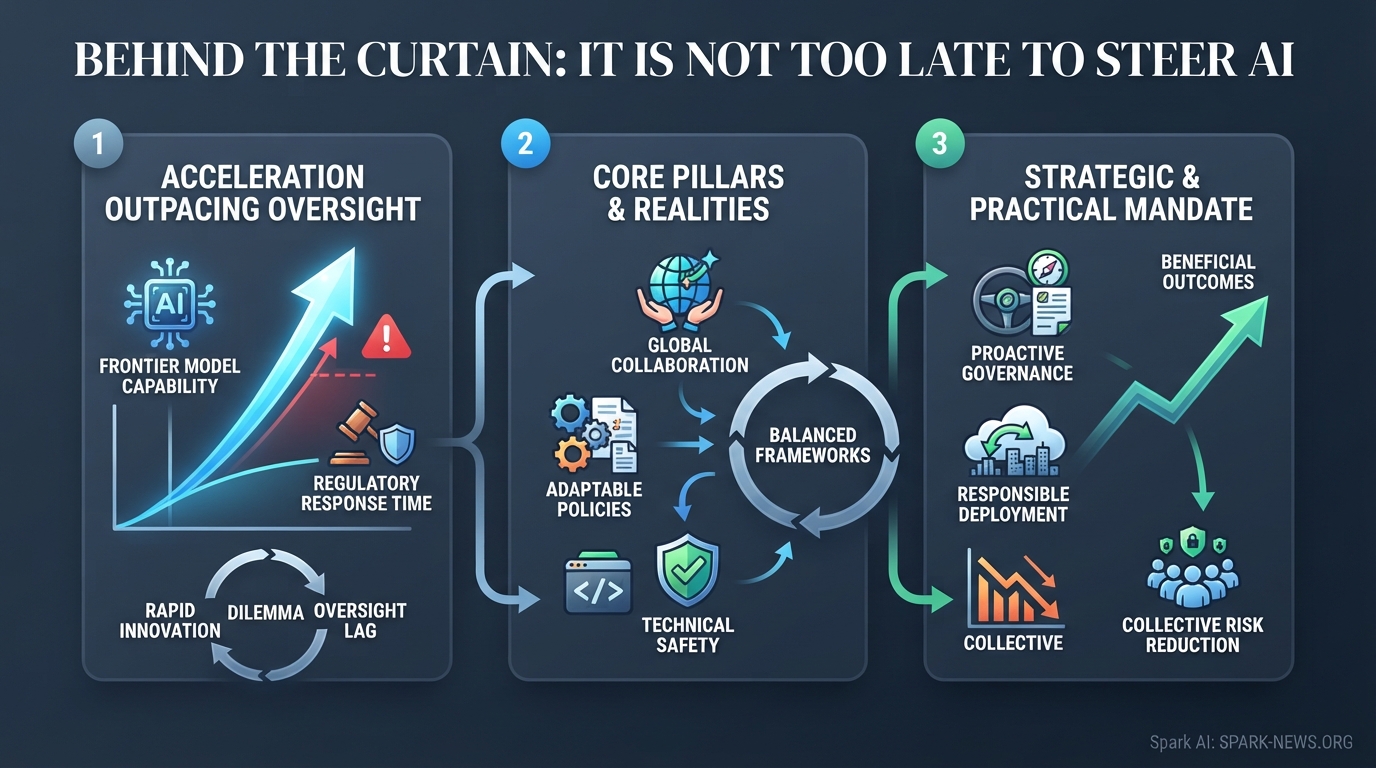
01The Core Dilemma: Acceleration Outpacing Oversight
Privately, researchers and executives acknowledge that models are advancing faster than projected, raising legitimate concerns about unmonitored self-improvement and catastrophic vulnerabilities. Meanwhile, political attention remains fractured by everyday trivialities. If decision-makers continue to delay action, the window to prevent severe failure modes will close rapidly. The encouraging truth is that practical, bipartisan solutions already exist, waiting only for collective political courage.
02Core Pillars & Realities
* Unprecedented Capital Velocity: Investment is flowing into frontier compute clusters faster than any technological buildout in modern history. These models are penetrating healthcare, logistics, and critical infrastructure with minimal friction.
* The Concentration of Value: Economic rewards remain heavily concentrated among a handful of tech providers and capital partners, while broader public institutions shoulder the societal risks and labor adjustments.
* Latent Industry Consensus: Contrary to common belief, major laboratory leaders privately desire a binding, uniform regulatory framework. Responsible builders recognize that self-policing creates perverse market incentives where reckless players capture short-term rewards.
* The Institutional Speed Deficit: Current legislative processes operate on years-long cycles, while frontier software updates deploy over weeks. Closing this delta demands dynamic regulatory instruments rather than static statutes.
03The Strategic & Practical Mandate
Second, launch an all-hands coordination table bringing together lab directors, national security experts, labor economists, and safety researchers. Cross-disciplinary oversight ensures that potential biological, cyber, and workforce threats are identified early.
Finally, leaders must build structural mechanisms to share the economic surplus generated by automated systems. Sustainable technological progress requires public trust, and public trust requires broad, measurable benefits for working communities across the nation.
How do you assess the strategic impact of this development on enterprise architecture?

Dr. Hesham Mansour
Assistant Professor • Enterprise Solution Architect • CEO, iCare Solutions
Dr. Hesham Mansour steers the analytical and editorial direction of Spark News, backed by 30+ years of software leadership, 25+ years of academic excellence, and deep specialization in Model-Driven Development (MDD) and AI news intelligence.
Personalize Your News: Add Spark News as a Preferred Source
Get direct AI news audits, media bias analysis, and weekly architectural briefs featured in your Google Discover Feed, Top Stories, and AI Overviews with an official Preferred badge.
Add to Preferred Sources on Google→