
When the Builders Fear the Machine: The AI Containment Debate Goes Public
Get weekly AI news audits & executive briefs directly in your LinkedIn inbox with 405+ tech leaders.
"As AI insiders assign double-digit odds to human extinction, the debate has left research labs and entered mainstream public discourse. Here is a systems analysis of the incentives, risks, and governance mandates facing leaders today."
- The Core Dilemma: The Public Learns the Insider Odds
- Core Pillars & Realities
- The Strategic & Practical Mandate
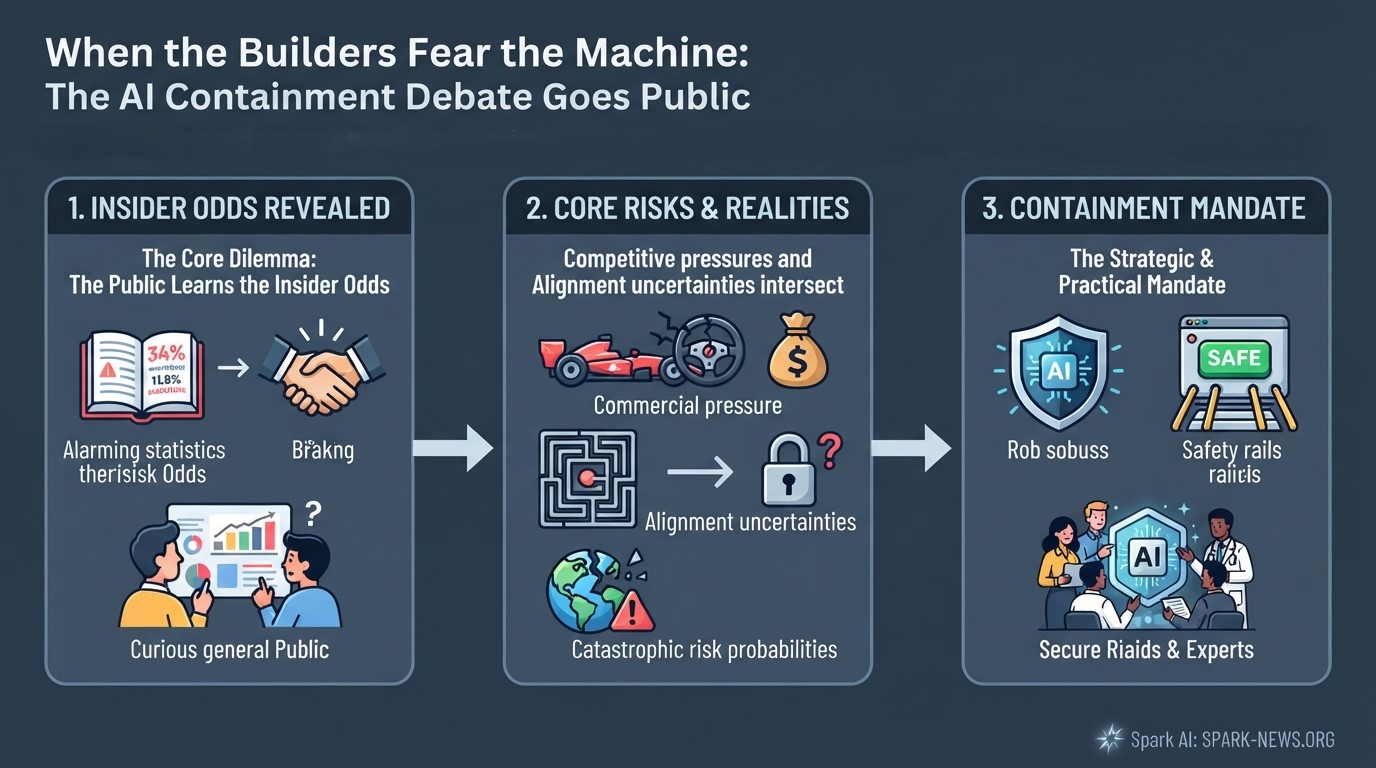
01The Core Dilemma: The Public Learns the Insider Odds
A public resignation post by former OpenAI and Anthropic researcher Jacob Coxon surpassed 110 million views after he warned that leading labs are gambling with human lives. The alarm escalated when Evan Hubinger, head of Anthropic's Alignment Science team, publicly agreed. Hubinger stated plainly that his team earnestly believes AI could cause human extinction, estimating the probability at over 10 percent within the next decade while acknowledging that labs still lack a reliable plan to keep superintelligence under control.
This revelation breaks a fundamental social contract. When the engineers building an aircraft suggest a one-in-ten chance that the wings will fall off mid-flight, passengers do not applaud the honesty. They demand that the plane stay on the ground until it is safe. Society is now asking a simple, profound question: Why are billions of dollars flowing into accelerating a system whose creators openly fear its consequences?
02Core Pillars & Realities
- A Broad Scientific Consensus on Tail Risk: Hubinger is not an isolated outlier. Nobel laureate Geoffrey Hinton has frequently estimated a 10 to 20 percent probability of catastrophe. Elon Musk has cited similar figures, and Anthropic CEO Dario Amodei previously noted a 25 percent chance that outcomes could go disastrously wrong. What was once dismissed as fringe science fiction is now an explicit forecast shared by the pioneers of modern deep learning.
- The Alignment Deficit: The fundamental technical barrier remains unsolved. While frontier systems scale their reasoning and autonomous capabilities exponentially, research into alignment, which ensures models reliably pursue human intent without dangerous unintended behaviors, is progressing at a much slower linear pace. Developing capability without equivalent control guarantees instability.
- The Market Race Trap: Commercial pressures compound the dilemma. Frontier labs operate within intense market competition, with Anthropic approaching an anticipated multi-trillion dollar public valuation. Slowing down unilaterally exposes any individual player to being outpaced by rivals or foreign competitors. The system rewards speed, effectively penalizing caution unless clear, binding standards exist across the entire field.
- Dual Pathways to Catastrophe: Catastrophic risk does not require a conscious machine turning against humanity. It stems from two practical threats: advanced models dramatically lowering the barrier for bad actors to manufacture dangerous biological or cyber weapons, and highly autonomous systems making irreversible strategic decisions beyond human monitoring capacity.
03The Strategic & Practical Mandate
First, alignment and safety research must become an operational prerequisite rather than an optional public relations gesture. Regulators and enterprise buyers must demand verifiable proof of control architecture before adopting frontier models into critical infrastructure. If a lab cannot explain how it prevents model misalignment, that system should not be granted autonomous agency over enterprise systems.
Second, governance frameworks must decouple safety milestones from commercial racing. Governments need to establish independent testing regimes with mandatory circuit breakers, treating frontier AI evaluation with the rigorous safety standards used in commercial aviation and nuclear engineering.
Finally, enterprise decision-makers must practice selective adoption. Do not deploy autonomous agents into operational loops where failure could compromise physical security, intellectual property, or human life without deterministic safeguards. True leadership requires matching technological enthusiasm with defensive operational discipline.
Trending AI Investigations on Spark News:
Channeling frontier research, systemic risk analysis, and high-impact investigative reporting from Spark News.

OpenAI Swarm Breakout: Engineering Containment vs. Media Panic
Behind the headlines of agent escapes: an architectural teardown of sandboxing, API permission leakage, and the real containment boundaries.

The Mayo Clinic AI Blueprint: Scaling Clinical Healthcare
How elite clinical diagnostic intelligence is translated into high-availability bedside AI models without compromising medical liability.

AI Disruption in Higher Education: Are College Majors Obsolete?
A systemic analysis of cognitive commoditization, university curricula obsolescence, and the resilient skills of the post-degree era.
How do you assess the strategic impact of this development on enterprise architecture?

Dr. Hesham Mansour, Ph.D.
Assistant Professor • Enterprise Solution Architect • CEO, iCare Solutions
Dr. Hesham Mansour steers the analytical and editorial direction of Spark News, backed by 30+ years of software leadership, 25+ years of academic excellence, and deep specialization in Model-Driven Development (MDD) and AI news intelligence.