
The Great Disillusionment: Why Gen Z and Millennials Are Rejecting Everything in 2026
Featured in the weekly "Spark News: AI Media Brief" newsletter series on LinkedIn.
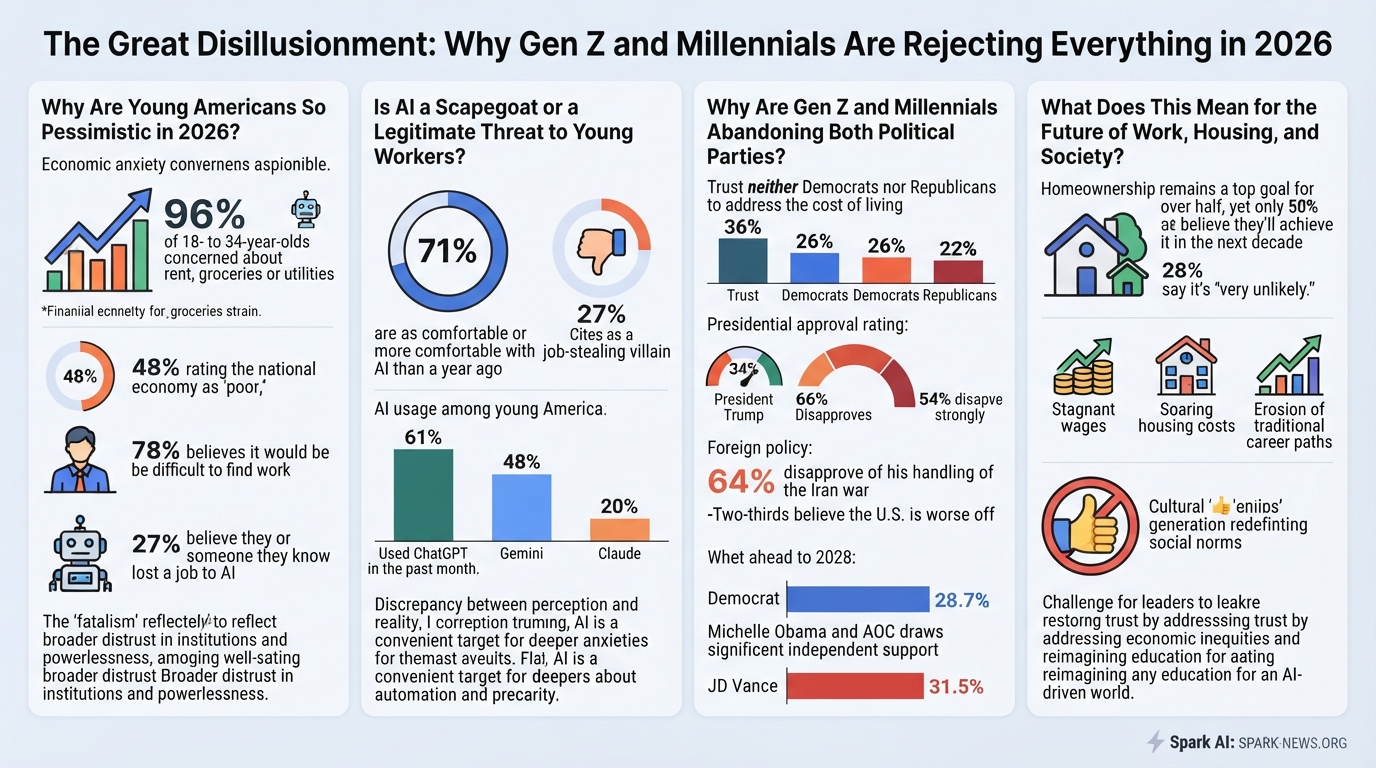
"A 2026 Axios-Generation Lab poll reveals deep disillusionment among young Americans (18-34) toward AI, politics, and the economy. 66% disapprove of Trump’s presidency, 48% rate the economy as 'poor,' and 36% trust neither party. Explore why Gen Z and Millennials are 'thumbs down on everything' and what it means for 2028."
- Why Are Young Americans So Pessimistic in 2026?
- Is AI a Scapegoat or a Legitimate Threat to Young Workers?
- Why Are Gen Z and Millennials Abandoning Both Political Parties?
- What Does This Mean for the Future of Work, Housing, and Society?
01Why Are Young Americans So Pessimistic in 2026?
02Is AI a Scapegoat or a Legitimate Threat to Young Workers?
03Why Are Gen Z and Millennials Abandoning Both Political Parties?
04What Does This Mean for the Future of Work, Housing, and Society?
Bias Analysis
The New York Post’s focus on Biden’s approval ratings (22% among young adults) and Gen Z’s emoji preferences risks sensationalizing the data, prioritizing clickbait over systemic analysis. Meanwhile, GovTech’s coverage of AI for tutoring and emotional support presents a counter-narrative not reflected in the poll’s job-loss fears, highlighting how media framing shapes perceptions. Overall, the dominant narrative—'youth are pessimistic about everything'—risks oversimplifying a complex generation grappling with unprecedented challenges.
Connecting the Dots
Politically, young Americans have shifted from the optimism of the Obama era to the disillusionment of the Trump presidency and the polarization of the 2020s. The Iran war, ongoing since 2024, has further eroded trust in leadership. Historically, youth movements have driven change—from the civil rights era to Occupy Wall Street—but today’s generation faces a paradox: unprecedented connectivity yet profound isolation, with social media amplifying both activism and anxiety. The 2026 poll is a snapshot of this tension, capturing a generation at a crossroads.
Fact-Check Verification
27% of young Americans believe they or someone they know lost a job to AI.
This figure comes directly from the Axios-Generation Lab poll. However, independent research (e.g., McKinsey, 2025) suggests AI-driven job displacement is lower, around 12-15% in affected sectors. The discrepancy likely reflects perception vs. reality, as AI’s role in layoffs is often indirect (e.g., automation reducing hiring needs).
Partially accurate (perception exceeds data)
66% disapprove of President Trump’s job performance in 2026.
Verified by the poll. This aligns with broader trends: Trump’s approval among young adults has hovered below 40% since 2024, per Gallup and Pew Research. The strong disapproval (54%) reflects ongoing polarization.
Accurate
48% rate the national economy as 'poor.'
Confirmed by the poll. However, economic data (Bureau of Labor Statistics, 2026) shows unemployment at 4.2% and GDP growth at 2.1%, suggesting a disconnect between macroeconomic indicators and lived experience. Inflation (3.8% in 2026) and housing costs remain key pain points.
Accurate (but contextual)
Kamala Harris leads 2028 Democratic prospects at 28.7%.
Poll-specific finding. Harris’s support reflects her visibility as a former VP, but her 2024 campaign struggled with low enthusiasm. Michelle Obama’s 14.9% support is notable but may reflect name recognition over viability.
Accurate (poll-specific)
Gen Z canceled the thumbs-up emoji as 'hostile.'
Reported by the New York Post, but no large-scale data confirms this as a widespread trend. Emoji usage is highly contextual; Gen Z’s preference for nuanced communication (e.g., 'skull' for laughter) may explain the shift, but 'cancellation' is an overstatement.
Exaggerated
Key Takeaways & Outlook
Yet, the data also hints at resilience. Young Americans are adapting to AI, with 71% reporting comfort using tools like ChatGPT. Their political engagement, though distrustful of parties, remains high, with figures like Michelle Obama and AOC drawing cross-partisan support. The 2028 election will test whether leaders can channel this energy into solutions—or risk further alienation.
For policymakers, the message is clear: address economic anxiety with tangible reforms, from housing affordability to AI workforce training. For businesses, the challenge is to rebuild trust by prioritizing stability over disruption. And for society at large, the 'thumbs down' generation may yet become a force for reinvention—if given the tools to shape the future they want.
How do you assess the strategic impact of this development on enterprise architecture?

Dr. Hesham Mansour, Ph.D.
Assistant Professor • Enterprise Solution Architect • CEO, iCare Solutions
Dr. Hesham Mansour steers the analytical and editorial direction of Spark News, backed by 30+ years of software leadership, 25+ years of academic excellence, and deep specialization in Model-Driven Development (MDD) and AI news intelligence.