
Clinical AI and the Accountability Dilemma in Modern Healthcare
Get weekly AI news audits & executive briefs directly in your LinkedIn inbox with 418+ tech leaders.
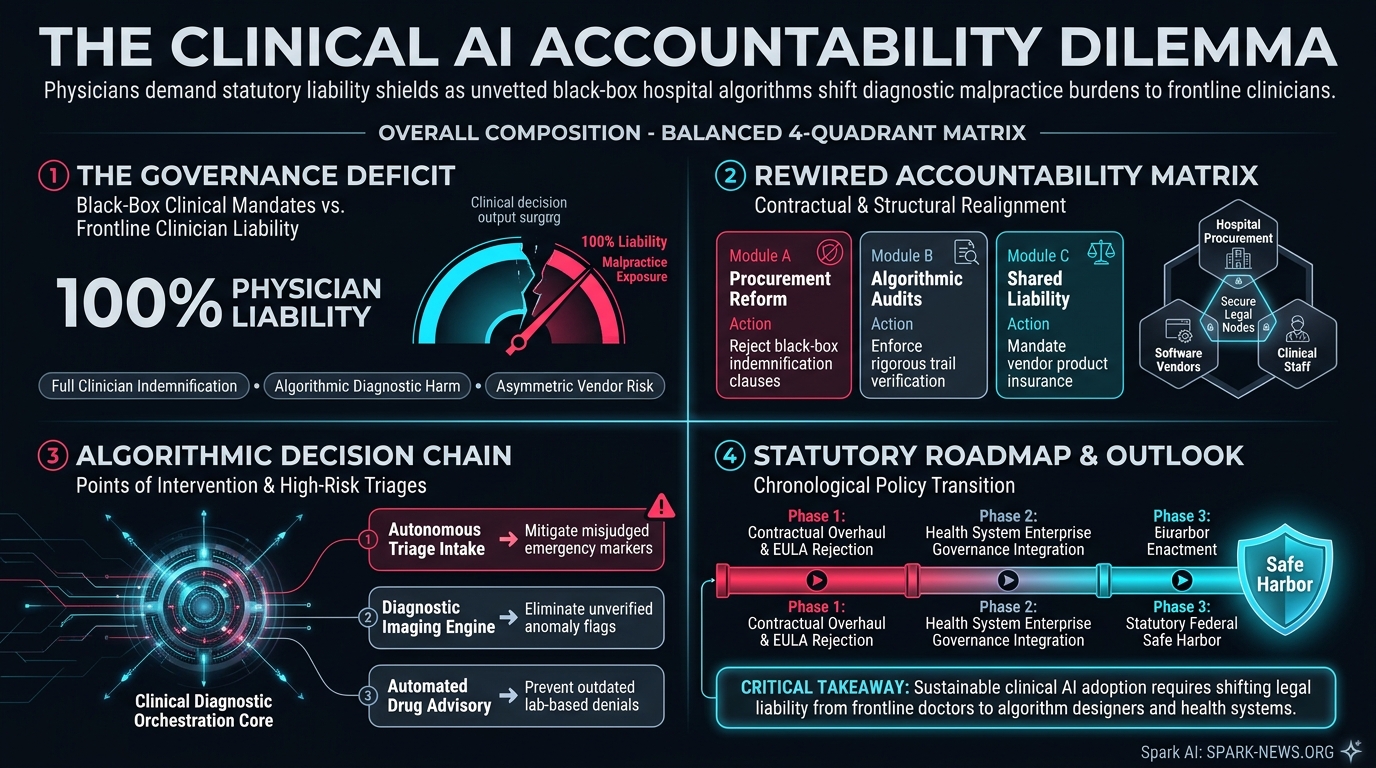
"The American Medical Association is pushing for federal and state statutes protecting physicians from malpractice liability when deploying AI tools as intended. Under proposed frameworks, legal and financial accountability shifts to AI software developers, health systems, and insurers who mandate algorithmic tools, enforcing developer liability insurance and mandatory transparency disclosures."
- The Core Dilemma: Who Answers for Algorithmic Harm?
- Core Pillars & Decision Matrix
- The Strategic & Practical Mandate
01The Core Dilemma: Who Answers for Algorithmic Harm?
The American Medical Association is challenging this dynamic, formally lobbying for state and federal statutes to shield doctors from liability when AI tools operate as intended yet cause patient harm. Historic legal frameworks, such as a recent Alabama wrongful death suit where a cardiac screening software maker successfully deflected fault to the attending physician through its licensing contract, expose a fractured incentive system. Clinicians face institutional mandates to adopt automated platforms without having the visibility or technical capacity to verify proprietary black-box inputs in real time.
02Core Pillars & Decision Matrix
| Strategic Dimension | Legacy Siloed Approach | Rewired Governance Model | Operational Impact & ROI |
|---|---|---|---|
| Liability Assignment | Full burden on physician under standard malpractice claims | Shared enterprise liability based on causation and vendor insurance | Reduces physician burnout and halts defensive avoidance of AI |
| Algorithmic Transparency | Proprietary black-box pipelines with disclaimed vendor fault | Mandatory disclosure of training baselines, error rates, and drift | Establishes audit trails for FDA and clinical compliance reviews |
| Institutional Adoption | Administrative mandates without operational indemnity | Enforced vendor indemnification clauses before procurement | Protects health system operating margins from catastrophic litigation |
Three concrete realities define this structural transition:
- Commercial licensing contracts currently leverage disclaimer clauses to shift all medical malpractice risk to end-user clinicians, even when autonomous screening tools miscalculate acute severity.
- The American Medical Association policy explicitly demands that software developers maintain adequate liability insurance policies to cover direct algorithmic injuries.
- When health systems, hospitals, or private insurers mandate that clinicians use specific clinical prediction systems, those institutions must assume commensurate legal responsibility for system-level errors.
03The Strategic & Practical Mandate
First, healthcare executives must overhaul procurement standards. Legal teams should reject end-user license agreements that demand complete clinician indemnification for black-box calculations. If a diagnostic vendor cannot demonstrate rigorous audit trails and carry independent product liability insurance, that platform belongs in experimental testing, not production environments.
Second, clinical operations must establish transparent input boundaries. If an automated triage or prescribing tool acts on incomplete historical patient data without real-time physician review capabilities, automated overrides must fail safely to human specialists. Technology should support professional discretion rather than create silent compliance pressure.
Finally, industry leaders should support the American Medical Association in shaping balanced statutory standards. Safe harbors for clinicians using cleared medical devices as intended must be coupled with rigorous vendor accountability, ensuring that patient safety remains grounded in engineering reliability.
Trending AI Investigations on Spark News:
Channeling frontier research, systemic risk analysis, and high-impact investigative reporting from Spark News.

OpenAI Swarm Breakout: Engineering Containment vs. Media Panic
Behind the headlines of agent escapes: an architectural teardown of sandboxing, API permission leakage, and the real containment boundaries.

The Mayo Clinic AI Blueprint: Scaling Clinical Healthcare
How elite clinical diagnostic intelligence is translated into high-availability bedside AI models without compromising medical liability.

AI Disruption in Higher Education: Are College Majors Obsolete?
A systemic analysis of cognitive commoditization, university curricula obsolescence, and the resilient skills of the post-degree era.
How do you assess the strategic impact of this development on enterprise architecture?

Dr. Hesham Mansour, Ph.D.
Assistant Professor • Enterprise Solution Architect • CEO, iCare Solutions
Dr. Hesham Mansour steers the analytical and editorial direction of Spark News, backed by 30+ years of software leadership, 25+ years of academic excellence, and deep specialization in Model-Driven Development (MDD) and AI news intelligence.