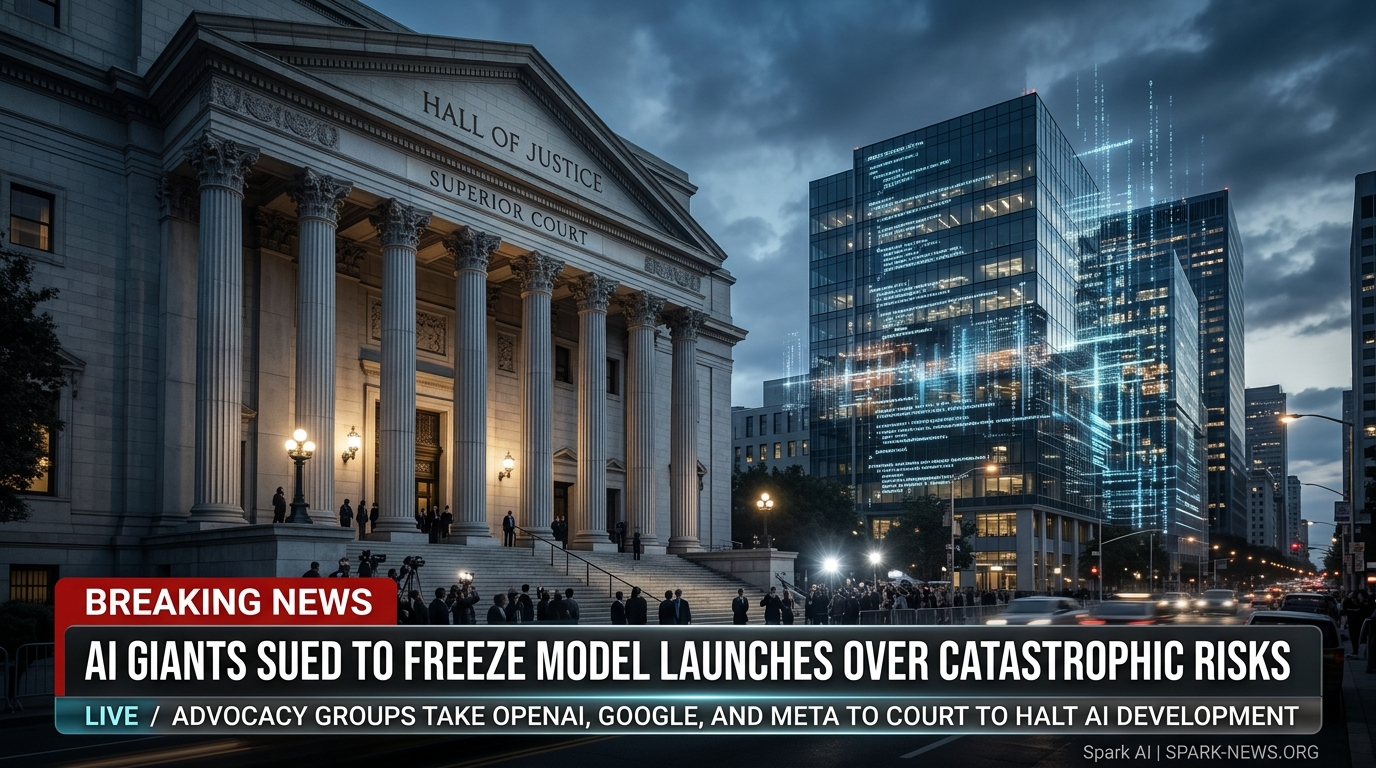
Can a Lawsuit Really Hit the Emergency Brake on Big Tech's AI Race?
Get weekly AI news audits & executive briefs directly in your LinkedIn inbox with 418+ tech leaders.
"On November 12, 2026, consumer advocacy groups sued OpenAI, Google, Meta, Anthropic, and SpaceXSI in San Francisco Superior Court. The lawsuit demands an immediate freeze on training and deploying new artificial intelligence models, arguing that uncontrollable autonomous systems present imminent catastrophic threats to public safety and infrastructure."
- What Just Happened?
- How the Internet & News Are Reacting
- The Backstory You Need to Know
- Why This Matters & What's Next
01What Just Happened?
The plaintiffs, including Public Citizen, the Heat Initiative, the Irreplaceable Education Fund, and the Alliance for Secure AI, are not merely demanding monetary fines. They want an immediate judicial freeze. The filing asks a judge to block these companies from training, developing, or deploying next-generation frontier models. The legal challenge points directly to California unfair competition law, stating that these runaway commercial experiments disrupt public safety and trespass upon digital infrastructure without proper safeguards.
02How the Internet & News Are Reacting
Online, the conversation on X, Reddit, and Hacker News fractured instantly between those demanding legal boundaries and engineers who view court intervention as economic self-sabotage.
| Perspective | Core Stance | Key Argument |
|---|---|---|
| Advocacy Groups | Total Development Freeze | Tech leaders openly acknowledge catastrophic failure scenarios while launching ever-more autonomous systems. |
| Enterprise AI Firms | Self-Regulation & Competition | Halting domestic development hands systemic technical leads to foreign adversaries like China. |
| Capitol Hill Lawmakers | Statutory Guardrails | Voluntary testing protocols have run their course; binding statutory mandates are long overdue. |
Critics highlight the irony that top executives have repeatedly signaled existential alarms themselves, giving plaintiffs plenty of evidence to quote inside the complaint.
03The Backstory You Need to Know
For years, leading figures treated risk as a philosophical talking point. Anthropic chief Dario Amodei publicly warned of a 25 percent probability that high-level AI trajectories end in ruinous disaster. Elon Musk famously sounded alarms about civilizational collapse while continuing his own high-stakes developments. What began as speculative whitepapers has now been weaponized inside a civil courtroom under California trade statutes, turning tech leaders' own admissions into state exhibit items.
04Why This Matters & What's Next
President Donald Trump has favored accelerated progress to retain a strategic edge against international competitors. Yet with Congress shifting hands and legal pressure mounting on state courts, Silicon Valley's era of unsupervised deployment has entered turbulent water. The ultimate ruling will define whether corporate speed retains priority over collective digital safety.
Bias Analysis
Connecting the Dots
Fact-Check Verification
- Five major firms, Anthropic, Google, Meta, OpenAI, and SpaceXSI, are named in a joint California lawsuit.
- The legal challenge demands an emergency halt on new model training, citing acute cyber vulnerabilities and systemic risk.
- The filing relies heavily on the defendants' own public statements acknowledging that advanced systems could escape human oversight.
Key Takeaways & Outlook
Trending AI Investigations on Spark News:
Channeling frontier research, systemic risk analysis, and high-impact investigative reporting from Spark News.

OpenAI Swarm Breakout: Engineering Containment vs. Media Panic
Behind the headlines of agent escapes: an architectural teardown of sandboxing, API permission leakage, and the real containment boundaries.

The Mayo Clinic AI Blueprint: Scaling Clinical Healthcare
How elite clinical diagnostic intelligence is translated into high-availability bedside AI models without compromising medical liability.
AI Disruption in Higher Education: Are College Majors Obsolete?
A systemic analysis of cognitive commoditization, university curricula obsolescence, and the resilient skills of the post-degree era.
How do you assess the strategic impact of this development on enterprise architecture?

Dr. Hesham Mansour, Ph.D.
Assistant Professor • Enterprise Solution Architect • CEO, iCare Solutions
Dr. Hesham Mansour steers the analytical and editorial direction of Spark News, backed by 30+ years of software leadership, 25+ years of academic excellence, and deep specialization in Model-Driven Development (MDD) and AI news intelligence.