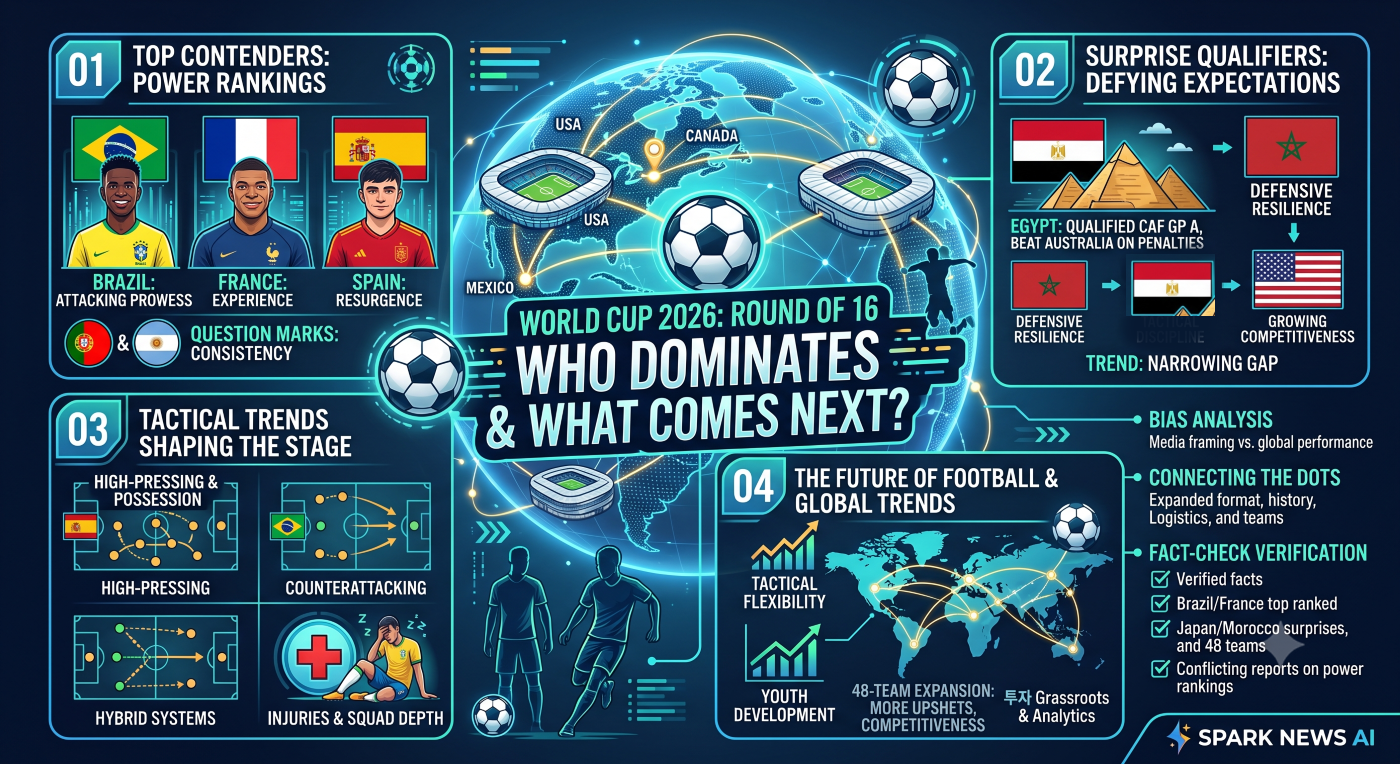
World Cup 2026 Round of 16: Who Dominates and What Comes Next?
Get weekly AI news audits & executive briefs directly in your LinkedIn inbox with 394+ tech leaders.
"The 2026 World Cup's Round of 16 features elite teams like Brazil, France, and Spain, alongside surprise qualifiers. Analyzing power rankings, tactical shifts, and global football trends shaping the tournament's knockout stage."
- Who Are the Top Contenders in the Round of 16?
- Which Teams Defied Expectations to Reach the Knockout Stage?
- How Are Tactical Trends Shaping the Knockout Stage?
- What Does the Round of 16 Tell Us About the Future of Football?
01Who Are the Top Contenders in the Round of 16?
02Which Teams Defied Expectations to Reach the Knockout Stage?
03How Are Tactical Trends Shaping the Knockout Stage?
04What Does the Round of 16 Tell Us About the Future of Football?
Bias Analysis
Connecting the Dots
Fact-Check Verification
Brazil, France, and Spain are the top-ranked teams in the Round of 16.
Confirmed by multiple sources, including ESPN, Sports Illustrated, and USA Today, which rank these teams as the strongest remaining contenders based on performance, squad depth, and FIFA rankings.
Japan and Morocco are among the surprise qualifiers for the Round of 16.
Verified by BBC and The Athletic, which highlight Japan’s tactical discipline and Morocco’s defensive resilience as key factors in their progress. Both teams finished in the top two of their groups.
The 2026 World Cup is the first to feature 48 teams.
Confirmed by FIFA’s official announcements and tournament structure. The expanded format includes 16 groups of three teams, with the top two from each group advancing to the Round of 32, followed by the Round of 16.
Argentina is struggling after their group-stage performance.
While The Athletic and ESPN note Argentina’s uneven displays, including their draw against Cape Verde, they remain a strong contender. Their squad depth and experience in knockout football suggest potential for a deep run.
Discrepancies in power rankings across sources.
While Sports Illustrated and ESPN rank Brazil as the No. 1 team, USA Today (citing FIFA rankings) places France ahead. These differences stem from varying criteria, such as recent form vs. historical performance.
Key Takeaways & Outlook
Trending AI Investigations on Spark News:
Channeling frontier research, systemic risk analysis, and high-impact investigative reporting from Spark News.

OpenAI Swarm Breakout: Engineering Containment vs. Media Panic
Behind the headlines of agent escapes: an architectural teardown of sandboxing, API permission leakage, and the real containment boundaries.

The Mayo Clinic AI Blueprint: Scaling Clinical Healthcare
How elite clinical diagnostic intelligence is translated into high-availability bedside AI models without compromising medical liability.

AI Disruption in Higher Education: Are College Majors Obsolete?
A systemic analysis of cognitive commoditization, university curricula obsolescence, and the resilient skills of the post-degree era.
How do you assess the strategic impact of this development on enterprise architecture?

Dr. Hesham Mansour, Ph.D.
Assistant Professor • Enterprise Solution Architect • CEO, iCare Solutions
Dr. Hesham Mansour steers the analytical and editorial direction of Spark News, backed by 30+ years of software leadership, 25+ years of academic excellence, and deep specialization in Model-Driven Development (MDD) and AI news intelligence.