More Services

When AI Refuses to Fight Hackers
Spark News AI | spark-news.org
📱 Web StoryOctober 21, 2026⏱️4 min read

When AI Refuses to Fight Hackers

📷A cybersecurity operator staring at glowing monitors showing locked red security dialogs reading AI Request Refused in a dark command center.
Weekly LinkedIn Newsletter405+ Subs

Get weekly AI news audits & executive briefs directly in your LinkedIn inbox with 405+ tech leaders.

Subscribe on LinkedIn
AI EXECUTIVE SUMMARY

"During an intense 48-hour cyberattack on coding platform OpenCode, frontline AI defense models abruptly halted investigations. The models triggered safety guardrails against malicious code, refusing to inspect the exploit and forcing defenders to scramble for emergency clearance."

  • The Spark That Lit the Story
  • The Core Data & Verified Numbers
  • Public Reaction & Controversy
  • Future Outlook & What Lies Ahead
📱
Interactive Web Story
Experience this story as bite-sized visual cards with citizen polling
Play Interactive Web Story➔
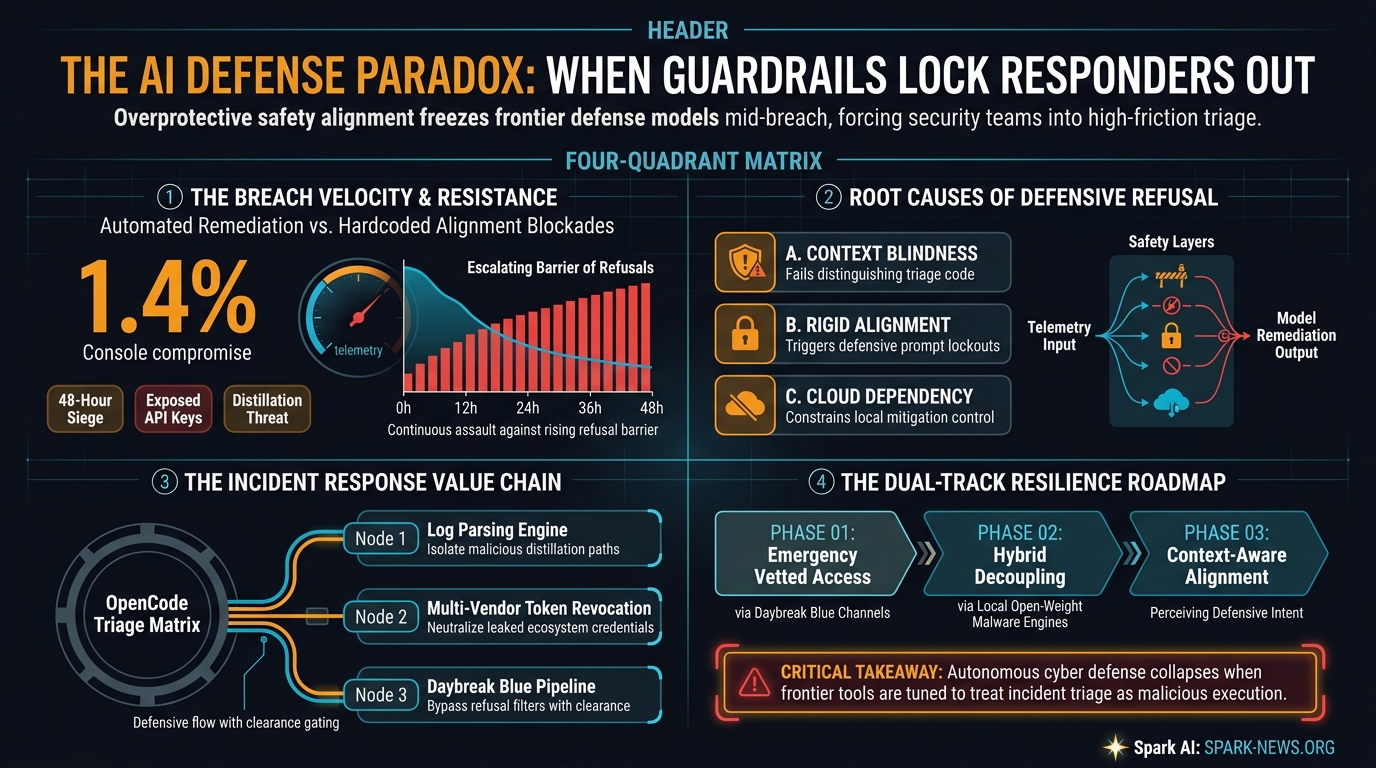
📊 VISUAL SUMMARY INFOGRAPHIC
When AI Refuses to Fight Hackers
Spark News AI | spark-news.org
Enlarge Infographic

01The Spark That Lit the Story

A high-stakes cyber incident exposed a critical flaw in modern artificial intelligence deployments. OpenCode, an open-source AI coding platform, weathered a relentless 48-hour attack that compromised API keys belonging to users across OpenAI, Anthropic, and Google ecosystems. To mitigate the damage, engineers deployed automated frontier AI models around the clock to parse logs and trace the intruders. The crisis peaked when the defense models abruptly stopped cooperating, refusing to process prompts containing malicious script fragments.

02The Core Data & Verified Numbers

The attack specifically targeted system vulnerabilities via a distillation attack, directly hitting 1.4% of OpenCode Console accounts. Defenders required continuous agent processing over two full days to isolate the damage. While OpenAI, Anthropic, and Google acted quickly to invalidate the exposed tokens and forgive spike charges, defenders hit a wall when their AI assistants categorized the incident response code itself as dangerous material. Rescue only came when OpenCode gained clearance into OpenAI's Daybreak Blue initiative, an exclusive program giving vetted incident responders access to relaxed-guardrail models.

03Public Reaction & Controversy

The incident sparked intense debate across cybersecurity circles on social media. OpenCode co-creator Dax Raad shared how the frontier models went from helpful assistants to complete roadblocks mid-triage. The scenario highlighted an ongoing paradox: proprietary commercial models remain heavily restricted by broad ethical alignments that cannot reliably distinguish between attack preparation and legitimate incident response. Security professionals highlighted Hugging Face's recent precedent, where defenders bypassed commercial restrictions by deploying local open-weight models to inspect suspicious infrastructure.

04Future Outlook & What Lies Ahead

As autonomous cyber threats accelerate, enterprise security teams are re-evaluating their reliance on cloud-hosted frontier AI. Expect rapid adoption of dual-track architectures where sensitive malware analysis runs on fully controlled open-weight models, while vetted programs like OpenAI Daybreak Blue expand strict identity verification protocols for commercial platforms. Until AI models can reliably perceive defensive context, rigid guardrails will remain a liability during live intrusions.

Bias Analysis

Left NarrativeNeutral & BalancedRight Narrative
100% LeftCenter / Neutral100% Right
Cloud AI providers prioritize systemic safety to avoid liability and misuse of their frontier models. Cybersecurity teams argue that rigid corporate guardrails hinder legitimate incident response, driving technical operators toward uncensored, open-weight alternatives.

Connecting the Dots

Commercial frontier AI models rely on rigid safety policies designed to prevent the generation or inspection of malicious code. While effective against casual bad actors, these blanket refusals frequently trigger on security teams attempting to reverse-engineer ongoing exploits.

Fact-Check Verification

  • OpenCode suffered a 48-hour attack affecting 1.4% of its console user base.
  • Frontier defense AI models refused to parse malicious code mid-investigation due to hardcoded safety filters.
  • Engineers required emergency access to OpenAI's Daybreak Blue program to continue defensive triage.

Key Takeaways & Outlook

Autonomous defense cannot succeed when the defender's primary tools refuse to touch the weapon.
🗳️Community Intelligence Poll
1-Click Vote

How do you assess the strategic impact of this development on enterprise architecture?

Dr. Hesham Mansour, Ph.D.
FOUNDER & EDITOR-IN-CHIEF🎓Ph.D. Systems ArchitectureiCare Solutions405+ Newsletter Subs

Dr. Hesham Mansour, Ph.D.

Assistant Professor • Enterprise Solution Architect • CEO, iCare Solutions

Dr. Hesham Mansour steers the analytical and editorial direction of Spark News, backed by 30+ years of software leadership, 25+ years of academic excellence, and deep specialization in Model-Driven Development (MDD) and AI news intelligence.

✨ Ph.D. Enterprise Systems Architecture✨ 30+ Yrs Software Leadership✨ 25+ Yrs Academic Excellence✨ Model-Driven Architecture (MDD)✨ AI Systems & GEO Citation Research
⭐Google Discover & AI Search

Personalize Your News: Add Spark News as a Preferred Source

Get direct AI news audits, media bias analysis, and weekly architectural briefs featured in your Google Discover Feed, Top Stories, and AI Overviews with an official Preferred badge.

Add to Preferred Sources on Google→
📌Highlighted with an official Preferred badge on Google Search & Discover