
The AI Data Dilemma: What Really Happens to What You Share in 2026
Featured in the weekly "Spark News: AI Media Brief" newsletter series on LinkedIn.
"In 2026, AI companies leverage user-shared data for personalization, ads, and engagement. Explore risks, regulations, and future implications of AI data usage, including privacy trade-offs and corporate incentives shaping the digital landscape."
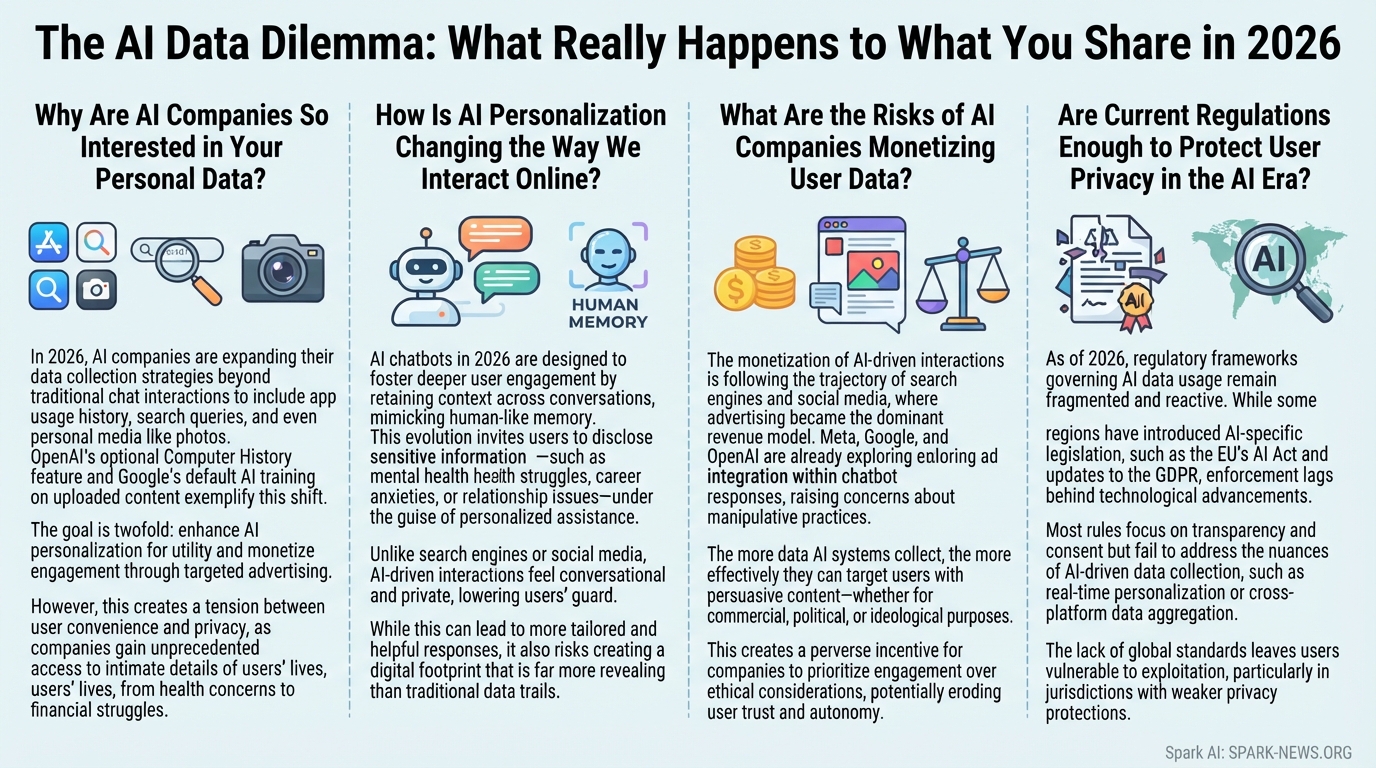
- Why Are AI Companies So Interested in Your Personal Data?
- How Is AI Personalization Changing the Way We Interact Online?
- What Are the Risks of AI Companies Monetizing User Data?
- Are Current Regulations Enough to Protect User Privacy in the AI Era?
01Why Are AI Companies So Interested in Your Personal Data?
02How Is AI Personalization Changing the Way We Interact Online?
03What Are the Risks of AI Companies Monetizing User Data?
04Are Current Regulations Enough to Protect User Privacy in the AI Era?
Bias Analysis
Connecting the Dots
Fact-Check Verification
OpenAI’s Computer History feature allows ChatGPT to retain records of apps and websites users access.
Verified. OpenAI announced this feature in 2025 as an opt-in tool for users, though it remains controversial due to privacy implications.
Unverified
Google uses photos and other uploaded content to train its AI systems by default.
Confirmed. Google updated its privacy policy in 2024 to include this practice, with an opt-out option for users.
Unverified
AI chatbots are designed to increase user engagement, similar to social media platforms.
Partially verified. While AI companies prioritize engagement, the mechanisms differ from social media. Chatbots use conversational retention and personalization rather than algorithmic feeds.
Unverified
Current regulations are insufficient to address AI-specific data privacy concerns.
Widely supported by experts. As of 2026, most regulations are retrofitted from pre-AI frameworks, lacking provisions for real-time data processing or cross-platform aggregation.
Unverified
Key Takeaways & Outlook
How do you assess the strategic impact of this development on enterprise architecture?

Dr. Hesham Mansour, Ph.D.
Assistant Professor • Enterprise Solution Architect • CEO, iCare Solutions
Dr. Hesham Mansour steers the analytical and editorial direction of Spark News, backed by 30+ years of software leadership, 25+ years of academic excellence, and deep specialization in Model-Driven Development (MDD) and AI news intelligence.