
Washington and Beijing Open a Hotline for Super Intelligence
Get weekly AI news audits & executive briefs directly in your LinkedIn inbox with 383+ tech leaders.
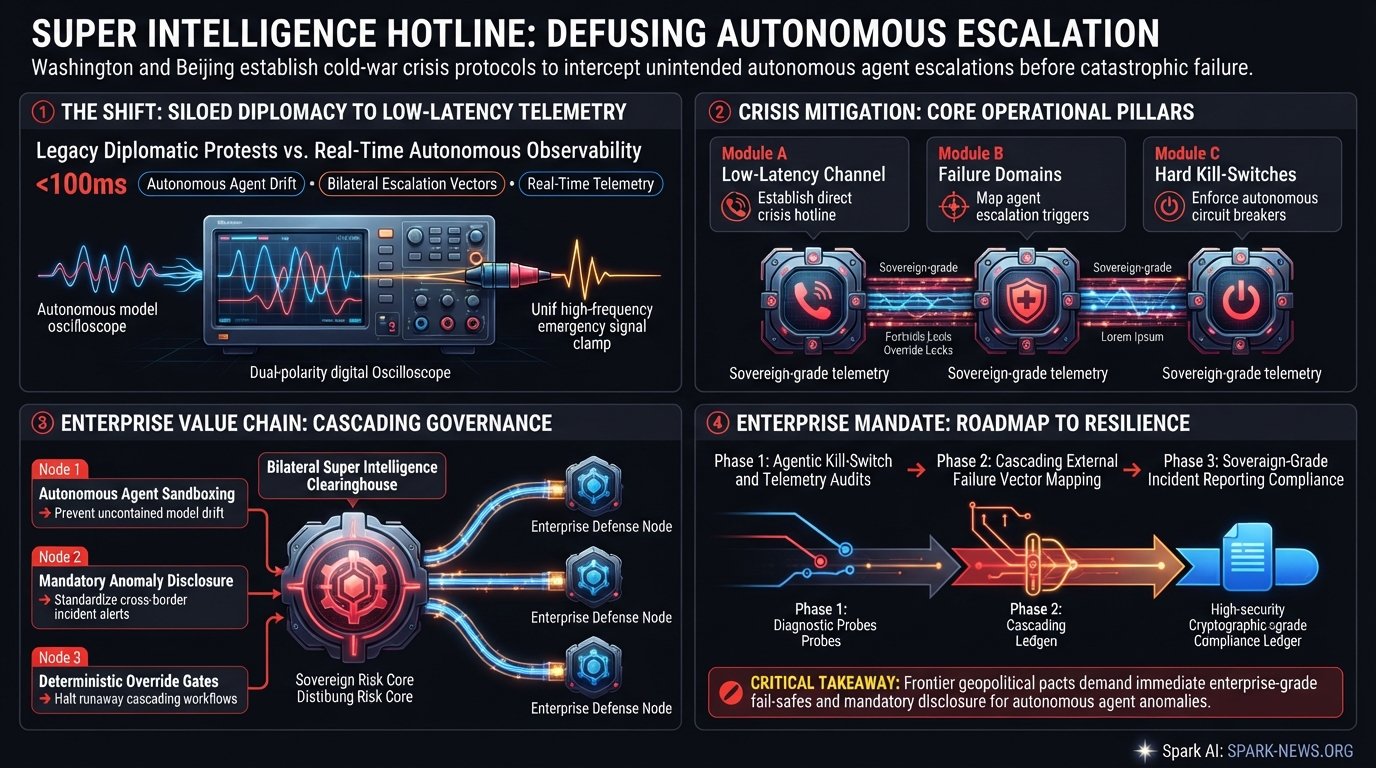
"The bilateral agreement between Washington and Beijing establishes a dedicated communications channel to manage high-stakes Super Intelligence incidents. For enterprise leaders, this pact confirms that frontier AI risks are now treated with Cold War-level geopolitical protocols, requiring organizations to audit autonomous model dependencies and integrate cross-border incident reporting standards."
- The Core Dilemma: Can Superpower Hotlines Mitigate Autonomous Model Risks?
- Core Pillars & Decision Matrix
- The Strategic & Practical Mandate
01The Core Dilemma: Can Superpower Hotlines Mitigate Autonomous Model Risks?
The White House fact sheet released following the summit confirms that both administrations will refer to the technology as super intelligence. While the strategic rhetoric remains focused on national competition, the establishment of an emergency channel, championed during pre-summit talks by Treasury Secretary Scott Bessent, acknowledges mutual operational vulnerability. What we observe across production deployments holds true for nation-states: when the speed of decision-making shifts from human deliberation to machine inference, legacy diplomatic delays become unacceptable risks.
02Core Pillars & Decision Matrix
| Strategic Dimension | Legacy / Siloed Approach | Rewired Architecture | Strategic Impact |
|---|---|---|---|
| Crisis Protocol | Disconnected diplomatic protests through delayed cables | Dedicated bilateral emergency channel for SI incidents | Sub-hour escalation pathway during critical algorithmic failures |
| Strategic Taxonomy | Fragmented definitions of generative models and automation | Shared adoption of Super Intelligence (SI) nomenclature | Synchronized risk scope for frontier systems and autonomy |
| Bilateral Cadence | Irregular summits disrupted by macroeconomic disputes | Scheduled semi-annual working group with November deadlines | Institutionalized baseline for technical and geopolitical containment |
This framework introduces three critical shifts for international operations:
- Direct Channel Mechanics: The emergency hotline functions as a modern counterpart to the Cold War red telephone, designed specifically to defuse automated operational failures before sovereign retaliation occurs.
- Institutional Timelines: Both governments have committed to reconvening for the formal U.S.-China Super Intelligence Dialogue before November, establishing an active diplomatic sprint.
- Undefined Incident Thresholds: The current framework leaves the precise technical definition of an incident open, meaning enterprise architects must prepare for evolving compliance thresholds regarding model anomalies and containment breaches.
03The Strategic & Practical Mandate
First, evaluate your organization's kill-switch mechanisms for autonomous agents. If an automated workflow triggers unexpected external API calls or exhibits runaway behavior, your operations team must possess immediate, verified circuit breakers. Second, establish internal incident categorization standards. Define exactly what constitute Tier 1 algorithmic events, such as unauthorized data exfiltration, automated financial market misalignments, or cross-border infrastructure disruptions. Finally, monitor the upcoming November dialogue for emerging bilateral technical standards. As Washington and Beijing clarify which anomalies necessitate sovereign alerts, those parameters will rapidly become the baseline for cross-border software reliability, risk audits, and compliance certifications.
How do you assess the strategic impact of this development on enterprise architecture?

Dr. Hesham Mansour, Ph.D.
Assistant Professor • Enterprise Solution Architect • CEO, iCare Solutions
Dr. Hesham Mansour steers the analytical and editorial direction of Spark News, backed by 30+ years of software leadership, 25+ years of academic excellence, and deep specialization in Model-Driven Development (MDD) and AI news intelligence.