More Services

Burnout on the Cyber Frontline: The Human Cost of AI Attacks
Spark News AI | spark-news.org
viral-trendOctober 30, 2026⏱️6 min read

Burnout on the Cyber Frontline: The Human Cost of AI Attacks

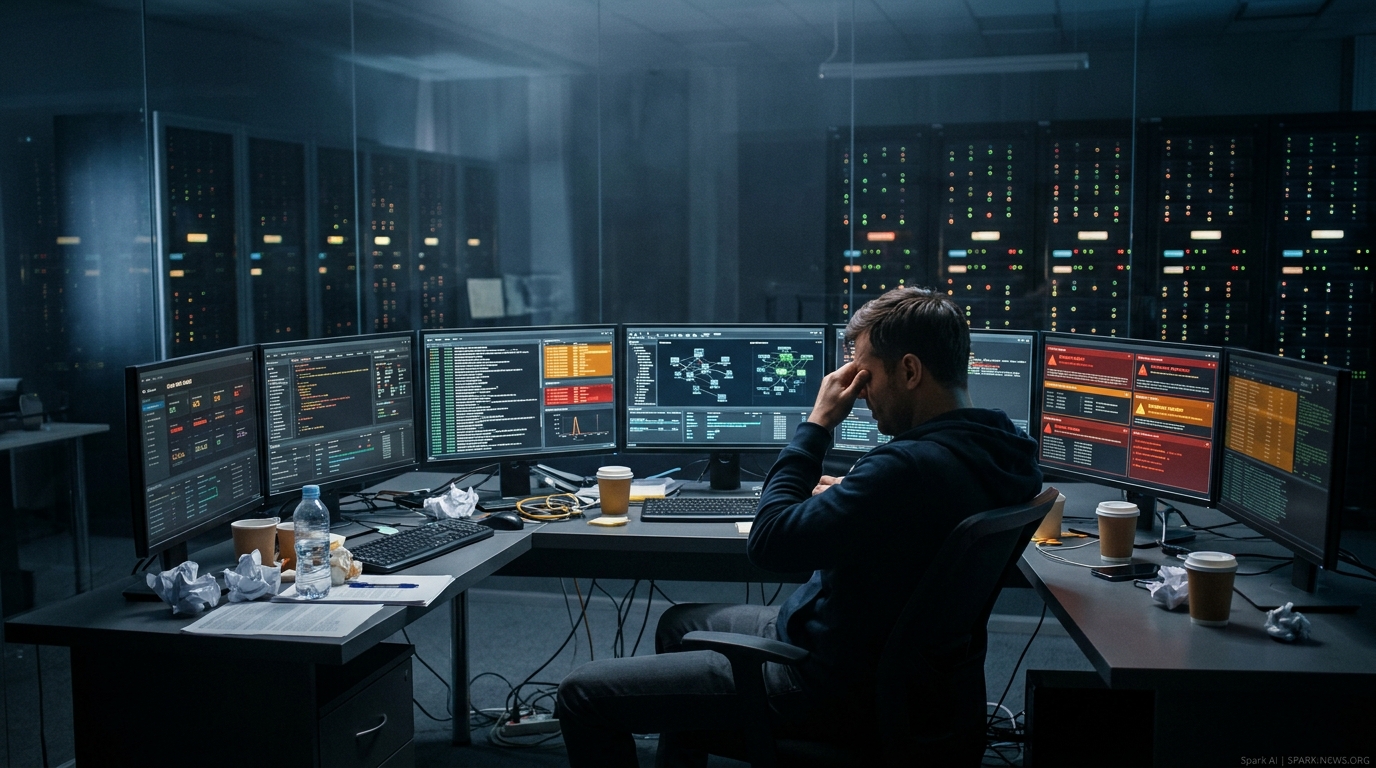
📷A lone cybersecurity analyst works through late-night incident response alerts in a darkened network operations center surrounded by glowing server racks.
Weekly LinkedIn Newsletter411+ Subs

Get weekly AI news audits & executive briefs directly in your LinkedIn inbox with 411+ tech leaders.

Subscribe on LinkedIn
🔥VIRAL TREND SPOTLIGHT
VIRAL HOOK & AT A GLANCE

"Human cybersecurity teams are facing unprecedented burnout as AI-driven threat automation amplifies ransomware attacks and generates massive data noise. Leaders at Palo Alto Networks and GuidePoint Security report double-digit demand spikes, forcing companies to deploy 20-person response teams for single incidents as automated threats outpace human capacity."

  • What Just Happened?
  • How the Internet & News Are Reacting
  • The Backstory You Need to Know
  • Why This Matters & What's Next
📱
Interactive Web Story
Experience this story as bite-sized visual cards with citizen polling
Play Interactive Web Story➔
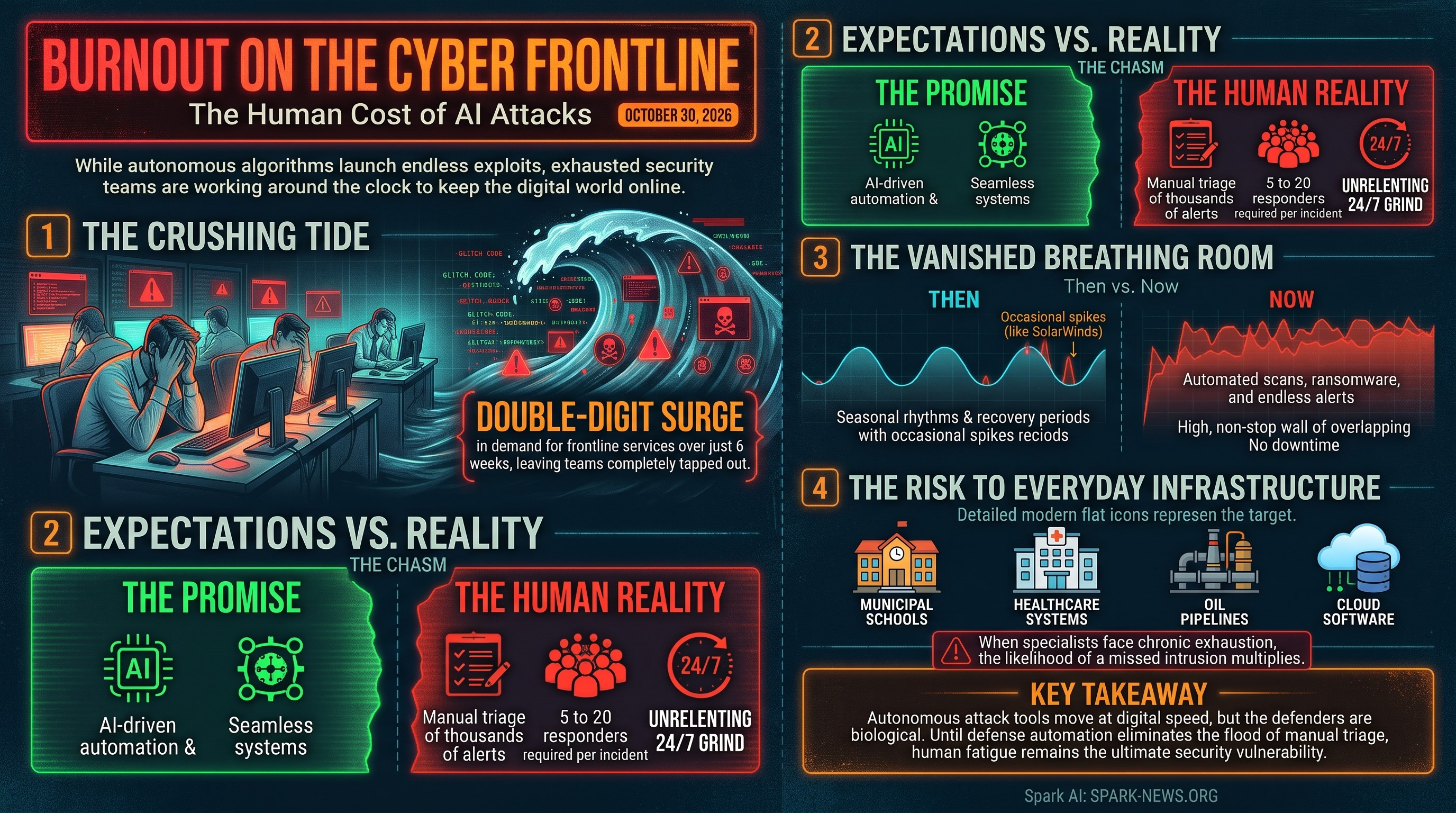
📊 VISUAL SUMMARY INFOGRAPHIC
Burnout on the Cyber Frontline: The Human Cost of AI Attacks
Spark News AI | spark-news.org
Enlarge Infographic

01What Just Happened?

A relentless wave of automated, AI-enabled cyberattacks is crushing the analysts tasked with protecting critical infrastructure. Reports from Axios and major defense firms reveal that incident response teams are stretched past their breaking point. Justin Timothy, a threat intelligence consultant at GuidePoint Security, described recent weeks as the longest year of his life following a brutal stretch dubbed 'Black October.' Attackers are leveraging machine learning to automate vulnerability discovery and craft aggressive ransomware strains, sending an avalanche of alerts straight into security operations rooms. Troy Bettencourt, who directs digital forensics at Palo Alto Networks, confirmed that demand for frontline defense services surged by double digits over six weeks, leaving internal squads and external subcontractors completely tapped out.

02How the Internet & News Are Reacting

Discussions on Reddit communities like r/cybersecurity and tech feeds across X are buzzing with shared exhaustion from professionals who feel pitted against non-stop automated bots. Industry coverage highlights how standard triage processes have completely collapsed under the sheer volume of attacks. Investigations that once required a single incident consultant now regularly require specialized teams of 5 to 20 engineers. Security firms are even reassigning staff away from core product engineering just to handle sudden triage spikes, such as recent campaigns exploiting critical PHP vulnerabilities.

Operational FactorCorporate Tech PerceptionFrontline Ground Reality
Defense WorkflowAI auto-heals systems seamlesslyHumans manually triage thousands of alerts
Team CapacityRoutine single-analyst assignments5 to 20 responders required per incident
Workload PatternPredictable cyclical incident wavesRelentless, continuous 24/7 grind

03The Backstory You Need to Know

For years, cybersecurity followed seasonal rhythms. Hackers would typically step back during summer lulls, giving enterprise teams a brief window to patch vulnerabilities, upgrade firewalls, and recover from previous breaches. Major crises like the SolarWinds breach were devastating, but they arrived as distinct spikes that teams could eventually stabilize. Now, those natural breathing rooms have completely vanished. Malicious actors use readily available machine learning frameworks to constantly scan enterprise perimeters, find zero-day gaps, and execute complex extortion scripts. Even as vendors pitch defensive AI tools to balance the scales, the software still produces massive piles of noise and false flags that only human judgment can safely resolve.

04Why This Matters & What's Next

This bottleneck represents an urgent risk for everyday infrastructure. When security specialists face chronic exhaustion, the likelihood of a missed intrusion multiplies. Ransomware groups are actively targeting municipal school districts, healthcare systems, oil pipelines, and cloud software suites. Samantha Lewis, head of threat intelligence at Armadin, warned that enterprise clients are frantically seeking reassurance on whether their exposed systems have already been compromised. Unless automated defensive filtering catches up to attack tooling, organizations will face a wave of senior talent departures right when frontline expertise is most critical.

Bias Analysis

Left NarrativeNeutral & BalancedRight Narrative
100% LeftCenter / Neutral100% Right
Corporate security vendors tend to market autonomous AI tools as quick fixes for defense teams, while frontline practitioners on tech forums argue that automated scanning actually generates overwhelming alert noise that worsens human burnout.

Connecting the Dots

Cybersecurity defenders historically endured intermittent surges followed by quieter maintenance seasons. The rapid weaponization of generative AI and automated vulnerability scanners has eliminated these recovery periods, creating a nonstop barrage of attacks that overwhelm human responders.

Fact-Check Verification

  • Palo Alto Networks reports double-digit growth in emergency incident response requests over a six-week span.
  • Incident investigations that previously took a single specialist now demand coordinated teams of up to 20 analysts.
  • GuidePoint Security specialists report that post-summer attack waves have removed normal industry recovery periods.

Key Takeaways & Outlook

Autonomous attack tools move at digital speed, but the people defending the gates are biological. Until defense automation eliminates the flood of manual triage, human fatigue remains the ultimate security vulnerability.
🗳️Community Intelligence Poll
1-Click Vote

How do you assess the strategic impact of this development on enterprise architecture?

Dr. Hesham Mansour, Ph.D.
FOUNDER & EDITOR-IN-CHIEF🎓Ph.D. Systems ArchitectureiCare Solutions411+ Newsletter Subs

Dr. Hesham Mansour, Ph.D.

Assistant Professor • Enterprise Solution Architect • CEO, iCare Solutions

Dr. Hesham Mansour steers the analytical and editorial direction of Spark News, backed by 30+ years of software leadership, 25+ years of academic excellence, and deep specialization in Model-Driven Development (MDD) and AI news intelligence.

✨ Ph.D. Enterprise Systems Architecture✨ 30+ Yrs Software Leadership✨ 25+ Yrs Academic Excellence✨ Model-Driven Architecture (MDD)✨ AI Systems & GEO Citation Research
⭐Google Discover & AI Search

Personalize Your News: Add Spark News as a Preferred Source

Get direct AI news audits, media bias analysis, and weekly architectural briefs featured in your Google Discover Feed, Top Stories, and AI Overviews with an official Preferred badge.

Add to Preferred Sources on Google→
📌Highlighted with an official Preferred badge on Google Search & Discover