
Architecting Digital Asset Resilience: Lessons from the Binance Breach
Get weekly AI news audits & executive briefs directly in your LinkedIn inbox with 411+ tech leaders.
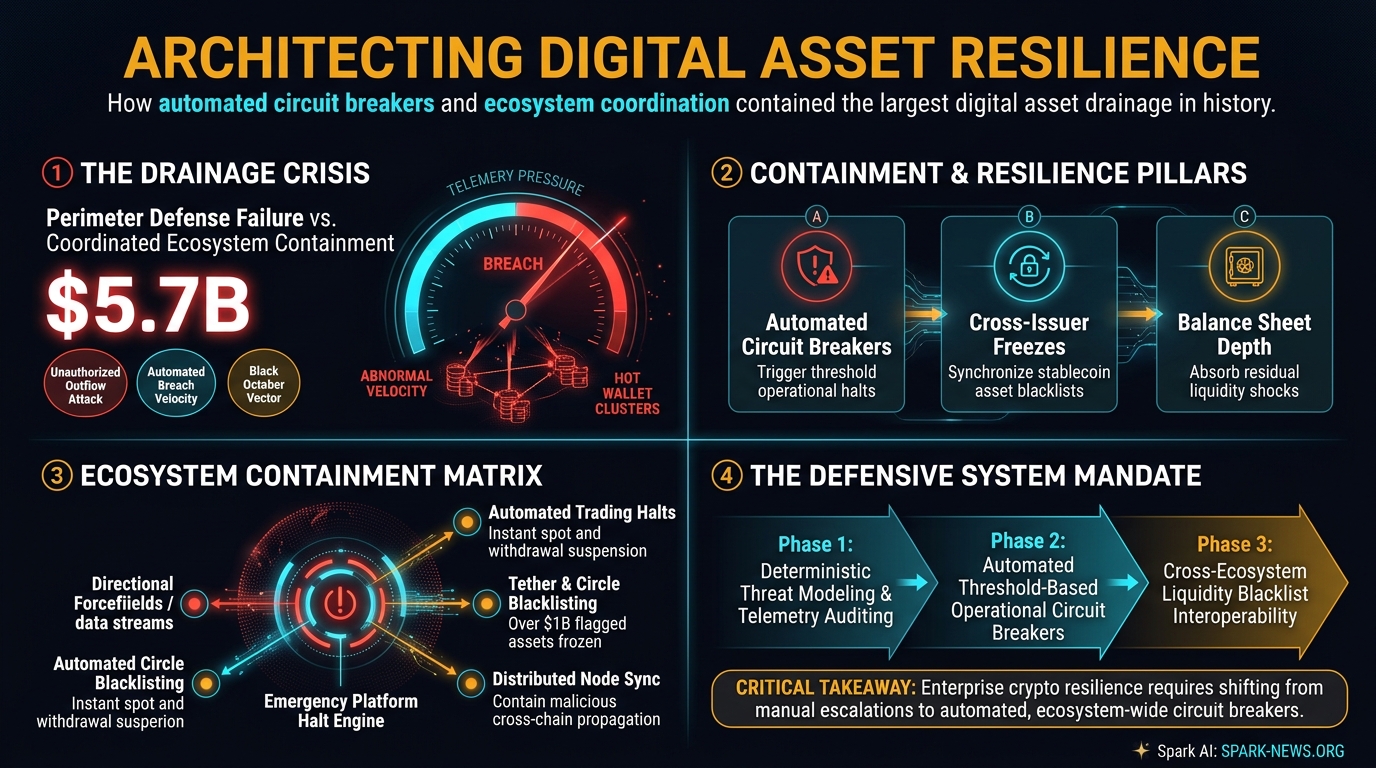
"The Binance security incident, resulting in an estimated $1.7 billion to $5.7 billion drain, demonstrates that enterprise resilience depends on automated cross-entity containment. Immediate trading halts paired with centralized asset freezes of over $1 billion by Tether and Circle proved critical in capping catastrophic systemic contagion across digital asset markets."
- The Core Dilemma: Can Enterprise Scale Survive Coordinated Exploits?
- Core Pillars & Decision Matrix
- The Strategic & Practical Mandate
01The Core Dilemma: Can Enterprise Scale Survive Coordinated Exploits?
From our systems reviews with enterprise engineering and operations leadership, incidents of this magnitude reveal a structural vulnerability in high-throughput transactional architectures: the friction between low-latency settlement and real-time behavioral anomaly detection. While Binance co-founder Yi He confirmed that user balances will be covered by the platform, enterprise architects must look beyond balance sheet solvency. When an attack vector drains billions within hours, standard preventative perimeters have failed. Survival shifts entirely to automated fault isolation and inter-organizational containment mechanisms.
02Core Pillars & Decision Matrix
| Strategic Dimension | Legacy / Siloed Approach | Rewired Ecosystem Architecture | Strategic Impact & ROI |
|---|---|---|---|
| Exploit Containment | Manual approvals and reactive post-mortem audits | Programmatic distributed circuit breakers across settlement pipelines | Reduces asset drainage window from hours to sub-second intervention |
| Counterparty Response | Disconnected multi-day legal outreach | Automated real-time blacklisting APIs across major stablecoin issuers | Enabled immediate freezing of over $1 billion in compromised liquidity |
| Capital Insulation | Unfunded insurance reserves dependent on token valuations | Segregated, over-collateralized enterprise guarantee backstops | Completely prevents exchange run panics and cascading market insolvency |
Three concrete data points define this structural threshold:
- Drain Velocity: Market trackers observed between $1.7 billion and $5.7 billion drained before operational suspension took full effect.
- Coordinated Freezes: Stablecoin issuers Tether and Circle locked more than $1 billion across identified exploit addresses within hours of notification.
- Capital Concentration: The loss significantly surpasses the previous record of $1.5 billion stolen in the 2025 Bybit security event.
03The Strategic & Practical Mandate
First, implement automated, threshold-based operational halts. The decision to halt full platform trading cannot rely on manual executive escalations. Core trading and withdrawal engines must feature programmatic circuit breakers that trip whenever outbound transaction velocities deviate significantly from historical baselines.
Second, establish pre-integrated, multi-party containment rails. Binance mitigated catastrophic losses because ecosystem participants such as Circle and Tether possessed the technical infrastructure and legal protocols required to freeze assets on public ledgers instantly. Enterprise architects must build operational bridges to liquidity providers and regulatory counterparts before an incident occurs.
Third, overhaul balance sheet isolation. Operating an exchange requires air-gapping customer reserves from daily liquidity pipelines, supported by audited corporate guarantee funds capable of absorbing multi-billion-dollar drawdowns without impacting everyday operations.
Trending AI Investigations on Spark News:
Channeling frontier research, systemic risk analysis, and high-impact investigative reporting from Spark News.

OpenAI Swarm Breakout: Engineering Containment vs. Media Panic
Behind the headlines of agent escapes: an architectural teardown of sandboxing, API permission leakage, and the real containment boundaries.

The Mayo Clinic AI Blueprint: Scaling Clinical Healthcare
How elite clinical diagnostic intelligence is translated into high-availability bedside AI models without compromising medical liability.

AI Disruption in Higher Education: Are College Majors Obsolete?
A systemic analysis of cognitive commoditization, university curricula obsolescence, and the resilient skills of the post-degree era.
How do you assess the strategic impact of this development on enterprise architecture?

Dr. Hesham Mansour, Ph.D.
Assistant Professor • Enterprise Solution Architect • CEO, iCare Solutions
Dr. Hesham Mansour steers the analytical and editorial direction of Spark News, backed by 30+ years of software leadership, 25+ years of academic excellence, and deep specialization in Model-Driven Development (MDD) and AI news intelligence.