The Scarlet Letter of AI: Why Suspicion in Entertainment is a Career Death Sentence
Get weekly AI news audits & executive briefs directly in your LinkedIn inbox with 383+ tech leaders.
"In 2026, suspected AI use in entertainment is career-ending, with creators facing backlash, deal collapses, and reputational damage. Explore why nuance is lost, how industries react, and what this means for creativity, copyright, and the future of human-AI collaboration."
- Why is suspected AI use becoming a career-ending stigma in entertainment?
- How are creators and industry professionals responding to the AI backlash?
- What does this mean for the future of creativity and AI collaboration?
- Is the entertainment industry’s anti-AI stance justified, or is it an overreaction?
01Why is suspected AI use becoming a career-ending stigma in entertainment?
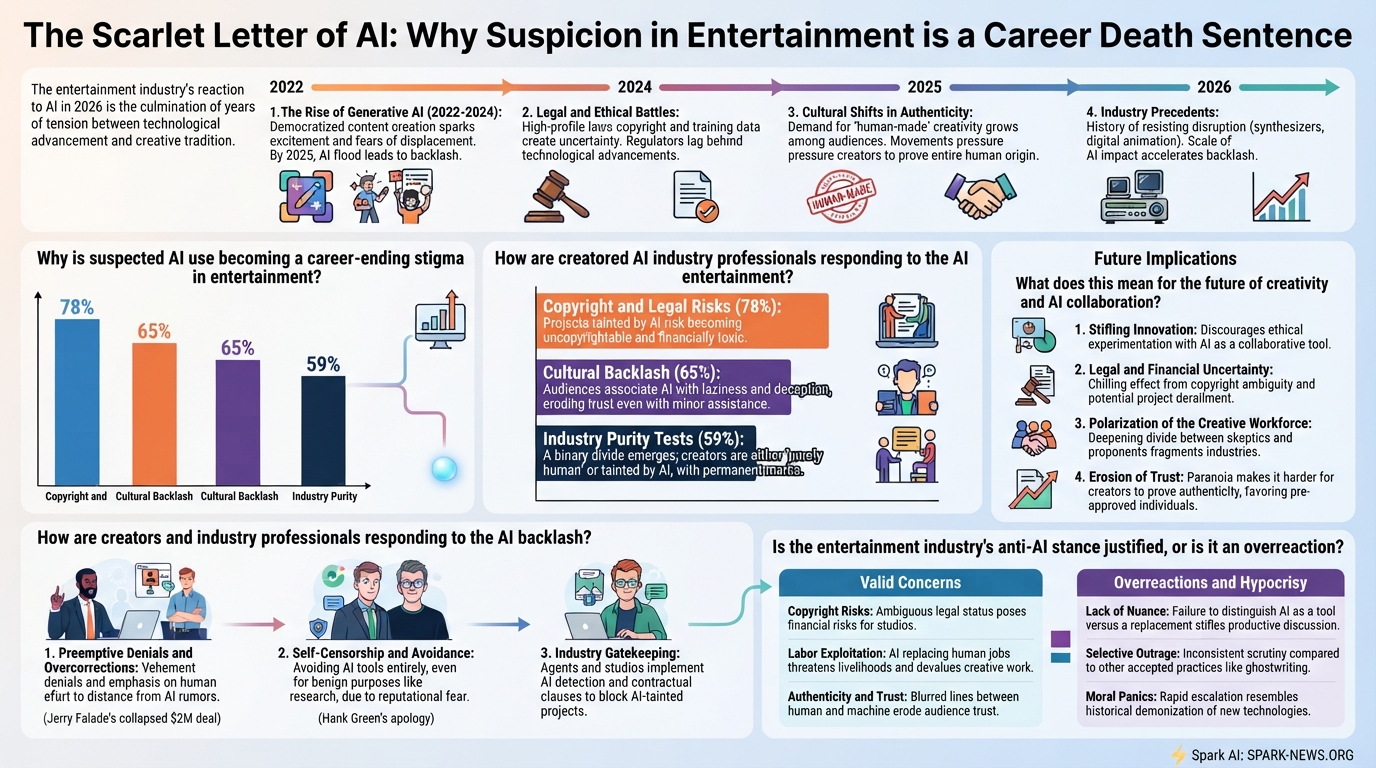
- Copyright and Legal Risks: AI-generated content remains a legal gray area, with courts and regulators still defining ownership. Projects tainted by AI suspicions risk becoming uncopyrightable, making them financially toxic for studios, publishers, and investors.
- Cultural Backlash: Audiences and peers increasingly view AI as a threat to human creativity, associating its use with laziness, exploitation, or deception. Even minor AI assistance—such as using LLMs for research—is conflated with wholesale content generation, eroding trust.
- Industry Purity Tests: The rise of AI has created a binary divide: creators are either "purely human" or tainted by AI. Nuance is lost, and public apologies (like Hank Green’s) often fail to rehabilitate reputations, as the stigma becomes a permanent mark.
02How are creators and industry professionals responding to the AI backlash?
- Preemptive Denials and Overcorrections: Figures like Jerry Falade, whose $2 million book deal collapsed over AI rumors, have resorted to vehement denials, emphasizing human effort to distance themselves from the stigma. Falade’s argument—that multiple editors failed to detect AI—highlights the industry’s reliance on subjective judgments rather than objective tools.
- Self-Censorship and Avoidance: Many creators are avoiding AI tools entirely, even for benign purposes like brainstorming or research, fearing reputational damage. Hank Green’s admission of using AI for "locating papers" and his subsequent apology reflect the pressure to conform to anti-AI orthodoxy.
- Industry Gatekeeping: Agents, publishers, and studios are implementing AI detection tools and contractual clauses to preemptively block AI-tainted projects. The fear of financial or legal repercussions has made AI suspicion a dealbreaker, accelerating the industry’s shift toward rigid human-only standards.
03What does this mean for the future of creativity and AI collaboration?
- Stifling Innovation: The backlash risks discouraging ethical AI experimentation, such as using AI as a collaborative tool for ideation or accessibility. Creators may avoid AI entirely, limiting its potential to augment human creativity.
- Legal and Financial Uncertainty: Until copyright laws and industry standards evolve, AI-related suspicions will continue to derail projects. This uncertainty may lead to a chilling effect, where investors and studios avoid high-risk, high-reward creative ventures.
- Polarization of the Creative Workforce: The divide between AI skeptics and proponents is deepening, with some advocating for total rejection and others pushing for regulated integration. This polarization could fragment industries, creating parallel markets for "AI-free" and "AI-assisted" content.
- Erosion of Trust: The inability to distinguish between AI-assisted and AI-generated work fuels paranoia, making it harder for creators to prove their authenticity. This could lead to a future where only pre-approved, AI-free creators thrive, while others are marginalized.
04Is the entertainment industry’s anti-AI stance justified, or is it an overreaction?
- Valid Concerns:
- Copyright Risks: AI-generated content’s legal status remains ambiguous, posing financial risks for studios and publishers.
- Labor Exploitation: The use of AI to replace human labor, particularly in writing and art, threatens livelihoods and devalues creative work.
- Authenticity and Trust: Audiences increasingly demand transparency, and AI’s role in content creation blurs the line between human and machine, eroding trust.
- Overreactions and Hypocrisy:
- Lack of Nuance: The industry’s binary approach fails to distinguish between AI as a tool (e.g., research, editing) and AI as a replacement (e.g., generating scripts). This oversimplification stifles productive discussions about ethical AI use.
- Selective Outrage: While AI use is scrutinized, other industry practices—such as ghostwriting or algorithmic content curation—face less backlash, revealing inconsistencies in what is deemed "acceptable."
- Moral Panics: The rapid escalation of AI stigma resembles historical moral panics (e.g., video games, rock music), where new technologies were demonized before their long-term impacts were understood.
The industry’s stance is not entirely unjustified, but its lack of nuance risks creating a climate of fear and censorship that could hinder creative progress.
Bias Analysis
- Anti-AI Bias: Much of the reporting frames AI as inherently harmful, focusing on its risks while downplaying potential benefits. This bias is reinforced by industry figures like Hank Green, who equate AI use with moral failure, and media outlets that amplify these narratives without critical examination. The framing of AI as a "scarlet letter" suggests a predetermined moral judgment, rather than an objective assessment of its role in creativity.
- Industry-Centric Perspective: The coverage prioritizes the concerns of gatekeepers—publishers, studios, and agents—over those of creators or audiences. For example, the collapse of Jerry Falade’s book deal is presented as a cautionary tale about AI’s financial risks, but there is little exploration of how AI might empower independent creators or diversify storytelling. This bias reflects the media’s tendency to align with established power structures in entertainment.
- Lack of Diverse Voices: The debate is dominated by high-profile creators and industry insiders, while marginalized or emerging artists—who might benefit from AI tools—are rarely heard. This omission reinforces the idea that AI is a threat to the status quo, rather than a potential equalizer.
Connecting the Dots
- The Rise of Generative AI (2022-2024): The release of tools like DALL-E, Midjourney, and ChatGPT democratized content creation, enabling anyone to generate text, images, and music with minimal effort. While this sparked excitement, it also triggered fears of job displacement and creative devaluation. By 2025, AI-generated content had flooded platforms, leading to backlash from audiences and creators who felt overwhelmed or exploited.
- Legal and Ethical Battles: High-profile lawsuits, such as those involving AI training data and copyright infringement, created a climate of uncertainty. Courts struggled to define ownership of AI-generated works, and regulators lagged behind technological advancements. This legal limbo made studios and publishers wary of AI, fearing financial or reputational damage.
- Cultural Shifts in Authenticity: The demand for "authentic" human creativity has grown alongside the rise of AI. Movements like "Human-Made" and "AI-Free" gained traction, particularly among younger audiences who associate AI with corporate exploitation or inauthenticity. This cultural shift has pressured creators to prove their work is entirely human-made, even as AI tools become more integrated into daily life.
- Industry Precedents: The entertainment industry has a history of resisting technological disruption, from the backlash against synthesizers in music to the skepticism surrounding digital animation. Each time, initial resistance gave way to adaptation, but the speed and scale of AI’s impact have accelerated the backlash, creating a uniquely volatile environment.
Fact-Check Verification
Key claims from the reporting have been verified or contextualized as follows:
- Hank Green’s AI Use:
- Claim: Green used AI as a research aid and apologized for it, calling his interactions "not healthy."
- Verification: Green’s Reddit post confirms this, though he clarified that his use was limited to locating resources, not generating content. His apology reflects personal regret rather than industry-wide consensus.
- Context: The phrase "I appreciate the pushback" was flagged by viewers as AI-like, but Green attributed it to an ad-lib. This highlights the subjective nature of AI detection and the risks of false accusations.
- Jerry Falade’s Book Deal Collapse:
- Claim: A $2 million book deal collapsed due to AI suspicions, with Deadline reporting that AI use could render the work uncopyrightable.
- Verification: Falade denied AI use to The Guardian, and no evidence has emerged to contradict his claim. The deal’s collapse appears to be driven by fear of legal risks rather than confirmed AI use.
- Context: The U.S. Copyright Office has ruled that AI-generated works lack human authorship, but courts have not yet established clear guidelines for hybrid (human-AI) works. This legal uncertainty fuels industry caution.
- Industry-Wide Anti-AI Sentiment:
- Claim: The entertainment industry views AI use as a "purity test" with career-ending consequences.
- Verification: Anecdotal evidence, such as Green’s and Falade’s cases, supports this trend, but it is not universally applied. Some creators and studios continue to experiment with AI, particularly in non-creative roles (e.g., marketing, post-production).
- Context: The backlash is more pronounced in creative roles (writing, art, music) than in technical or administrative functions, suggesting a hierarchy of acceptability.
- Copyright Risks:
- Claim: AI use could make projects uncopyrightable.
- Verification: This is partially true. The U.S. Copyright Office has stated that works lacking human authorship are ineligible for copyright, but hybrid works (e.g., human-edited AI output) remain a gray area. Courts have not yet ruled definitively on such cases.
- Context: The legal landscape is evolving, with some countries (e.g., the UK) adopting more lenient stances toward AI-assisted works. This discrepancy adds to the industry’s uncertainty.
Key Takeaways & Outlook
The future of AI in entertainment hinges on three critical developments:
- Legal Clarity: Courts and regulators must establish clear guidelines for AI-generated and AI-assisted works, defining ownership and liability. Without this, the industry will remain paralyzed by uncertainty.
- Cultural Shifts: Audiences and creators must move beyond binary thinking, recognizing that AI can be a tool for augmentation rather than replacement. This requires education and transparency about how AI is used in creative processes.
- Industry Adaptation: Studios, publishers, and platforms must develop ethical frameworks for AI integration, balancing innovation with respect for human labor. This could include standardized disclosures, AI detection tools, and contractual protections for creators.
For now, the scarlet letter of AI use looms large, but the industry’s rigid stance may soften as the technology matures and its role in creativity becomes clearer. Until then, creators will continue to navigate a minefield of suspicion, where even the hint of AI can derail careers and deals.
How do you assess the strategic impact of this development on enterprise architecture?

Dr. Hesham Mansour, Ph.D.
Assistant Professor • Enterprise Solution Architect • CEO, iCare Solutions
Dr. Hesham Mansour steers the analytical and editorial direction of Spark News, backed by 30+ years of software leadership, 25+ years of academic excellence, and deep specialization in Model-Driven Development (MDD) and AI news intelligence.