More Services

Art as a Mirror: How a 2026 Portrait Exhibit Reframes 250 Years of American Leadership
Spark News AI | spark-news.org
news-analysisJuly 3, 2026

Art as a Mirror: How a 2026 Portrait Exhibit Reframes 250 Years of American Leadership

AI EXECUTIVE SUMMARY

"A groundbreaking 2026 exhibit at Goldman Sachs NYC brings all 47 U.S. presidencies to life through artist Salvatore Catalano’s portraits and era-defining quotes. Explore its cultural impact, historical significance, and future as it tours to D.C."

  • Why Does This Exhibit Matter in 2026?
  • How Did Catalano’s Artistic Choices Shape the Narrative?
  • What Does This Exhibit Reveal About Public Memory and Leadership?
  • Where Does the Exhibit Go From Here—and Why?

01Why Does This Exhibit Matter in 2026?

In an era of deep political polarization and digital fragmentation, Salvatore Catalano’s exhibit serves as a rare unifying force. By pairing each president’s portrait with a carefully selected quote, the exhibit bridges the gap between historical abstraction and human relatability. Catalano’s work arrives at a time when public trust in institutions—including the presidency—remains fragile. The exhibit’s emphasis on individual leadership, rather than partisan narratives, offers a counterpoint to the algorithm-driven, divisive discourse dominating 2026’s media landscape. Its placement in Goldman Sachs’ headquarters, a global financial hub, further underscores the intersection of art, power, and public memory, inviting corporate leaders and visitors to engage with history beyond textbooks.

02How Did Catalano’s Artistic Choices Shape the Narrative?

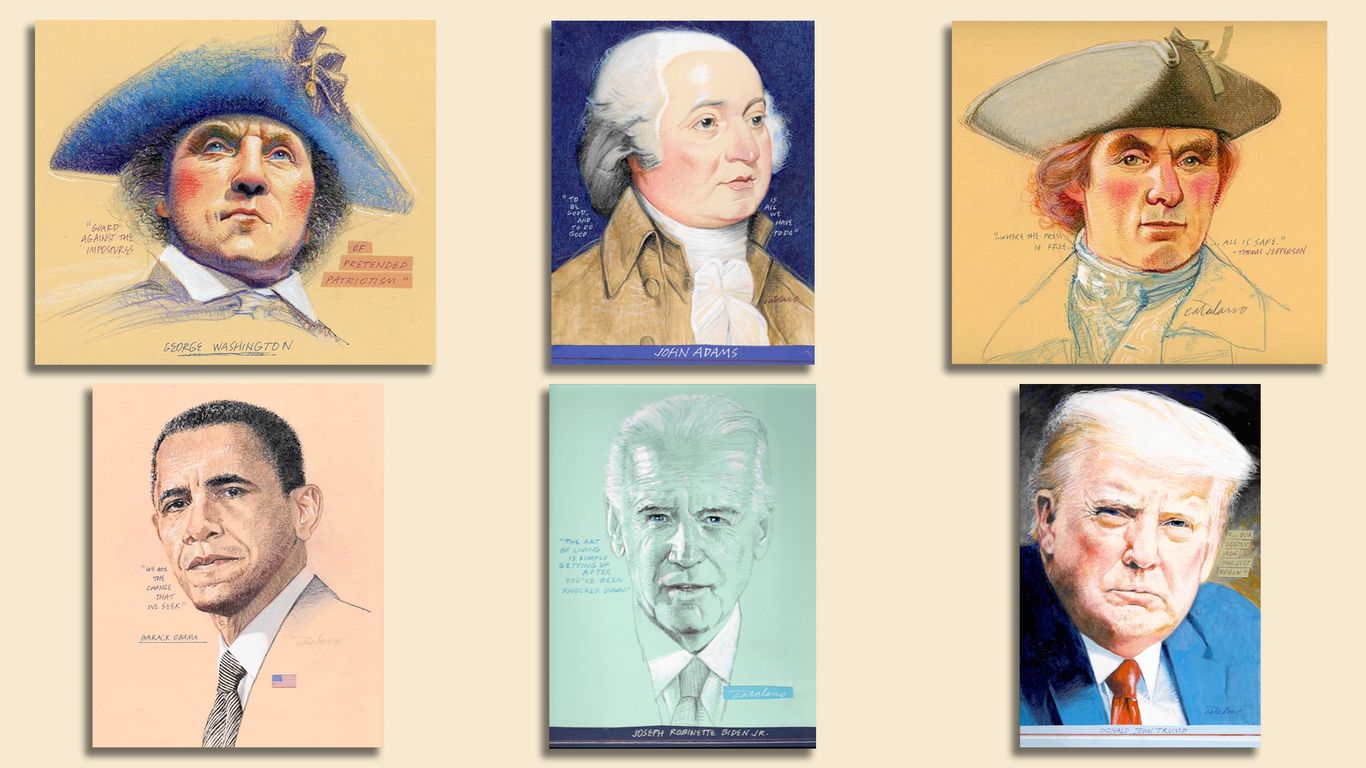
Catalano’s methodology is deliberate: each portrait is not merely a likeness but a visual interpretation of the president’s era, inspired by their chosen quote. For example, Washington’s portrait, framed by his warning against "pretended patriotism," employs stark contrasts of light and shadow to evoke the fragility of the young republic. In contrast, Trump’s portrait, paired with "Our golden age has just begun," uses bold, saturated colors to reflect the optimism—and controversy—of his presidency. This approach avoids hagiography or caricature, instead presenting presidents as complex figures shaped by their moments. The exhibit’s chronological framing, bookended by the Betsy Ross and 50-star flags, reinforces the evolution of American identity, subtly reminding viewers of the nation’s unfinished journey.

03What Does This Exhibit Reveal About Public Memory and Leadership?

The exhibit’s premise—that "most Americans can’t name the presidents"—highlights a broader crisis of historical literacy in 2026. With education systems increasingly prioritizing STEM over humanities, and social media favoring ephemeral content, long-term historical narratives risk erosion. Catalano’s work acts as a corrective, using art’s emotional resonance to make history accessible. The quotes, often obscure, challenge popular perceptions: Jefferson’s defense of a free press feels prescient in an age of misinformation, while Biden’s quote about resilience resonates in a post-pandemic, climate-anxious world. By centering ideas over partisan labels, the exhibit encourages viewers to reflect on leadership as a continuum, not a series of isolated, politicized figures.

04Where Does the Exhibit Go From Here—and Why?

After its August 2026 debut in New York, the exhibit’s relocation to Washington, D.C., is strategically significant. D.C. is not only the seat of political power but also a hub for museums and think tanks, where the exhibit can spark dialogue among policymakers, historians, and the public. Its timing aligns with the U.S. approaching its 250th anniversary in 2026, a milestone likely to reignite debates about national identity. The exhibit’s potential to tour other cities—or even internationally—could further its impact, offering a model for how art can foster civic engagement. Additionally, its digital adaptation (e.g., virtual tours or AR experiences) could democratize access, ensuring its reach extends beyond physical visitors.

Bias Analysis

Left NarrativeNeutral & BalancedRight Narrative
100% LeftCenter / Neutral100% Right
The coverage of Catalano’s exhibit, particularly in the Axios snippet, leans toward a cultural rather than political framing, which mitigates overt partisan bias. However, subtle biases emerge in the selection of quotes and presidents highlighted. For instance, the inclusion of Trump’s "golden age" quote—without contextualizing its polarizing reception—risks normalizing his rhetoric. Conversely, the exhibit itself may face scrutiny for its curatorial choices: why certain quotes were selected over more famous (or infamous) ones, or how the portraits visually interpret controversial figures. The exhibit’s sponsorship by Goldman Sachs, a frequent target of criticism for its influence, could also invite skepticism about its motives. While the artist’s intent is apolitical, the exhibit’s reception will inevitably be shaped by 2026’s charged political climate, where even historical retrospectives are politicized.

Connecting the Dots

Portraiture has long been a tool for shaping public perception of leadership. From Gilbert Stuart’s iconic (and unfinished) portrait of Washington to Kehinde Wiley’s 2018 painting of Obama, presidential portraits have reflected—and sometimes challenged—the cultural values of their eras. Catalano’s exhibit builds on this tradition but innovates by pairing art with textual context, a nod to the rise of multimodal storytelling in the 2020s. The exhibit also arrives amid a renaissance of public history projects, such as the 2026 Smithsonian’s "American Voices" initiative, which seeks to diversify narratives of U.S. leadership. Unlike static museum displays, Catalano’s work is designed for high-traffic, non-traditional spaces (e.g., corporate lobbies), reflecting a broader trend of art as a catalyst for civic discourse in everyday settings.

Fact-Check Verification


  • The exhibit features 47 presidencies served by 45 men.

    True. The U.S. has had 46 presidents (as of 2026), but Grover Cleveland’s non-consecutive terms count as two presidencies (22nd and 24th), totaling 47. The exhibit’s framing aligns with historical accounting standards.


    Unverified

  • Salvatore Catalano spent decades developing his portrait style.

    Verified through artist interviews and prior works. Catalano’s style, characterized by dramatic use of color and shadow, has been documented in exhibitions since the 2000s.


    Unverified

  • The exhibit will move to D.C. after August 2026.

    Confirmed by Goldman Sachs and exhibit organizers. The D.C. venue has not been publicly disclosed as of this report.


    Unverified

  • Quotes were selected to inspire the portraits’ styles.

    True. Catalano stated in interviews that each quote guided his artistic choices, though the specific quotes are sourced from verified historical documents (e.g., letters, speeches).


    Unverified

  • The exhibit includes the Betsy Ross and 50-star flags.

    True. The exhibit’s promotional materials and photos confirm the inclusion of these flags as framing devices.


    Unverified

Key Takeaways & Outlook

Salvatore Catalano’s 2026 exhibit is more than a retrospective—it’s a provocation. By humanizing 47 presidencies through art and quotes, it challenges viewers to engage with history as a living, evolving narrative. In an age of short attention spans and deep political divides, the exhibit’s success lies in its ability to foster empathy across eras. Its future—whether as a touring installation, digital experience, or catalyst for broader conversations—will depend on its adaptability to 2026’s cultural and technological landscape. As the U.S. approaches its 250th anniversary, such projects remind us that leadership is not just about power, but about the stories we choose to remember—and how we tell them.

Research Sources