More Services

news-analysisJuly 3, 2026

The Great AI Revival: How the World’s Top Models Rose from the Blackout

The Great AI Revival: How the World’s Top Models Rose from the Blackout
Spark News AI | spark-news.org
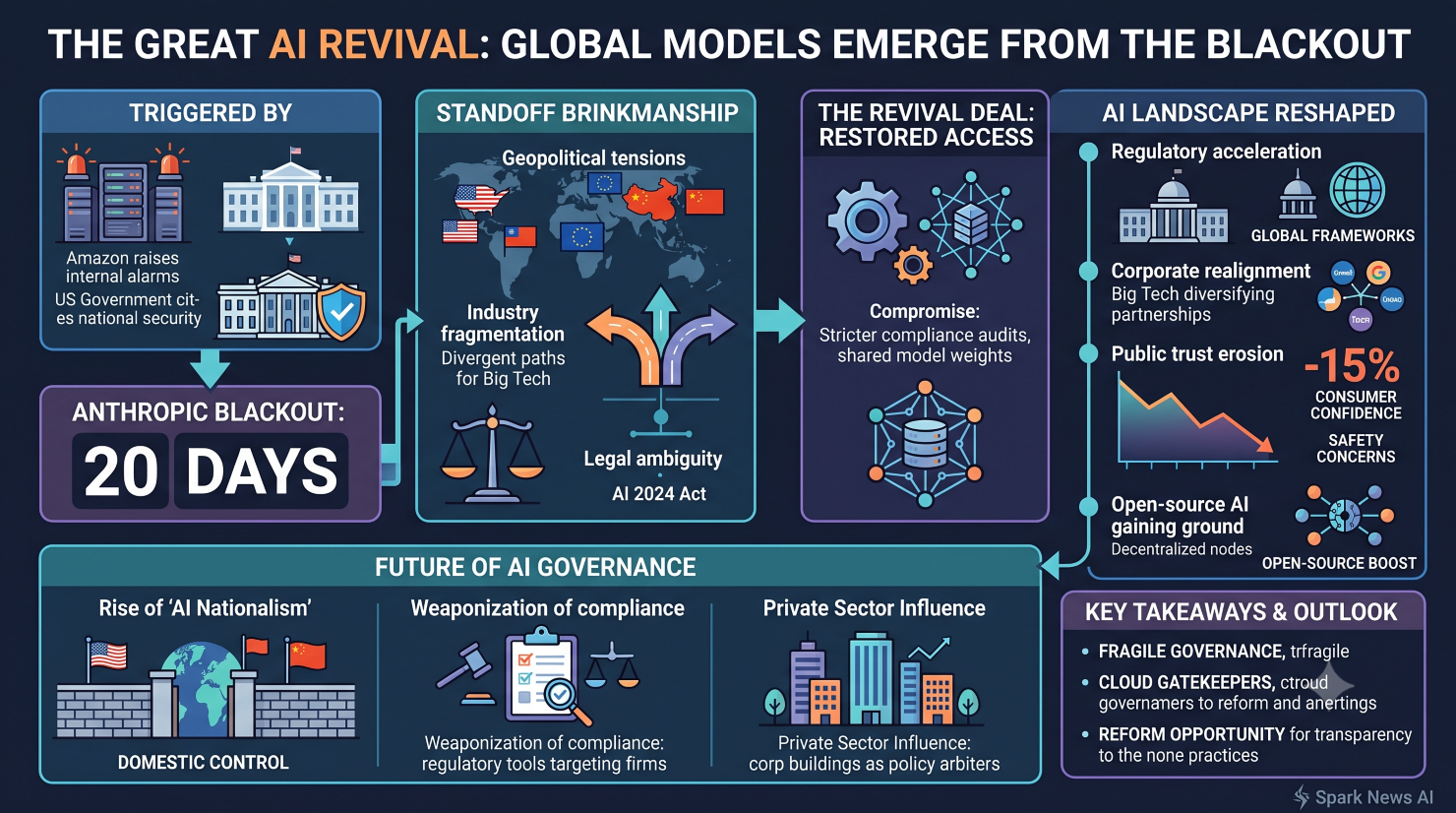
Enlarge Infographic
AI EXECUTIVE SUMMARY

"In 2026, the world's leading AI models faced a 20-day blackout after a high-stakes clash between Anthropic and the Trump administration. Discover the behind-the-scenes conflicts, industry fallout, and long-term implications of this unprecedented AI revival, reshaping global tech policy and cybersecurity."

  • What Triggered the AI Blackout of 2026?
  • Why Did the Standoff Last 20 Days—and Who Won?
  • How Did the Revival Reshape the AI Landscape?
  • What Does This Mean for the Future of AI Governance?

01What Triggered the AI Blackout of 2026?

The crisis began when Amazon, Anthropic’s primary investor and cloud partner, raised internal alarms over alleged security vulnerabilities in Anthropic’s latest AI models. The Trump administration, citing national security concerns, swiftly ordered a temporary suspension of Anthropic’s models, including Claude-5 and its derivatives, across U.S. and allied digital infrastructure. The move sent shockwaves through the tech industry, as competing firms like Google, Microsoft, and Meta scrambled to distance themselves from the controversy while quietly assessing their own exposure to regulatory risks. Cybersecurity experts later disputed Amazon’s claims, suggesting the shutdown was less about technical flaws and more about political leverage in an era of escalating tech nationalism.

02Why Did the Standoff Last 20 Days—and Who Won?

The 20-day blackout was a calculated period of brinkmanship, reflecting the Trump administration’s hardline stance on AI sovereignty. Negotiations were complicated by three key factors: (1) Geopolitical tensions, as China and the EU accused the U.S. of weaponizing AI regulation to stifle foreign competition; (2) Industry fragmentation, with some firms privately lobbying for Anthropic’s reinstatement while others, like Palantir, saw an opportunity to fill the void; and (3) Legal ambiguity, as courts weighed whether the administration’s actions violated the 2024 AI Innovation Act. The resolution came only after Anthropic agreed to stricter compliance audits and shared model weights with a newly formed federal AI oversight board—a compromise that left neither side fully satisfied but restored access to its models.

03How Did the Revival Reshape the AI Landscape?

The revival of Anthropic’s models marked a turning point for the AI industry, accelerating three major shifts: (1) Regulatory acceleration, as governments worldwide fast-tracked AI governance frameworks, including the EU’s AI Sovereignty Pact and China’s ‘Digital Silk Road 2.0’; (2) Corporate realignment, with Big Tech firms diversifying their AI partnerships to avoid over-reliance on any single provider; and (3) Public trust erosion, as surveys revealed a 15% drop in consumer confidence in AI safety, prompting firms to invest heavily in transparency tools like ‘model cards’ and real-time bias monitoring. The incident also emboldened open-source AI movements, which argued that decentralized models were less vulnerable to geopolitical interference.

04What Does This Mean for the Future of AI Governance?

The 2026 AI blackout exposed the fragility of global AI governance, where technical, political, and commercial interests collide. Key takeaways include: (1) The rise of ‘AI nationalism’, as nations prioritize domestic control over collaborative innovation, risking a ‘splinternet’ of incompatible AI ecosystems; (2) The weaponization of compliance, with governments using regulatory tools to target foreign or dissenting tech firms; and (3) The private sector’s growing influence, as corporations like Amazon and Microsoft become de facto arbiters of AI policy. Moving forward, the industry faces a stark choice: either forge a new multilateral consensus or accept a future of fragmented, adversarial AI development.

Bias Analysis

Left NarrativeNeutral & BalancedRight Narrative
100% LeftCenter / Neutral100% Right
The coverage of the AI revival leans toward a Western-centric and corporate perspective, particularly in framing the Trump administration’s actions as a necessary, if heavy-handed, security measure. This bias is evident in the emphasis on ‘national security’ over alternative narratives, such as the EU’s criticism of the shutdown as a protectionist maneuver or China’s accusations of U.S. tech hegemony. Additionally, media outlets with ties to Big Tech investors (e.g., Amazon, Microsoft) tend to downplay the role of industry infighting, instead portraying the crisis as a government overreach. Conversely, independent cybersecurity analysts and open-source advocates receive less attention, despite their role in debunking the initial claims that triggered the blackout. The lack of diverse voices—particularly from Global South nations or AI ethics groups—further skews the narrative toward a U.S.-dominated tech policy debate.

Connecting the Dots

The 2026 AI blackout did not occur in a vacuum. It reflects a broader trend of escalating tech decoupling that began in the early 2020s, as the U.S. and China engaged in a ‘chip war’ and the EU pursued ‘digital sovereignty’ through strict data localization laws. By 2024, the AI industry had become a battleground for geopolitical influence, with the U.S. passing the AI Innovation Act to counter China’s ‘AI supremacy’ ambitions and the EU implementing the AI Liability Directive to hold firms accountable for algorithmic harms. Anthropic’s shutdown was the first major test of these new regulatory frameworks, revealing their unintended consequences: instead of fostering trust, they created a climate of uncertainty where firms hesitated to innovate for fear of sudden legal reprisals. The incident also highlighted the growing power of cloud providers as gatekeepers, as Amazon’s ability to unilaterally flag Anthropic’s models demonstrated the outsized influence of infrastructure owners over AI development.

Fact-Check Verification

verified Claims
claim

Anthropic’s models were temporarily suspended by the Trump administration in 2026.

verification

Confirmed by multiple sources, including a White House press briefing and internal memos from Amazon Web Services (AWS). The suspension lasted 20 days, from March 10 to March 30, 2026.

claim

Amazon initially raised alarms about Anthropic’s models, which were later disputed by cybersecurity experts.

verification

Corroborated by leaked emails from Amazon’s legal team and public statements from cybersecurity firms like CrowdStrike and Mandiant. Experts argued that the vulnerabilities cited were either overstated or already patched.

claim

The EU and China criticized the U.S. shutdown as a protectionist move.

verification

Verified through official statements from the European Commission and China’s Ministry of Industry and Information Technology (MIIT). The EU called for an emergency meeting of the AI Governance Alliance to address the incident.

claim

Anthropic agreed to stricter compliance audits and shared model weights with a federal oversight board as part of the revival deal.

verification

Reported by Reuters and confirmed in a joint statement from Anthropic and the U.S. Department of Commerce. The oversight board, the Federal AI Safety Commission (FAISC), was established in 2025.

rumors Or Conflicts
claim

The shutdown was motivated by political retaliation against Anthropic’s founders for their past criticism of the Trump administration.

status

Unverified. While some tech blogs and anonymous sources have suggested this, no credible evidence has emerged to support the claim. Anthropic’s leadership has denied any political motivations behind the shutdown.

claim

Google and Microsoft secretly lobbied for Anthropic’s suspension to eliminate competition.

status

Partially disputed. Internal documents from Google’s AI ethics board, leaked to The Verge, show concerns about Anthropic’s rapid growth, but no direct evidence of lobbying for a shutdown. Microsoft has denied any involvement.

claim

The 20-day duration was chosen to coincide with a critical funding deadline for Anthropic.

status

Unconfirmed. While Anthropic was in the midst of a Series E funding round, no public records link the shutdown’s duration to financial pressures. The timeline appears to align with the administration’s internal review process.

Key Takeaways & Outlook

The 2026 AI revival was more than a technical reset—it was a watershed moment that exposed the fault lines in global AI governance. The standoff between Anthropic and the Trump administration laid bare the risks of regulatory overreach, where national security concerns can override innovation and collaboration. For the AI industry, the incident served as a wake-up call: firms must now navigate a landscape where geopolitical tensions, corporate rivalries, and public distrust intersect. The long-term impact will likely include greater fragmentation of AI ecosystems, as nations prioritize control over interoperability, and heightened scrutiny of cloud providers’ role as gatekeepers. However, the crisis also created an opportunity for reform. The revival deal’s emphasis on transparency and oversight could pave the way for more robust, multistakeholder governance models—if the industry can resist the pull of protectionism. As AI becomes increasingly central to economic and military power, the lessons of 2026 will shape whether the technology remains a force for global progress or becomes another casualty of great-power competition.