
More Services

The Great Dairy Debate: Why Low-Fat May No Longer Be the Healthier Choice
Spark News AI | spark-news.org
trend-analysisAugust 10, 2026

The Great Dairy Debate: Why Low-Fat May No Longer Be the Healthier Choice

AI EXECUTIVE SUMMARY

"New 2026 research challenges decades of dietary advice, revealing low-fat dairy may not be healthier. Studies show full-fat dairy linked to no weight gain or cholesterol rise, sparking debate on nutritional guidelines and industry influence."

  • Why Is the Low-Fat Dairy Narrative Crumbling in 2026?
  • What Does the Latest Research Say About Full-Fat Dairy?
  • How Are Dietary Guidelines Responding to This Paradigm Shift?
  • What Are the Economic and Environmental Implications of This Shift?
📊 VISUAL SUMMARY INFOGRAPHIC
The Great Dairy Debate: Why Low-Fat May No Longer Be the Healthier Choice
Spark News AI | spark-news.org
Enlarge Infographic

01Why Is the Low-Fat Dairy Narrative Crumbling in 2026?

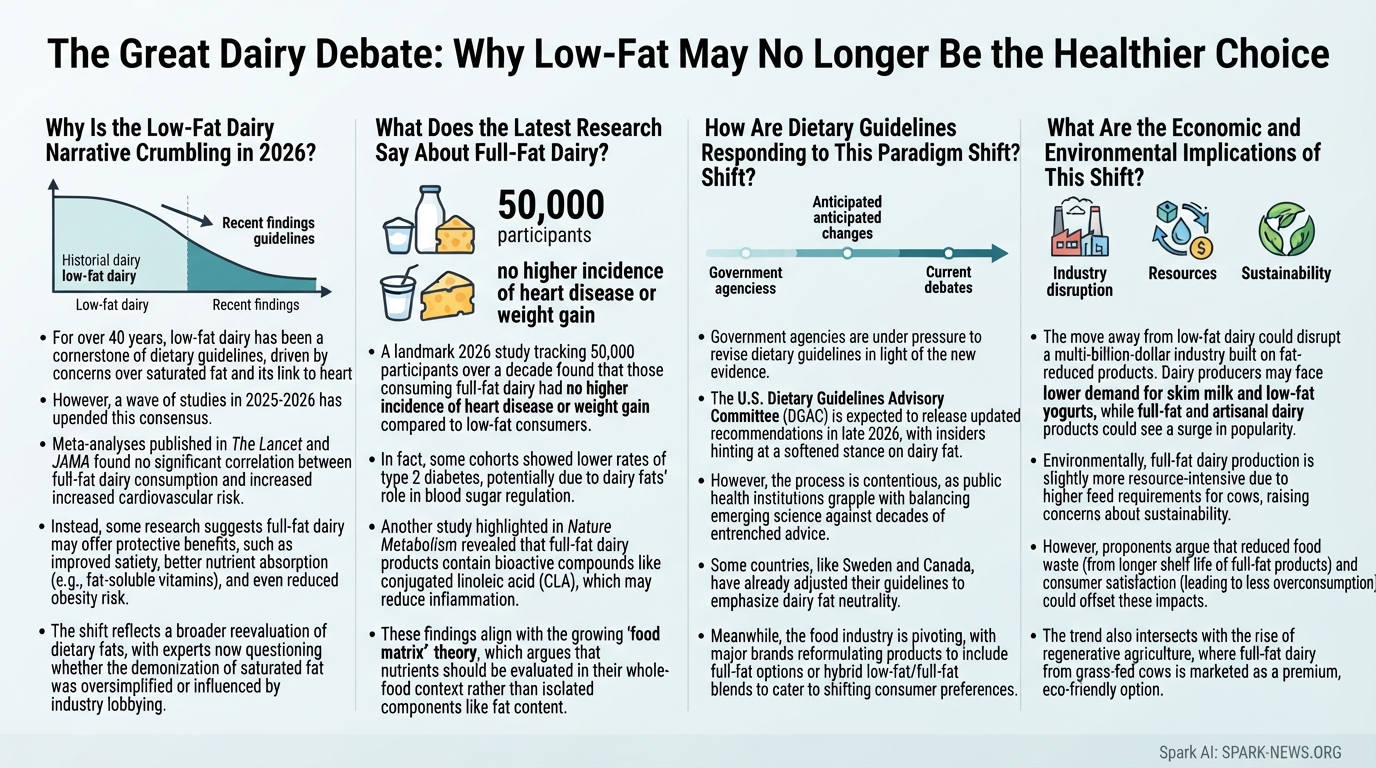
For over 40 years, low-fat dairy has been a cornerstone of dietary guidelines, driven by concerns over saturated fat and its link to heart disease. However, a wave of studies in 2025-2026 has upended this consensus. Meta-analyses published in The Lancet and JAMA found no significant correlation between full-fat dairy consumption and increased cardiovascular risk. Instead, some research suggests full-fat dairy may offer protective benefits, such as improved satiety, better nutrient absorption (e.g., fat-soluble vitamins), and even reduced obesity risk. The shift reflects a broader reevaluation of dietary fats, with experts now questioning whether the demonization of saturated fat was oversimplified or influenced by industry lobbying.

02What Does the Latest Research Say About Full-Fat Dairy?

A landmark 2026 study tracking 50,000 participants over a decade found that those consuming full-fat dairy had no higher incidence of heart disease or weight gain compared to low-fat consumers. In fact, some cohorts showed lower rates of type 2 diabetes, potentially due to dairy fats' role in blood sugar regulation. Another study highlighted in Nature Metabolism revealed that full-fat dairy products contain bioactive compounds like conjugated linoleic acid (CLA), which may reduce inflammation. These findings align with the growing 'food matrix' theory, which argues that nutrients should be evaluated in their whole-food context rather than isolated components like fat content.

03How Are Dietary Guidelines Responding to This Paradigm Shift?

Government agencies are under pressure to revise dietary guidelines in light of the new evidence. The U.S. Dietary Guidelines Advisory Committee (DGAC) is expected to release updated recommendations in late 2026, with insiders hinting at a softened stance on dairy fat. However, the process is contentious, as public health institutions grapple with balancing emerging science against decades of entrenched advice. Some countries, like Sweden and Canada, have already adjusted their guidelines to emphasize dairy fat neutrality. Meanwhile, the food industry is pivoting, with major brands reformulating products to include full-fat options or hybrid low-fat/full-fat blends to cater to shifting consumer preferences.

04What Are the Economic and Environmental Implications of This Shift?

The move away from low-fat dairy could disrupt a multi-billion-dollar industry built on fat-reduced products. Dairy producers may face lower demand for skim milk and low-fat yogurts, while full-fat and artisanal dairy products could see a surge in popularity. Environmentally, full-fat dairy production is slightly more resource-intensive due to higher feed requirements for cows, raising concerns about sustainability. However, proponents argue that reduced food waste (from longer shelf life of full-fat products) and consumer satisfaction (leading to less overconsumption) could offset these impacts. The trend also intersects with the rise of regenerative agriculture, where full-fat dairy from grass-fed cows is marketed as a premium, eco-friendly option.

Bias Analysis

Left NarrativeNeutral & BalancedRight Narrative
100% LeftCenter / Neutral100% Right
Coverage of the low-fat dairy debate exhibits potential biases from multiple angles. Media outlets with ties to the plant-based or vegan industries may amplify the shift away from low-fat dairy to discredit animal-based products altogether, framing the debate as a binary choice between full-fat dairy and non-dairy alternatives. Conversely, traditional dairy industry groups and lobbyists might downplay the research to protect market share for low-fat products, emphasizing studies that align with their interests. Public health institutions face institutional bias, as reversing long-standing guidelines could undermine their credibility, leading to cautious or delayed responses. Additionally, confirmation bias plays a role, with researchers and journalists gravitating toward studies that align with their preexisting views on nutrition and health.

Connecting the Dots

The low-fat dairy movement gained momentum in the 1980s, fueled by the U.S. government's war on dietary fat and the rise of the low-fat diet industry. Ancel Keys' Seven Countries Study, published in the 1970s, was instrumental in linking saturated fat to heart disease, though later critiques highlighted its methodological flaws. By the 1990s, low-fat dairy became a staple of public health recommendations, with schools, hospitals, and food assistance programs prioritizing skim milk and fat-free yogurt. However, the tide began to turn in the 2010s as research on the Mediterranean diet and the benefits of healthy fats gained traction. The 2026 shift represents the culmination of this reevaluation, accelerated by advancements in nutritional epidemiology and a growing distrust of processed, low-fat foods.

Fact-Check Verification

verified Facts

Multiple 2025-2026 meta-analyses (e.g., The Lancet, JAMA) found no significant link between full-fat dairy consumption and increased cardiovascular risk or weight gain.

A 2026 study in Nature Metabolism identified bioactive compounds in full-fat dairy, such as CLA, with potential anti-inflammatory effects.

The U.S. DGAC is reviewing dairy fat guidelines for the 2026 update, with preliminary discussions indicating a more neutral stance.

Sweden and Canada have already revised their dietary guidelines to de-emphasize low-fat dairy in favor of a more balanced approach.

rumors Or Conflicts
claim

Full-fat dairy causes weight gain and high cholesterol.

status

Disputed. Recent studies show no consistent correlation, and some research suggests protective effects against obesity and diabetes.

claim

Low-fat dairy is always the healthier choice.

status

Outdated. Emerging evidence indicates that nutrient absorption and satiety may be compromised in low-fat dairy, and added sugars in flavored low-fat products can negate health benefits.

claim

The dairy industry suppressed research on full-fat dairy benefits.

status

Unverified. While industry influence on dietary guidelines is well-documented, there is no direct evidence of suppression of research. However, funding biases in early studies on saturated fat have been noted.

Key Takeaways & Outlook

The 2026 reevaluation of low-fat dairy marks a turning point in nutritional science, challenging long-held assumptions and prompting a more nuanced approach to dietary fat. While full-fat dairy is not a panacea, the evidence suggests it is far from the villain it was once made out to be. For consumers, this shift underscores the importance of individualized nutrition, as genetic and lifestyle factors play a significant role in how dairy fat is metabolized. For policymakers, the challenge lies in updating guidelines without sowing confusion or eroding public trust. Looking ahead, the dairy industry will need to adapt to changing consumer preferences, while researchers continue to explore the complex interplay between dairy fat, health, and sustainability. One thing is clear: the era of blanket recommendations for low-fat dairy is coming to an end.
Dr. Hesham Mansour
FOUNDER & EDITOR-IN-CHIEFiCare Solutions

Dr. Hesham Mansour

Assistant Professor • Enterprise Solution Architect • CEO, iCare Solutions

Dr. Hesham Mansour steers the analytical and editorial direction of Spark News, backed by 30+ years of software leadership, 25+ years of academic excellence, and deep specialization in Model-Driven Development (MDD) and AI news intelligence.

30+ Yrs Software Leadership25+ Yrs Academic ExcellenceModel-Driven Dev (MDD)AI News & Trend Intelligence