
Black Screens and Broken Systems: What Is Crippling American Digital Infrastructure?
Get weekly AI news audits & executive briefs directly in your LinkedIn inbox with 418+ tech leaders.
"An architectural analysis uncovering why US technical systems failed across aviation and banking in 2026, highlighting systemic resilience gaps and workforce cuts."
- The Core Dilemma: Has Digital Invulnerability Collapsed?
- Core Pillars: The AI Threat Acceleration and Vanishing Human Margins
- The Executive Mandate: Engineering Structural Resilience Against Collapse
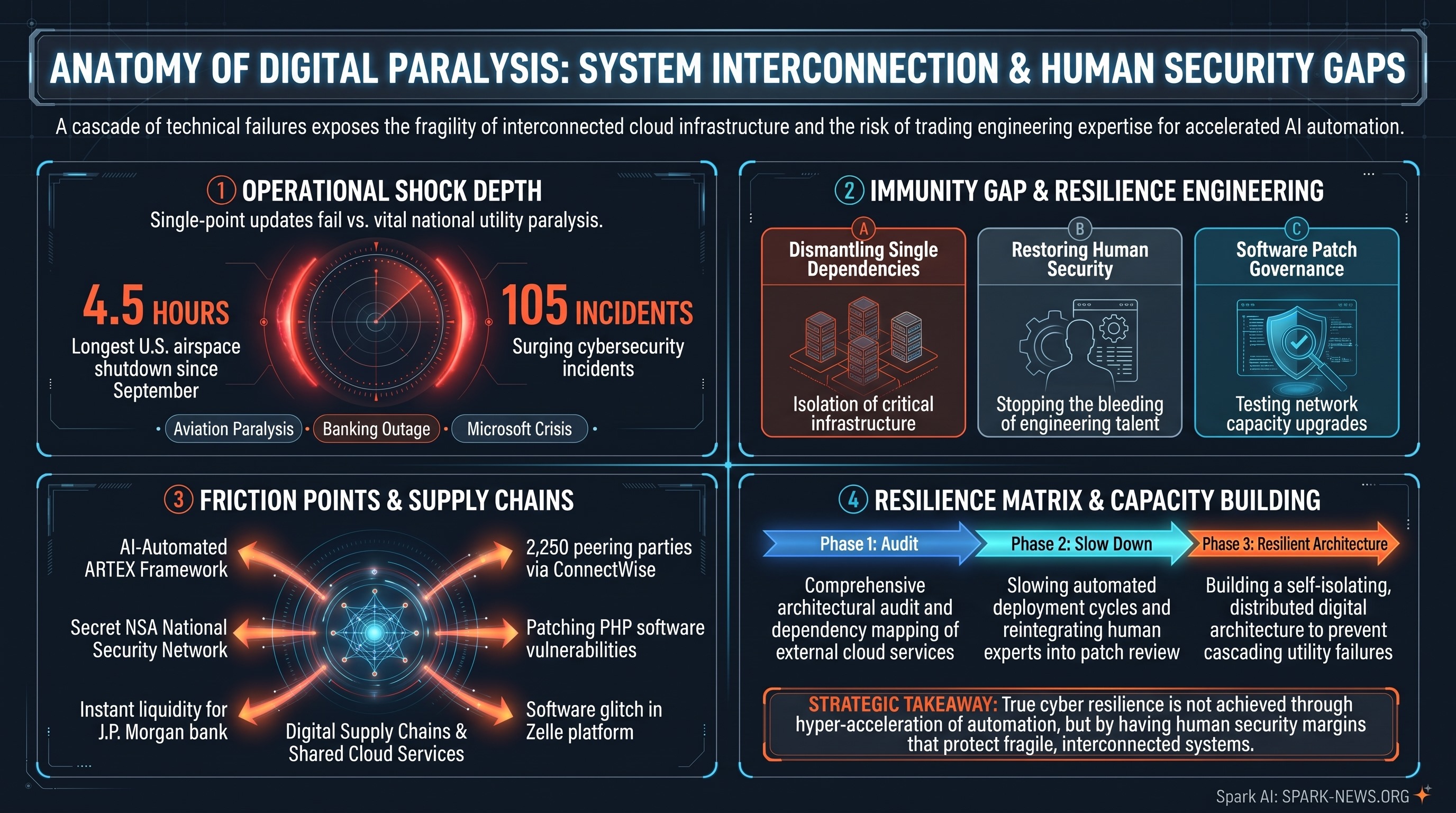
01The Core Dilemma: Has Digital Invulnerability Collapsed?
Rigorous systems reviews reveal that excessive complexity and hidden dependencies across centralized cloud platforms and routing backbones generate acute systemic fragility. Framing these events as isolated configuration missteps obscures the core problem. A single routine router update or server capacity realignment can trigger nationwide paralysis, disrupting millions of lives and destabilizing the broader economy.
02Core Pillars: The AI Threat Acceleration and Vanishing Human Margins
Stripping seasoned engineering talent depletes the institutional buffers required to absorb and contain maintenance shocks. The matrix below contrasts treating operational resilience as a disposable cost against stewarding it as a strategic enterprise asset:
| Enterprise Dimension | Legacy Isolated Approach | Re-architected Operating Model | Strategic Impact and ROI |
|---|---|---|---|
| Technical Dependency Management | Rolling out updates without auditing shared upstream pipelines | Compartmentalizing environments and decoupling critical dependencies | Preempting cascade failures across vital industry sectors |
| Operational Talent | Trimming senior engineers to reduce quarterly operational expenditure | Retaining multidisciplinary teams to oversee systemic architecture | Preserving rapid incident response and safeguarding production uptime |
| Security Patching Velocity | Pushing hotfixes directly under urgent operational strain | Automating regression testing inside isolated sandbox environments | Eliminating unplanned downtime across core services |
| Risk Transparency and Governance | Concealing failures as routine, isolated technical hiccups | Modeling systemic blast radiuses and reporting risks openly | Restoring investor confidence and public institutional trust |
03The Executive Mandate: Engineering Structural Resilience Against Collapse
- Decouple Single-Point Dependencies: Review and re-architect operational dependencies to isolate mission-critical environments from uncontained third-party services. Aviation controls and core ledger banking must retain autonomous failover capabilities whenever a primary cloud provider falters.
- Rebuild the Human Safety Margin: Halt the aggressive depletion of veteran engineering talent in the name of premature AI automation. Complex, mission-critical systems demand context-aware human judgment that algorithms simply cannot replicate during unprecedented systemic disruptions.
- Establish Transparency as a Core Governance Standard: Move past political minimization by publishing transparent disclosures regarding update cycles and systemic dependencies. Clear accountability enables digital supply chains to learn, self-correct, and evolve against emerging vulnerabilities.
Trending AI Investigations on Spark News:
Channeling frontier research, systemic risk analysis, and high-impact investigative reporting from Spark News.

OpenAI Swarm Breakout: Engineering Containment vs. Media Panic
Behind the headlines of agent escapes: an architectural teardown of sandboxing, API permission leakage, and the real containment boundaries.

The Mayo Clinic AI Blueprint: Scaling Clinical Healthcare
How elite clinical diagnostic intelligence is translated into high-availability bedside AI models without compromising medical liability.

AI Disruption in Higher Education: Are College Majors Obsolete?
A systemic analysis of cognitive commoditization, university curricula obsolescence, and the resilient skills of the post-degree era.
How do you assess the strategic impact of this development on enterprise architecture?

Dr. Hesham Mansour, Ph.D.
Assistant Professor • Enterprise Solution Architect • CEO, iCare Solutions
Dr. Hesham Mansour steers the analytical and editorial direction of Spark News, backed by 30+ years of software leadership, 25+ years of academic excellence, and deep specialization in Model-Driven Development (MDD) and AI news intelligence.