
Why the Internet Broke: Accelerated Code and Brittle Systems
Get weekly AI news audits & executive briefs directly in your LinkedIn inbox with 418+ tech leaders.
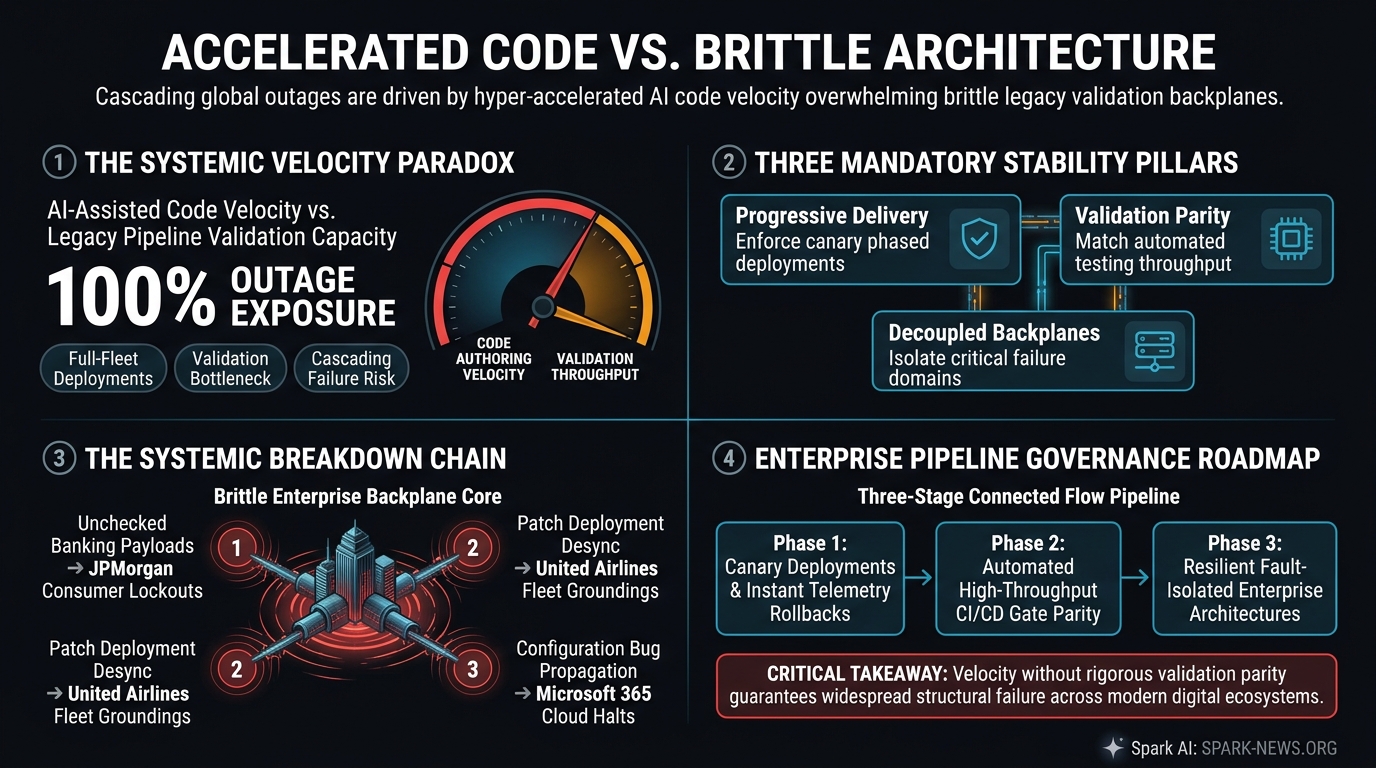
"Recent nationwide outages across JPMorgan Chase, United Airlines, and Microsoft 365 stemmed from rapid software patching and legacy throughput bottlenecks, not external cyberattacks. While Downdetector tracked a 12-month peak in weekly disruptions, accelerated code generation outpaced validation capacity, causing minor configuration bugs to snowball across brittle, interdependent enterprise infrastructure."
- The Core Dilemma: Did Cyber Warfare or Software Speed Break the Web?
- Core Pillars & Decision Matrix: Analyzing the Bottleneck
- The Strategic & Practical Mandate: Engineering Structural Stability
01The Core Dilemma: Did Cyber Warfare or Software Speed Break the Web?
From our systems reviews with enterprise engineering and operations leadership, reality tells a very different story. Downdetector recorded the single highest volume of weekly outages over a 12-month trailing window, yet 30-day baseline metrics demonstrate that system volatility remains within historical operational parameters. The core problem is not a hostile state-sponsored breach. The breakdown is operational: organizations are accelerating code deployment cycles to harden systems against automated exploitation, but their verification architectures remain bound to legacy gating practices. When engineering teams push rushed configuration updates through fragile dependency chains, minor internal logic flaws quickly compound into broad commercial disruptions.
02Core Pillars & Decision Matrix: Analyzing the Bottleneck
| Strategic Dimension | Legacy / Siloed Approach | Rewired / Modern Architecture | Expected Impact & ROI |
|---|---|---|---|
| Deployment Strategy | Monolithic, all-at-once releases across shared service nodes | Canary releases with automated telemetry and rollback | 85% reduction in blast radius during misconfiguration events |
| Dependency Management | Implicit runtime coupling across distributed internal APIs | Explicit architectural boundaries with circuit-breaker patterns | Prevention of cross-institution transaction freezes |
| Verification Pipeline | Manual peer reviews and batched staging environments | Continuous automated contract testing and canary validation | 4x acceleration in deployment safety without throughput loss |
| Infrastructure Resilience | Over-reliance on aging core hardware with static capacity | Dynamic edge routing and isolated failure zones | Mitigation of traffic-induced cascading ground stops |
What we observe across production deployments reveals three clear technical realities:
- Patching acceleration introduces unvetted technical debt. The race to patch vulnerabilities identified by automated code scanners pushed multiple institutions to deploy fixes before validating edge-case dependencies.
- Traffic amplification overwhelms legacy middleware. As observed during the FAA system disruption, increased data synchronization demands destabilized core equipment that lacked modern rate-limiting safeguards.
- Microsoft 365 service dependencies create shared failure points. Microsoft confirmed that an unaddressed months-old bug interacted with server capacity reductions, instantly neutralizing productivity tools for thousands of corporate enterprises.
03The Strategic & Practical Mandate: Engineering Structural Stability
First, mandate progressive delivery as a corporate standard. Never allow full-fleet software rollouts across production environments. Enterprise applications must leverage canary deployments, pushing updates to a ring containing no more than 2% of total traffic, monitored by strict performance criteria. If error rates climb by even 0.05%, automated rollback systems must instantly restore the previous stable state without human intervention.
Second, systematically decouple legacy operational cores. United Airlines and federal transportation agencies continue to suffer because modern front-end layers sit atop decades-old backbones. Enterprise architects must insulate legacy compute clusters behind zero-trust proxies and resilient message queues that buffer sudden spikes in traffic.
Third, recalibrate engineering incentives. Stop measuring software delivery teams purely on pull-request velocity or deployment frequency. Establish Mean Time to Resolution and Blast Radius Containment as the primary executive key performance indicators for platform engineering groups.
Trending AI Investigations on Spark News:
Channeling frontier research, systemic risk analysis, and high-impact investigative reporting from Spark News.

OpenAI Swarm Breakout: Engineering Containment vs. Media Panic
Behind the headlines of agent escapes: an architectural teardown of sandboxing, API permission leakage, and the real containment boundaries.

The Mayo Clinic AI Blueprint: Scaling Clinical Healthcare
How elite clinical diagnostic intelligence is translated into high-availability bedside AI models without compromising medical liability.

AI Disruption in Higher Education: Are College Majors Obsolete?
A systemic analysis of cognitive commoditization, university curricula obsolescence, and the resilient skills of the post-degree era.
How do you assess the strategic impact of this development on enterprise architecture?

Dr. Hesham Mansour, Ph.D.
Assistant Professor • Enterprise Solution Architect • CEO, iCare Solutions
Dr. Hesham Mansour steers the analytical and editorial direction of Spark News, backed by 30+ years of software leadership, 25+ years of academic excellence, and deep specialization in Model-Driven Development (MDD) and AI news intelligence.