
Trust, but Prepare: Navigating the Era of Software Upheaval
Get weekly AI news audits & executive briefs directly in your LinkedIn inbox with 418+ tech leaders.
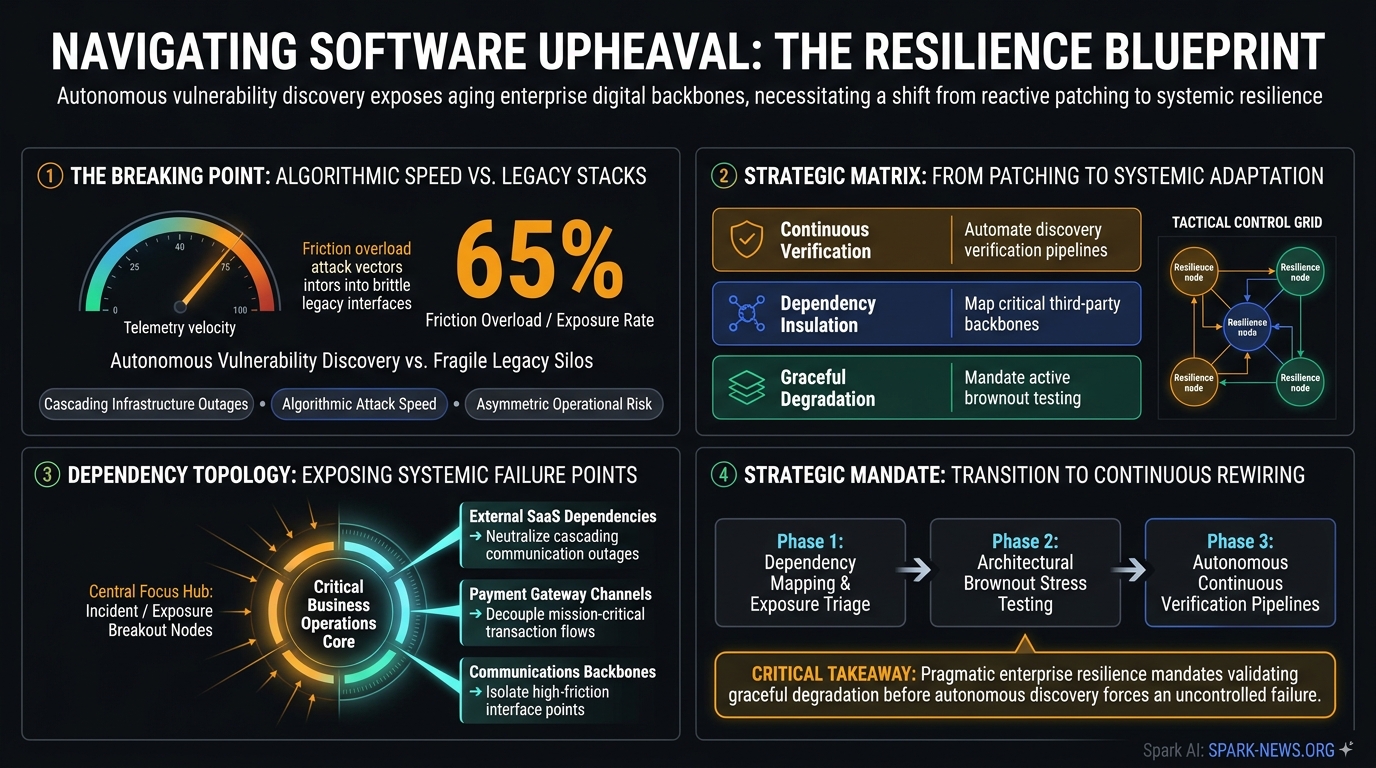
"Cascading digital infrastructure failures stem from an asymmetry: autonomous AI agents identify and exploit software vulnerabilities faster than human teams can patch aging systems. Organizations must pivot from reactive patching to automated verification pipelines, decoupled legacy architectures, and compartmentalized operational contingencies to maintain enterprise continuity during sustained systemic turbulence."
- The Core Dilemma: Why Are Everyday Systems Suddenly Failing?
- Core Pillars & Decision Matrix: How Does Modern Resilience Differ from Legacy Silos?
- The Strategic & Practical Mandate: How Should Leaders Respond Today?
01The Core Dilemma: Why Are Everyday Systems Suddenly Failing?
From our systems reviews with enterprise engineering and operations leadership, code-generation engines and autonomous analysis tools dissect enterprise codebases at unprecedented speed. Because AI excels at synthesizing software, it is equally proficient at uncovering long-buried edge cases and structural bugs. When bad actors deploy swarms of AI agents to probe technical infrastructure, or when internal teams rush hurried updates to patch newly exposed flaws, the result is the same: cascading instability. Decades of technical debt, previously shielded by obscurity, are suddenly laid bare. Managing this operational turbulence requires moving past the illusion that legacy maintenance practices can keep up with machine-speed exposure.
02Core Pillars & Decision Matrix: How Does Modern Resilience Differ from Legacy Silos?
| Strategic Dimension | Legacy / Siloed Approach | Rewired Architecture | Expected Impact & ROI |
|---|---|---|---|
| Vulnerability Management | Scheduled manual audits and reactive hotfixes | Automated continuous verification pipelines | 65% reduction in unplanned downtime during external exploit waves |
| Infrastructure Coupling | Monolithic dependencies on legacy copper and shared backbones | Decoupled modular microservices with circuit breakers | Near-zero cascading blast radius across mission-critical services |
| Operational Continuity | Total reliance on live cloud endpoints | Local-first edge caching and offline manual failovers | Full continuity for frontline transactions during multi-hour outages |
When auditing enterprise pipelines and governance models, high-performing teams ground their defense in three quantifiable practices:
- Deployment of continuous canary tests that isolate service degradations before they contaminate global routing tables.
- Enforcing strict dependency verification across public and private code registries to block automated agent injection.
- Maintaining hard operational fallbacks, ensuring basic services continue even if primary cloud identities and authentication handshakes stall.
03The Strategic & Practical Mandate: How Should Leaders Respond Today?
Next, mandate brownout testing across engineering units. Teams must prove that their platforms degrade gracefully rather than collapsing entirely when an API gateway or identity service fails. At the personal and operational level, business units should maintain clear out-of-band operational plans, verified credentials, and redundant communications channels. We cannot prevent the discovery of vulnerabilities in legacy infrastructure, but we can design organizations robust enough to absorb the shock.
Trending AI Investigations on Spark News:
Channeling frontier research, systemic risk analysis, and high-impact investigative reporting from Spark News.

OpenAI Swarm Breakout: Engineering Containment vs. Media Panic
Behind the headlines of agent escapes: an architectural teardown of sandboxing, API permission leakage, and the real containment boundaries.
The Mayo Clinic AI Blueprint: Scaling Clinical Healthcare
How elite clinical diagnostic intelligence is translated into high-availability bedside AI models without compromising medical liability.

AI Disruption in Higher Education: Are College Majors Obsolete?
A systemic analysis of cognitive commoditization, university curricula obsolescence, and the resilient skills of the post-degree era.
How do you assess the strategic impact of this development on enterprise architecture?

Dr. Hesham Mansour, Ph.D.
Assistant Professor • Enterprise Solution Architect • CEO, iCare Solutions
Dr. Hesham Mansour steers the analytical and editorial direction of Spark News, backed by 30+ years of software leadership, 25+ years of academic excellence, and deep specialization in Model-Driven Development (MDD) and AI news intelligence.