
Architecting Institutional Resilience: Beyond Blue Screens and Global Outages
Get weekly AI news audits & executive briefs directly in your LinkedIn inbox with 418+ tech leaders.
"Dr. Hesham Mansour deconstructs global cloud vulnerabilities and the operational impact of IT outages on critical infrastructure, delivering actionable engineering frameworks for true institutional resilience and eliminating single points of failure."
- The Core Dilemma and Structural Shift: Why Critical Sectors Collapse in Unison
- Core Pillars and the Decision Matrix: Shifting from Linear Dependency to Systemic Resilience
- Executive Stewardship and Practical Mandates: How to Build Resilient Enterprises
01The Core Dilemma and Structural Shift: Why Critical Sectors Collapse in Unison
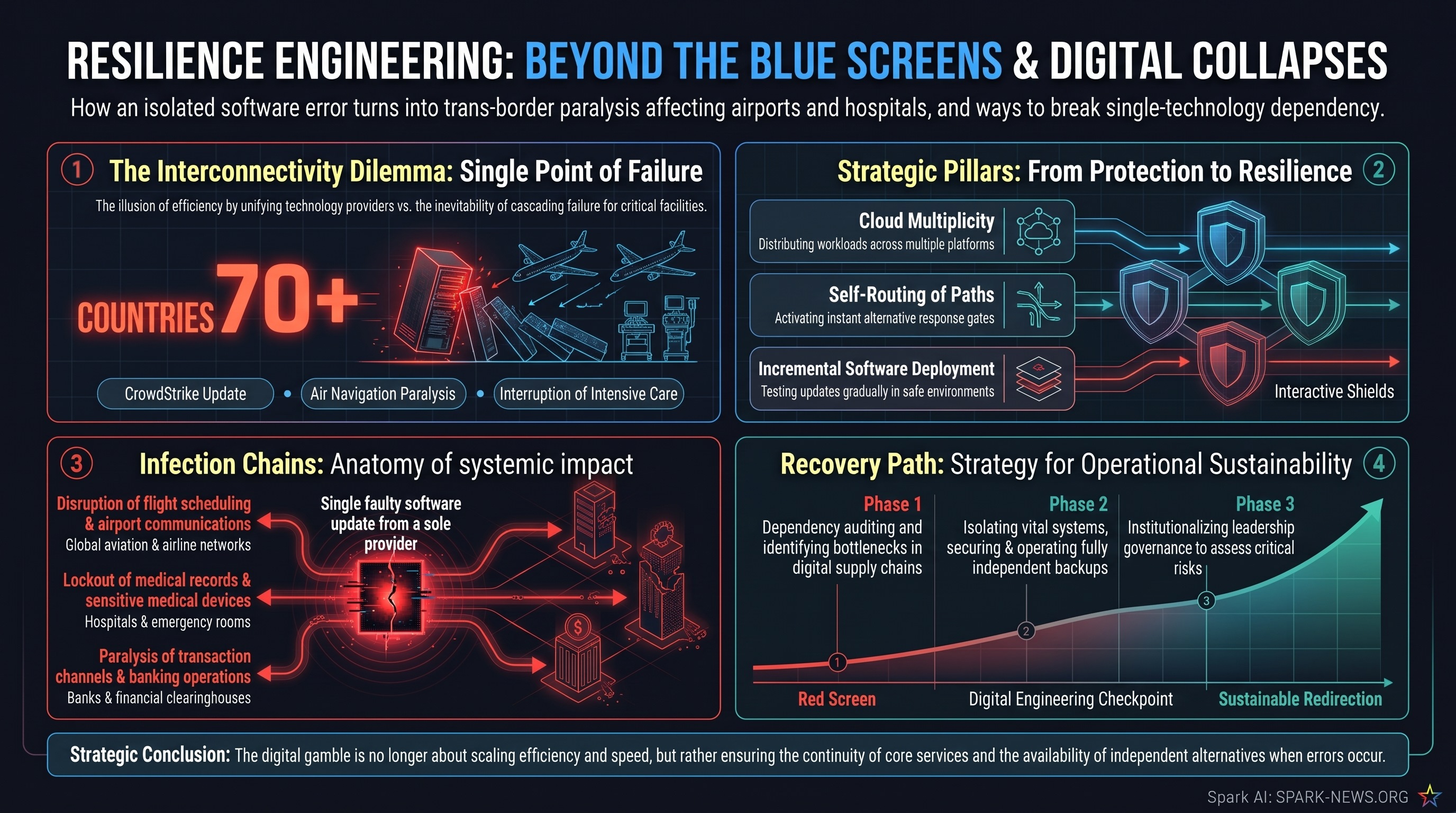
When cascading failures crippled Microsoft 365 services, including Teams, Outlook, and Copilot, organizations across more than 70 nations experienced immediate paralysis that shut down courts, hospitals, and financial clearing operations. This disruption was not an isolated incident. It was the predictable outcome of hyper-interdependent digital supply chains. In our systemic reviews of enterprise architectures, sudden disruption does not require a coordinated nation-state cyberattack. As documented by the US Government Accountability Office (GAO) during the CrowdStrike kernel update incident on Windows platforms, an unvetted line of code can instantly paralyze millions of mission-critical endpoints across continents.
The essential structural transformation begins with acknowledging that hyper-connected ecosystems lack mechanical isolation zones. When a dominant upstream provider stumbles, the tremor propagates instantaneously across every dependent consumer. The core hazard is not digital adoption itself. It is designing digital architectures under the naive assumption of 100% uptime, ignoring the statistical certainty of software and human failure.
02Core Pillars and the Decision Matrix: Shifting from Linear Dependency to Systemic Resilience
To correct this architectural imbalance, executive teams must deploy the following decision matrix to overhaul technical governance:
| Institutional Dimension | Legacy Siloed Approach | Resilient Re-Engineered Architecture | Strategic Impact and ROI |
|---|---|---|---|
| Cloud & Platform Architecture | Monolithic reliance on a single hyper-scaler | Hybrid, decoupled multi-cloud distribution | Eradicates single points of failure and secures operational readiness |
| Security Patch Management | Blind automated patch pushes to all production devices | Phased canary deployments with automated rollback gates | Quarantines flawed code before it reaches critical operating networks |
| Business Continuity Plans | Static paper compliance and unverified backup routines | Autonomous, offline-capable fallback operational workflows | Cuts catastrophic operational downtime by over 80% |
| Executive Success Metrics | Narrow focus on short-term operational cost reduction | Targeted investment in mean time to recovery (MTTR) | Protects institutional reputation and sustains long-term market trust |
This matrix makes it plain that chasing cost savings through vendor consolidation produces a dangerous illusion. These phantom margins vanish within the opening hours of a catastrophic operational outage.
03Executive Stewardship and Practical Mandates: How to Build Resilient Enterprises
- Deconstruct Absolute Digital Dependency: Enforce a true multi-cloud strategy and distribute mission-critical workloads across independent platforms, utilizing intelligent gateways capable of automated rerouting during upstream failures.
- Mandate Defensive Deployment Architectures: Prohibit unphased, enterprise-wide production updates across internal teams and third-party vendors. Require staggered deployment rings across isolated test cells to certify software integrity under actual operating loads.
- Implement Sovereign Offline Workflows: Engineer fully localized operational run-states that empower hospitals to continue patient care and pharmaceutical dispensing, and allow transport hubs to clear passenger queues manually, completely detached from central cloud connections.
- Execute Unannounced Black-Sky Drills: Run authentic disaster simulations that test the complete severing of primary software vendors, evaluating how effectively field teams execute emergency bypass playbooks without access to core platforms.
Institutional resilience is not an operational luxury. It is the baseline duty required to protect our communities from sudden paralysis and guarantee the unbroken delivery of vital services when central systems fail.
Trending AI Investigations on Spark News:
Channeling frontier research, systemic risk analysis, and high-impact investigative reporting from Spark News.

OpenAI Swarm Breakout: Engineering Containment vs. Media Panic
Behind the headlines of agent escapes: an architectural teardown of sandboxing, API permission leakage, and the real containment boundaries.

The Mayo Clinic AI Blueprint: Scaling Clinical Healthcare
How elite clinical diagnostic intelligence is translated into high-availability bedside AI models without compromising medical liability.

AI Disruption in Higher Education: Are College Majors Obsolete?
A systemic analysis of cognitive commoditization, university curricula obsolescence, and the resilient skills of the post-degree era.
How do you assess the strategic impact of this development on enterprise architecture?

Dr. Hesham Mansour, Ph.D.
Assistant Professor • Enterprise Solution Architect • CEO, iCare Solutions
Dr. Hesham Mansour steers the analytical and editorial direction of Spark News, backed by 30+ years of software leadership, 25+ years of academic excellence, and deep specialization in Model-Driven Development (MDD) and AI news intelligence.