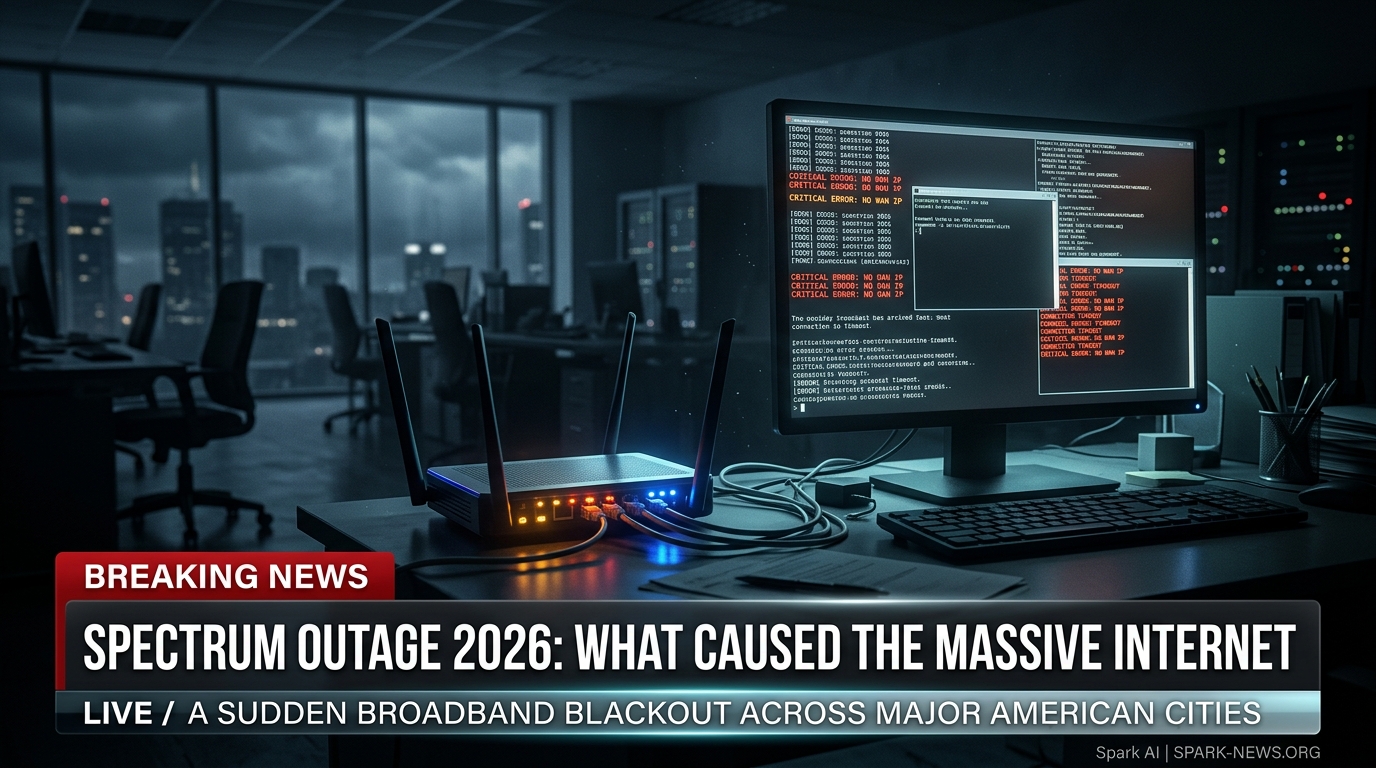
Why Did Spectrum Go Dark? Inside the Tech Outage Shaking Millions
Get weekly AI news audits & executive briefs directly in your LinkedIn inbox with 418+ tech leaders.
"The 2026 Spectrum outage cut internet and phone services across multiple US regions, leaving over 100,000 reported users offline on Downdetector within hours. Triggered by upstream fiber cuts and core routing failures, the disruption hit remote workers, local businesses, and municipal emergency services simultaneously."
- What Just Happened?
- How the Internet & News Are Reacting
- The Backstory You Need to Know
- Why This Matters & What's Next
01What Just Happened?
The disruption hit everyday life where it hurts most. Small business point-of-sale registers froze mid-transaction, hospital admin desks scrambled to switch to backup radios, and countless remote workers suddenly dropped from live corporate meetings. What initially looked like a routine neighborhood glitch quickly morphed into a multi-state crisis.
02How the Internet & News Are Reacting
| Issue Dimension | Viral Social Perception | Ground Reality |
|---|---|---|
| Root Cause | Widespread speculation of coordinated cyberattacks | Fiber line cuts and upstream backbone routing configuration errors |
| Customer Impact | Assumed to be isolated strictly to residential video streaming | Severely disrupted payment systems, small retail counters, and emergency call centers |
| Restoration Speed | Expected instant hotfix within 30 minutes | Required manual field crew dispatch and cascading DNS re-propagation over 8 hours |
| Accountability | Demand for immediate customer cash refunds | Standard carrier policies offer tiny prorated bill credits only upon manual request |
03The Backstory You Need to Know
Modern telecommunications rely on physical fiber trunk lines buried alongside public highways, paired with complex border gateway routing protocols. When an infrastructure contractor clips a key fiber bundle or a centralized software update misroutes traffic, the blast radius ripples far beyond a single zip code. The cascading nature of these systems means a local physical fault can easily cause regional gridlock.
04Why This Matters & What's Next
Regulators at the Federal Communications Commission (FCC) are facing renewed pressure from consumer advocacy coalitions to mandate stricter redundancy protocols and automatic compensation rules for prolonged downtime. Moving forward, businesses and households alike are accelerating investments in secondary cellular failovers to avoid being stranded by a single point of failure.
Bias Analysis
Connecting the Dots
Fact-Check Verification
- Over 100,000 incident reports flooded Downdetector within the opening two hours of the blackout.
- Critical services including municipal 911 transfer desks and retail payment gateways faced hours of downtime.
- Upstream routing errors and physical trunk line disruptions accounted for the prolonged recovery window.
- Consumer advocacy groups are pushing the FCC for mandatory automatic customer credits after major network blackouts.
Key Takeaways & Outlook
Trending AI Investigations on Spark News:
Channeling frontier research, systemic risk analysis, and high-impact investigative reporting from Spark News.

OpenAI Swarm Breakout: Engineering Containment vs. Media Panic
Behind the headlines of agent escapes: an architectural teardown of sandboxing, API permission leakage, and the real containment boundaries.

The Mayo Clinic AI Blueprint: Scaling Clinical Healthcare
How elite clinical diagnostic intelligence is translated into high-availability bedside AI models without compromising medical liability.

AI Disruption in Higher Education: Are College Majors Obsolete?
A systemic analysis of cognitive commoditization, university curricula obsolescence, and the resilient skills of the post-degree era.
How do you assess the strategic impact of this development on enterprise architecture?

Dr. Hesham Mansour, Ph.D.
Assistant Professor • Enterprise Solution Architect • CEO, iCare Solutions
Dr. Hesham Mansour steers the analytical and editorial direction of Spark News, backed by 30+ years of software leadership, 25+ years of academic excellence, and deep specialization in Model-Driven Development (MDD) and AI news intelligence.