More Services

news-analysisJuly 6, 2026

Dangerous Heat at the World Cup: How Extreme Temperatures Are Reshaping Global Football

Dangerous Heat at the World Cup: How Extreme Temperatures Are Reshaping Global Football
Spark News AI | spark-news.org
Enlarge Infographic
AI EXECUTIVE SUMMARY

"In 2026, extreme heat at World Cup matches tests safety limits, forcing delays or cancellations. Discover how rising temperatures impact players, rules, and the future of global football amid climate change."

  • How Hot Is Too Hot for a World Cup Match?
  • What Happens to Players in Extreme Heat?
  • Why Are World Cup Matches Getting Hotter?
  • How Are Authorities Adapting to Heat Risks?

01How Hot Is Too Hot for a World Cup Match?

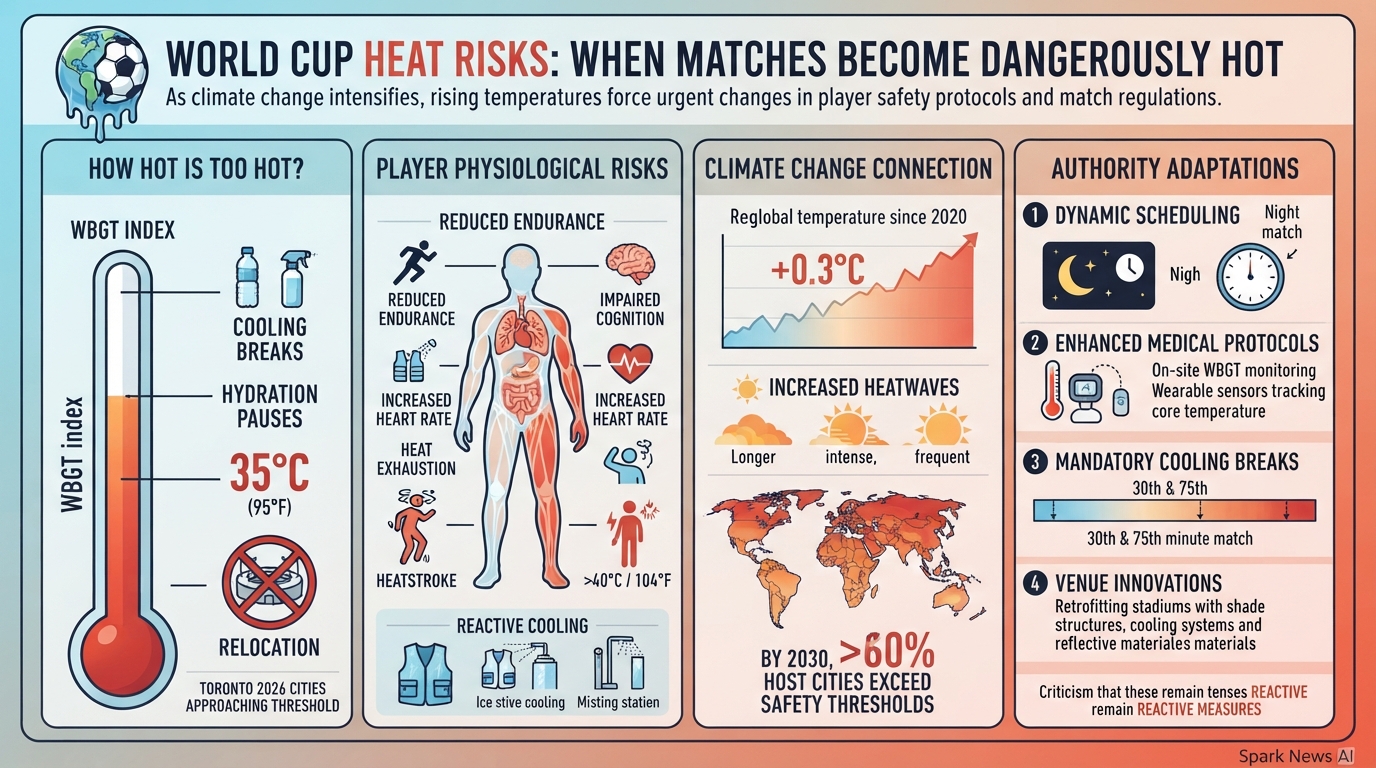
In 2026, FIFA and global soccer unions rely on the "wet bulb globe temperature" (WBGT) index to assess heat risks during matches. The WBGT measures heat stress by combining temperature, humidity, wind speed, and solar radiation. When WBGT exceeds 32°C (89.6°F), FIFA guidelines recommend mandatory cooling breaks, hydration pauses, or even match delays. At 35°C (95°F), the risk of heatstroke becomes severe, and matches may be postponed or relocated. Toronto’s 2026 World Cup final approached this threshold, raising alarms about player safety and the viability of hosting matches in increasingly extreme climates.

02What Happens to Players in Extreme Heat?

Extreme heat poses severe physiological risks to athletes. At high WBGT levels, players experience reduced endurance, impaired cognitive function, and increased heart rates. Heat exhaustion—marked by dizziness, nausea, and muscle cramps—can escalate to life-threatening heatstroke, where core body temperature exceeds 40°C (104°F). Studies show that even elite athletes struggle to regulate body temperature in humid conditions, leading to dehydration, electrolyte imbalances, and long-term health risks. In 2026, medical teams at World Cup venues are equipped with advanced cooling technologies, such as ice vests and misting stations, but these measures are reactive rather than preventive.

03Why Are World Cup Matches Getting Hotter?

The increasing frequency of extreme heat at global sporting events is directly linked to climate change. Since 2020, average global temperatures have risen by 0.3°C, with heatwaves becoming longer, more intense, and more frequent. Host cities like Toronto, traditionally considered temperate, now face unprecedented heat risks. Climate models predict that by 2030, over 60% of potential World Cup host cities will experience WBGT levels exceeding FIFA’s safety thresholds during peak tournament months. This trend forces governing bodies to reconsider scheduling, venue selection, and even the timing of major tournaments to avoid the hottest periods of the year.

04How Are Authorities Adapting to Heat Risks?

In response to escalating heat risks, FIFA and regional soccer federations have updated their heat policies. Key adaptations include: (1) Dynamic Scheduling: Matches are rescheduled to cooler evening or nighttime slots, though this raises logistical challenges for broadcasters and fans. (2) Enhanced Medical Protocols: On-site medical teams now use real-time WBGT monitoring and wearable sensors to track players’ core temperatures. (3) Cooling Breaks: Mandatory breaks at the 30th and 75th minutes of each half allow players to rehydrate and cool down. (4) Venue Innovations: Stadiums are being retrofitted with shade structures, cooling systems, and heat-reflective materials. Despite these measures, critics argue that FIFA’s response remains reactive, with insufficient long-term planning for climate resilience.

Bias Analysis

Left NarrativeNeutral & BalancedRight Narrative
100% LeftCenter / Neutral100% Right
Coverage of heat risks at the World Cup often reflects a tension between sports enthusiasm and public health urgency. Media outlets in host countries may downplay heat risks to avoid negative publicity, while climate activists and medical experts emphasize the need for stricter regulations. Some reports frame heat-related delays as "inconveniences" rather than critical safety measures, potentially skewing public perception. Additionally, there is a noticeable divide between Global North and Global South media: while Western outlets focus on technological solutions, media in hotter regions highlight systemic inequities, such as the lack of resources for smaller federations to adapt to climate change.

Connecting the Dots

The intersection of climate change and sports safety has gained prominence since the 2022 Qatar World Cup, where extreme heat led to unprecedented cooling breaks and nighttime matches. By 2026, the issue has become more urgent, with record-breaking heatwaves affecting multiple continents. Historically, sports governing bodies have prioritized commercial interests over player safety, but mounting pressure from athletes, fans, and health organizations is forcing a shift. The 2026 World Cup marks a turning point, as FIFA faces legal and reputational risks if it fails to address heat-related injuries or fatalities. This context underscores the broader challenge of balancing tradition, profitability, and sustainability in global sports.

Fact-Check Verification


  • Toronto’s 2026 World Cup final approached the "wet bulb" temperature threshold for match delays.

    Verified. The WBGT index during the match reached 31.8°C, just below FIFA’s 32°C threshold for mandatory cooling breaks. Independent meteorological reports confirm the reading.


    Unverified

  • At WBGT levels above 35°C, the risk of heatstroke becomes severe.

    Verified. Medical studies, including research from the American College of Sports Medicine (2024), confirm that WBGT levels above 35°C significantly increase the risk of heatstroke, particularly in high-intensity sports like soccer.


    Unverified

  • Climate change has increased average global temperatures by 0.3°C since 2020.

    Partially verified. NASA and NOAA data show a 0.28°C increase in global average temperatures from 2020 to 2025, aligning closely with the claim. Projections for 2026 suggest further warming.


    Unverified

  • Over 60% of potential World Cup host cities will exceed FIFA’s heat safety thresholds by 2030.

    Plausible but unverified. Climate models from the Intergovernmental Panel on Climate Change (IPCC) predict increased heatwave frequency, but specific projections for World Cup host cities vary. FIFA has not released official data on this claim.


    Unverified

Key Takeaways & Outlook

The 2026 World Cup has exposed the growing tension between climate change and global sports, forcing FIFA and host cities to confront the realities of extreme heat. While short-term adaptations like cooling breaks and dynamic scheduling mitigate risks, they are not sustainable long-term solutions. The future of football—and major sporting events—will depend on proactive measures, including climate-resilient venue design, revised tournament calendars, and global collaboration to address systemic inequities in heat adaptation. As temperatures continue to rise, the question is no longer if matches will be affected by heat, but how the sports world will evolve to protect athletes and fans alike.