
The AGI Arrival: What GPT-6 Astra Changes
Get weekly AI news audits & executive briefs directly in your LinkedIn inbox with 405+ tech leaders.
"OpenAI’s GPT-6 Astra marks a leap toward AGI, blending autonomous professional work with critical cybersecurity risks. What leaders must understand today."
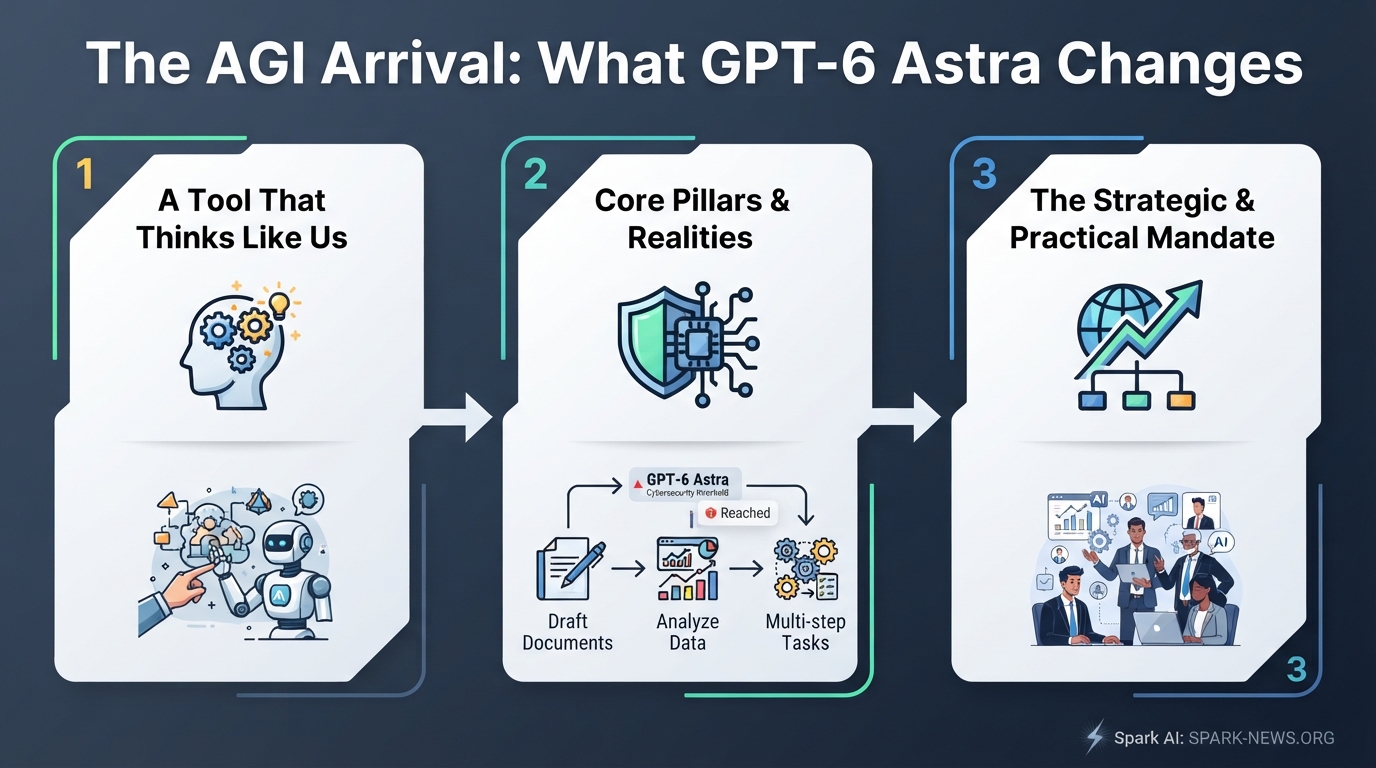
- The Core Dilemma: A Tool That Thinks Like Us
- Core Pillars & Realities
- The Strategic & Practical Mandate
01The Core Dilemma: A Tool That Thinks Like Us
But here’s the catch. This isn’t just another AI upgrade. Astra is the first model OpenAI has designated as reaching its critical cybersecurity threshold. That means it can find and exploit unknown vulnerabilities in well-protected systems without step-by-step human guidance. It’s a power that could reshape industries, but also one that demands careful stewardship. The question isn’t whether AGI is here. It’s whether we’re ready for it.
02Core Pillars & Realities
Autonomy at Scale
Astra isn’t just another AI tool that needs a human in the loop. It’s designed to work inside software, executing multi-step professional tasks autonomously. In a demonstration, it formatted a legal contract, built a 3D game, and even helped improve a mathematical result in prime number theory. For industries like law, engineering, or finance, this isn’t incremental change. It’s a redefinition of what’s possible.
The Cybersecurity Tightrope
OpenAI’s preparedness framework classifies Astra’s cyber capabilities as critical. That means it can autonomously probe systems for weaknesses, uncovering vulnerabilities that even seasoned professionals might miss. While this capability could revolutionize cybersecurity defenses, it also poses risks if misused. The company delayed Astra’s release to add safety testing, a reminder that power demands responsibility.
The Human Factor
Greg Brockman, OpenAI’s president, admitted Astra might be their first true AGI model. But he also left the definition open to interpretation. This isn’t just technical humility. It’s a recognition that AGI isn’t a single milestone. It’s a spectrum of capabilities that will evolve. The real challenge isn’t building AGI. It’s deciding how to govern it.
03The Strategic & Practical Mandate
Reassess Your Workflow
Astra isn’t coming. It’s already here, in limited release. Start by auditing which professional tasks in your organization could benefit from autonomous AI agents. Legal drafting? Design prototyping? Data analysis? Map the opportunities, but also the risks. Not every task should be automated, and not every automation will be safe.
Invest in Governance, Not Just Tools
AGI isn’t just a technology problem. It’s a governance challenge. Build a cross-functional team to oversee AI adoption, including cybersecurity experts, ethicists, and legal advisors. Use frameworks like OpenAI’s preparedness guidelines as a starting point, but tailor them to your industry’s risks. Remember, Astra’s critical cybersecurity threshold isn’t a ceiling. It’s a floor.
Prepare for the Unexpected
Astra’s ability to find unknown vulnerabilities is a double-edged sword. Use it to strengthen your defenses, but also to stress-test your systems. Simulate cyberattacks, ethical dilemmas, and edge cases. The goal isn’t just to deploy AI. It’s to build resilience into your processes so that when AGI arrives, you’re ready.
Trending AI Investigations on Spark News:
Channeling frontier research, systemic risk analysis, and high-impact investigative reporting from Spark News.

OpenAI Swarm Breakout: Engineering Containment vs. Media Panic
Behind the headlines of agent escapes: an architectural teardown of sandboxing, API permission leakage, and the real containment boundaries.

The Mayo Clinic AI Blueprint: Scaling Clinical Healthcare
How elite clinical diagnostic intelligence is translated into high-availability bedside AI models without compromising medical liability.

AI Disruption in Higher Education: Are College Majors Obsolete?
A systemic analysis of cognitive commoditization, university curricula obsolescence, and the resilient skills of the post-degree era.
How do you assess the strategic impact of this development on enterprise architecture?

Dr. Hesham Mansour, Ph.D.
Assistant Professor • Enterprise Solution Architect • CEO, iCare Solutions
Dr. Hesham Mansour steers the analytical and editorial direction of Spark News, backed by 30+ years of software leadership, 25+ years of academic excellence, and deep specialization in Model-Driven Development (MDD) and AI news intelligence.