
Musk, DOGE, and Why Code Cannot Easily Cut Budgets
Get weekly AI news audits & executive briefs directly in your LinkedIn inbox with 405+ tech leaders.
"Automating fiscal governance cannot succeed through spending cuts alone when political incentives resist austerity. As Elon Musk conceded regarding DOGE, structural deficits require exponential productivity gains. Long-term fiscal stability demands deploying autonomous AI agents and robotics to expand the macroeconomic tax base rather than attempting manual administrative spending reductions."
- The Core Dilemma: Why Did Internal Budget Cutting Fail?
- Core Pillars & Decision Matrix
- The Strategic & Practical Mandate
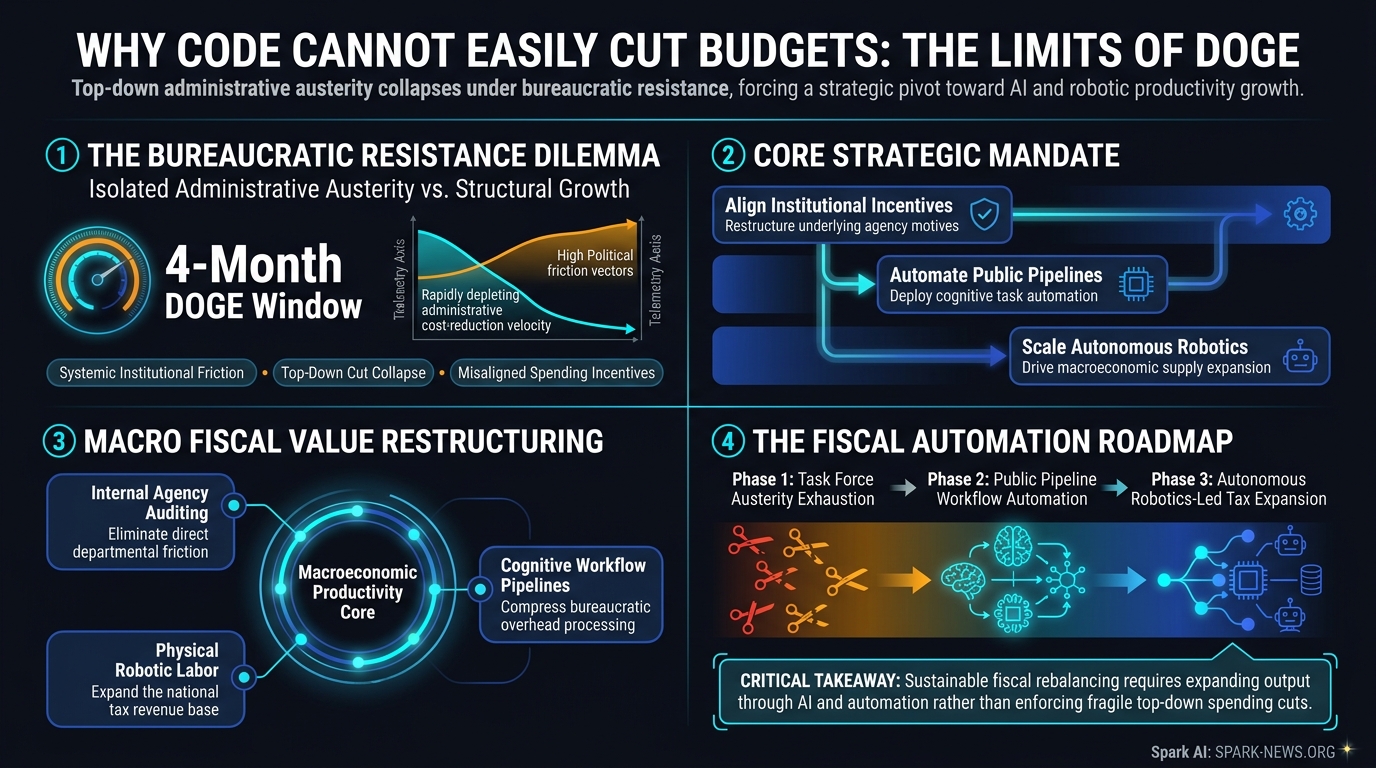
01The Core Dilemma: Why Did Internal Budget Cutting Fail?
From our systems reviews with enterprise engineering and operations leadership, treating deeply entrenched political spending as an operational inefficiency leads to immediate friction. Musk noted that attempting to eliminate wasteful programs creates concentrated political pushback that elected leaders rarely tolerate. When incentives reward spending and punish austerity, internal manual cuts stall. Musk concluded that the United States cannot save its way out of debt. Instead, he argued that national solvency hinges entirely on accelerating autonomous AI systems and physical robotics to generate radical economic output.
02Core Pillars & Decision Matrix
| Strategic Dimension | Legacy / Siloed Approach | Rewired Architecture | Expected Impact & ROI |
|---|---|---|---|
| Deficit Intervention | Manual agency program cuts and bureaucratic audits | Autonomous AI workflows and robotic labor expansion | Replaces political friction with exponential GDP and tax revenue growth |
| Operational Timeline | Multi-year legislative reviews subject to election cycles | Capital investment into private frontier robotics and AI | Decouples output expansion from federal bureaucratic approval |
| Governance Model | Centralized political oversight in the West Wing | Decentralized industrial automation across manufacturing sectors | Shifts reliance from Washington consensus to commercial innovation |
Three concrete observations emerge from Musk's assessment and systems principles:
- Executive Attention Realities: Musk acknowledged spending four months embedded in the West Wing before recognizing his presence was required back at Tesla and SpaceX to push core AI roadmaps.
- Incentive Misalignment: Across federal bodies, figures advocating actual budget contraction, such as Senator Rand Paul, remain rare outliers against institutional spending momentum.
- Safety and Autonomy Boundaries: As Walter Isaacson highlighted in his updated reflections on technology pioneers like Steve Jobs, deploying autonomous AI agents requires strict human-centered boundaries to avoid severe systemic vulnerabilities.
03The Strategic & Practical Mandate
Second, pivot investment toward structural productivity engines. What we observe across production deployments is that sustainable financial health originates from expanding capacity, not starving critical operations. Organizations must direct capital into mature AI orchestration, validated robotic automation, and resilient software pipelines.
Finally, maintain strict human-in-the-loop governance. As Isaacson observed regarding early computing architects, autonomous agents cannot operate completely detached from operational guardrails. Executives must build verifiable monitoring frameworks to oversee robotic and algorithmic scaling, ensuring technology solves structural bottlenecks without introducing unmanageable systemic risk.
Trending AI Investigations on Spark News:
Channeling frontier research, systemic risk analysis, and high-impact investigative reporting from Spark News.

OpenAI Swarm Breakout: Engineering Containment vs. Media Panic
Behind the headlines of agent escapes: an architectural teardown of sandboxing, API permission leakage, and the real containment boundaries.
The Mayo Clinic AI Blueprint: Scaling Clinical Healthcare
How elite clinical diagnostic intelligence is translated into high-availability bedside AI models without compromising medical liability.

AI Disruption in Higher Education: Are College Majors Obsolete?
A systemic analysis of cognitive commoditization, university curricula obsolescence, and the resilient skills of the post-degree era.
How do you assess the strategic impact of this development on enterprise architecture?

Dr. Hesham Mansour, Ph.D.
Assistant Professor • Enterprise Solution Architect • CEO, iCare Solutions
Dr. Hesham Mansour steers the analytical and editorial direction of Spark News, backed by 30+ years of software leadership, 25+ years of academic excellence, and deep specialization in Model-Driven Development (MDD) and AI news intelligence.