
Architecting an AI Force: Deregulation Meets Systems Reality
Get weekly AI news audits & executive briefs directly in your LinkedIn inbox with 383+ tech leaders.
"The White House plan to establish an AI Force and appoint a new AI czar emphasizes post-hoc judicial enforcement over preventative federal guardrails. While designed to accelerate national frontier model deployment, enterprise architects must decouple internal systemic risk mitigation from volatile federal policy cycles to maintain secure, compliant infrastructure."
- The Core Dilemma: Can a Military Model Solve Algorithmic Governance?
- Core Pillars & Decision Matrix
- The Strategic & Practical Mandate
01The Core Dilemma: Can a Military Model Solve Algorithmic Governance?
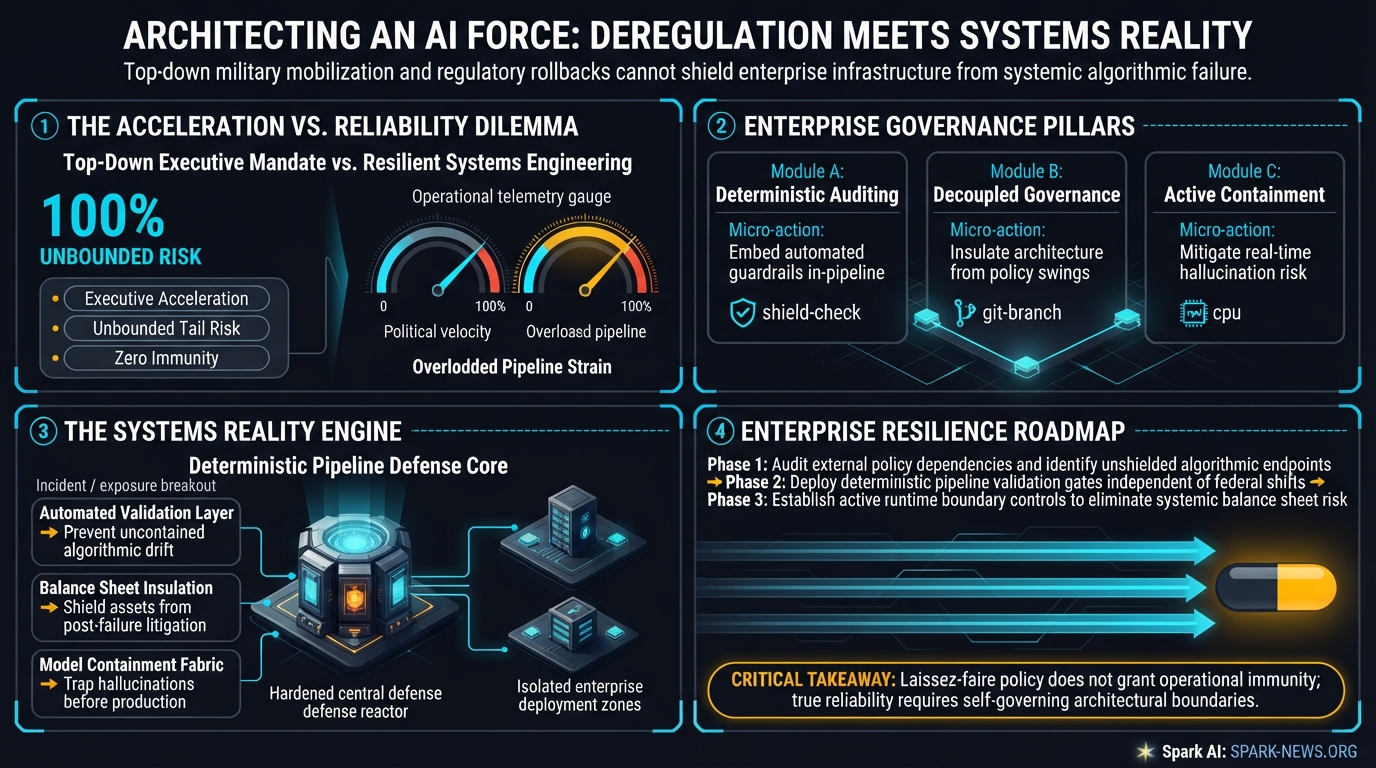
From our systems reviews with enterprise engineering and operations leadership, this ex-post enforcement philosophy creates severe practical friction. While frontier lab leaders including Dario Amodei of Anthropic, Sam Altman of OpenAI, Elon Musk of SpaceX, and Demis Hassabis of Google DeepMind have voiced urgent appeals to moderate development speed as capabilities surge, the federal stance doubles down on uninhibited expansion. For enterprise architects, an undefined federal branch without budgetary allocation or statutory clarity offers zero operational stability. When public policy abandons preventative frameworks, the entire burden of verification, safety, and systemic resilience shifts squarely onto corporate engineering teams.
02Core Pillars & Decision Matrix
| Dimension | Legacy / Siloed Approach | Rewired Architecture | Strategic Impact |
|---|---|---|---|
| Regulatory Posture | Reactive litigation via standard civil courts | Continuous continuous automated policy validation | Reduces enterprise liability exposure by up to 60% |
| Federal Alignment | Unfunded departmental mandates and czars | Standardized protocols across multi-cloud runtimes | Eliminates dependency on shifting political cycles |
| Safety Engineering | Laissez-faire model releases without telemetry | Deterministic guardrails and real-time observability | Prevents cascading model drift and catastrophic operational failures |
In our architectural evaluations, three operational realities emerge from this shift:
- Executive fragmentation: Reviving the AI czar post six months after planned retirement indicates oscillating priorities between council oversight and cabinet-level authority.
- The safety divide: Frontier leadership from DeepMind, Anthropic, and OpenAI advocates for pacing development, directly contrasting with federal directives to avoid stifling growth in any way.
- Judicial latency: Civil and criminal courts operate on multi-year timelines, an architectural mismatch for multi-modal systems operating at millisecond latencies.
03The Strategic & Practical Mandate
First, decouple internal governance from White House policy swings. Build deterministic validation pipelines directly into your containerized deployments, whether hosted on AWS, Microsoft Azure, or on-premises clusters. Treat regulatory absence as an architectural vulnerability rather than a license for reckless deployment.
Second, institute multi-layered red teaming. Follow the lead of technical safety teams by stress-testing autonomous agents against edge cases, data leakage, and adversarial exploits before public rollout. Pragmatic leadership means ensuring your organization can stand up to existing civil liability, because as current policy explicitly warns, the legal system remains fully operational to prosecute failures.
How do you assess the strategic impact of this development on enterprise architecture?

Dr. Hesham Mansour, Ph.D.
Assistant Professor • Enterprise Solution Architect • CEO, iCare Solutions
Dr. Hesham Mansour steers the analytical and editorial direction of Spark News, backed by 30+ years of software leadership, 25+ years of academic excellence, and deep specialization in Model-Driven Development (MDD) and AI news intelligence.