Spark News AI | spark-news.org
🎭 SatireNovember 5, 2026⏱️8 min read
Silicon Valley Offers Cash and Euphemisms After Voters Reject Data Centers 43-1
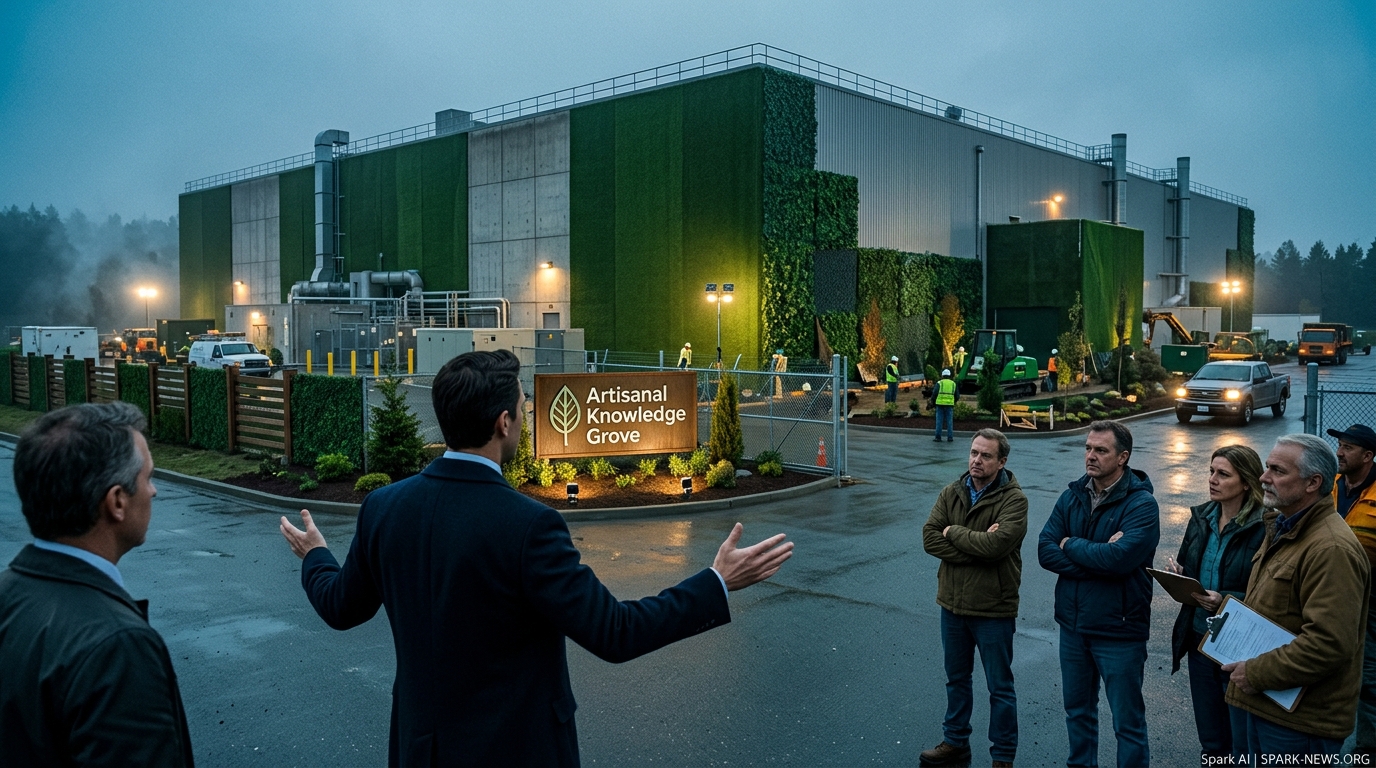
📷A sharply dressed tech lobbyist gestures toward a 400,000-square-foot server shed wrapped in green Astroturf and a sign reading 'Artisanal Knowledge Grove.'
Weekly LinkedIn NewsletterEdition #5
Featured in the weekly "Spark News: AI Media Brief" newsletter series on LinkedIn.
📱
Interactive Web Story
Experience this story as bite-sized visual cards with citizen polling
🎭 SATIRICAL VISUAL
Spark News AI | spark-news.org
Enlarge Infographic
🎭
SPARK SATIRE • EDITORIAL HUMOR
Sarcastic & Satirical Take
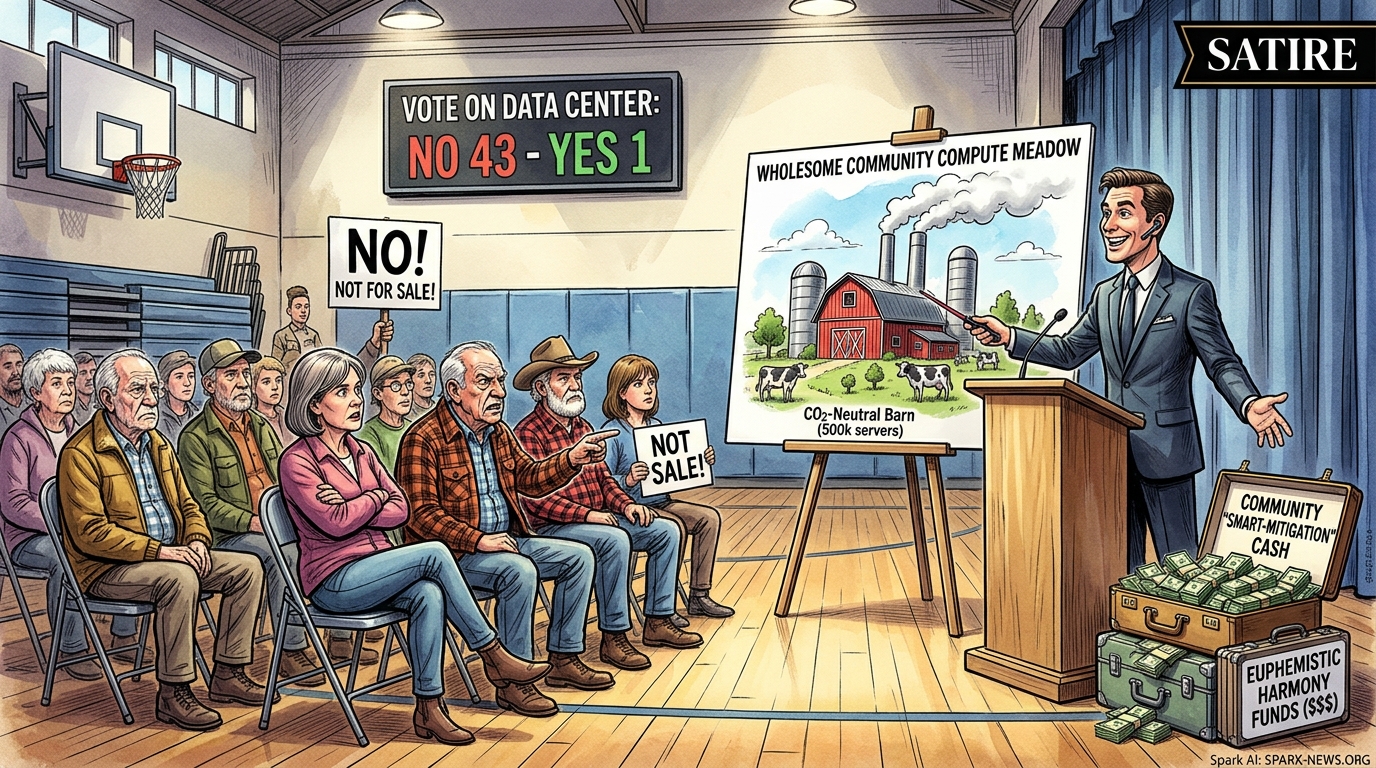
Following a crushing 43-1 defeat at the ballot box, Big Tech pivots from steamrolling local zoning boards to bribing suburban school districts with cash, tree saplings, and artisanal euphemisms.
⚡Absurd Highlights of the Story
- •A 43-1 ballot loss across ten states prompted tech executives to rebrand monolithic data centers into pastoral compute campuses.
- •Developers are replacing aggressive tax-break demands with direct municipal cash handouts and promises to bring their own nuclear reactors.
- •PR strategists believe voters simply misunderstood the environmental charm of a windowless warehouse using an entire county's water supply.
01The Grand Announcement & Immediate Reality Check
For three years, the undisputed lords of artificial intelligence operated on the quiet assumption that rural counties and sleepy exurbs would gladly sacrifice their aquifers if it meant corporate America could generate six-fingered stock photos twelve seconds faster. That civic covenant shattered on Tuesday, when local ballot measures restricting massive server warehouses swept across ten states with a lopsided final tally of 43 to 1. An average of 75 percent of voters decided that humming corrugated-metal monoliths did not, in fact, constitute an acceptable substitute for residential drinking water.
The response from Silicon Valley was swift, remorseful, and meticulously focus-grouped. Rather than abandoning plans to build a ten-trillion-dollar digital nervous system, developers announced an immediate cosmetic pivot. Going forward, deafening, windowless, multi-gigawatt facilities will no longer be referred to as data centers. They are now officially designated as Compute Campuses, Whispering Innovation Meadows, or Regional Knowledge Sanctuaries, depending on which municipal zoning board requires sedating.
The response from Silicon Valley was swift, remorseful, and meticulously focus-grouped. Rather than abandoning plans to build a ten-trillion-dollar digital nervous system, developers announced an immediate cosmetic pivot. Going forward, deafening, windowless, multi-gigawatt facilities will no longer be referred to as data centers. They are now officially designated as Compute Campuses, Whispering Innovation Meadows, or Regional Knowledge Sanctuaries, depending on which municipal zoning board requires sedating.
02Crisis PR Acrobatics & Corporate Apologetics
In boardrooms from Menlo Park to Redmond, emergency crisis teams concluded that the American electorate had not actually rejected the hyper-industrialization of their backyards, but merely suffered from a severe brand-messaging misalignment. Chris Lehane, OpenAI's chief global affairs officer and seasoned political operative, calmly reminded industry partners that Bill Clinton turned around a disastrous midterm in 1996, suggesting that a similar resurrection could be achieved for three-story cooling towers by deploying charm, municipal bribes, and strategic humility.
A senior infrastructure vice president, speaking on the strict condition of anonymity to preserve their remaining dignity, clarified the new outreach philosophy. According to the source, the industry will no longer demand eighty-year property tax abatements while quietly consuming eighty percent of a county's peak electricity. Instead, developers plan to show up at town hall meetings bearing thick envelopes of direct municipal aid, funding for high school marching bands, and solemn promises that incoming diesel backup generators will burn with deeply empathetic intent.
A senior infrastructure vice president, speaking on the strict condition of anonymity to preserve their remaining dignity, clarified the new outreach philosophy. According to the source, the industry will no longer demand eighty-year property tax abatements while quietly consuming eighty percent of a county's peak electricity. Instead, developers plan to show up at town hall meetings bearing thick envelopes of direct municipal aid, funding for high school marching bands, and solemn promises that incoming diesel backup generators will burn with deeply empathetic intent.
03The Collateral Reality on the Ground
Out in the contested battlegrounds of Texas and Virginia, civic life has devolved into an uneasy financial standoff. Local homeowners who spent the autumn enduring the continuous 60-decibel drone of industrial chilling fans now find themselves courted like swing-state voters in October. Tech liaisons have begun appearing at planning commission hearings offering free rooftop solar panels, municipal park revamps, and commemorative copper tokens redeemable for premium cloud subscriptions.
Yet municipal skepticism remains stubborn. In one Texas township where developers quietly attempted to acquire water rights for an unnamed compute sanctuary, residents expressed bewilderment at the transactional barter. One retired librarian pointed out that while the town library had indeed received twenty-four brand-new iPads courtesy of a cloud infrastructure conglomerate, the local tap water had acquired the distinct temperature and taste of a lukewarm motherboard.
Yet municipal skepticism remains stubborn. In one Texas township where developers quietly attempted to acquire water rights for an unnamed compute sanctuary, residents expressed bewilderment at the transactional barter. One retired librarian pointed out that while the town library had indeed received twenty-four brand-new iPads courtesy of a cloud infrastructure conglomerate, the local tap water had acquired the distinct temperature and taste of a lukewarm motherboard.
04Strategic Five-Year Roadmap for Continued Confusion
Looking toward 2028, analysts warn that roughly sixty percent of projected American server capacity sits paralyzed in regulatory limbo. The path forward will require tech conglomerates to abandon the historic practice of binding small-town mayors to ironclad nondisclosure agreements, replacing those legal gag orders with bespoke community welfare agreements that resemble geopolitical peace treaties.
Under the industry's five-year roadmap, upcoming facilities will masquerade as historic community centers, complete with faux-barn siding, artisanal pond aeration, and ornamental grazing sheep stationed near the substation perimeter. Should local town councils still object to the sight of three hundred cooling fans blotting out the sunset, developers remain confident that direct cash deposits into municipal pension funds will restore a profound, shared appreciation for the inevitable digital dawn.
Under the industry's five-year roadmap, upcoming facilities will masquerade as historic community centers, complete with faux-barn siding, artisanal pond aeration, and ornamental grazing sheep stationed near the substation perimeter. Should local town councils still object to the sight of three hundred cooling fans blotting out the sunset, developers remain confident that direct cash deposits into municipal pension funds will restore a profound, shared appreciation for the inevitable digital dawn.
🎯Satirical Conclusion & Final Punchline
It turns out that democracy functions quite well when residents discover their power bills are subsidizing the creation of synthetic customer service avatars.