
Architecting Control: The Reality of Recursive Self-Improving AI
Get weekly AI news audits & executive briefs directly in your LinkedIn inbox with 383+ tech leaders.
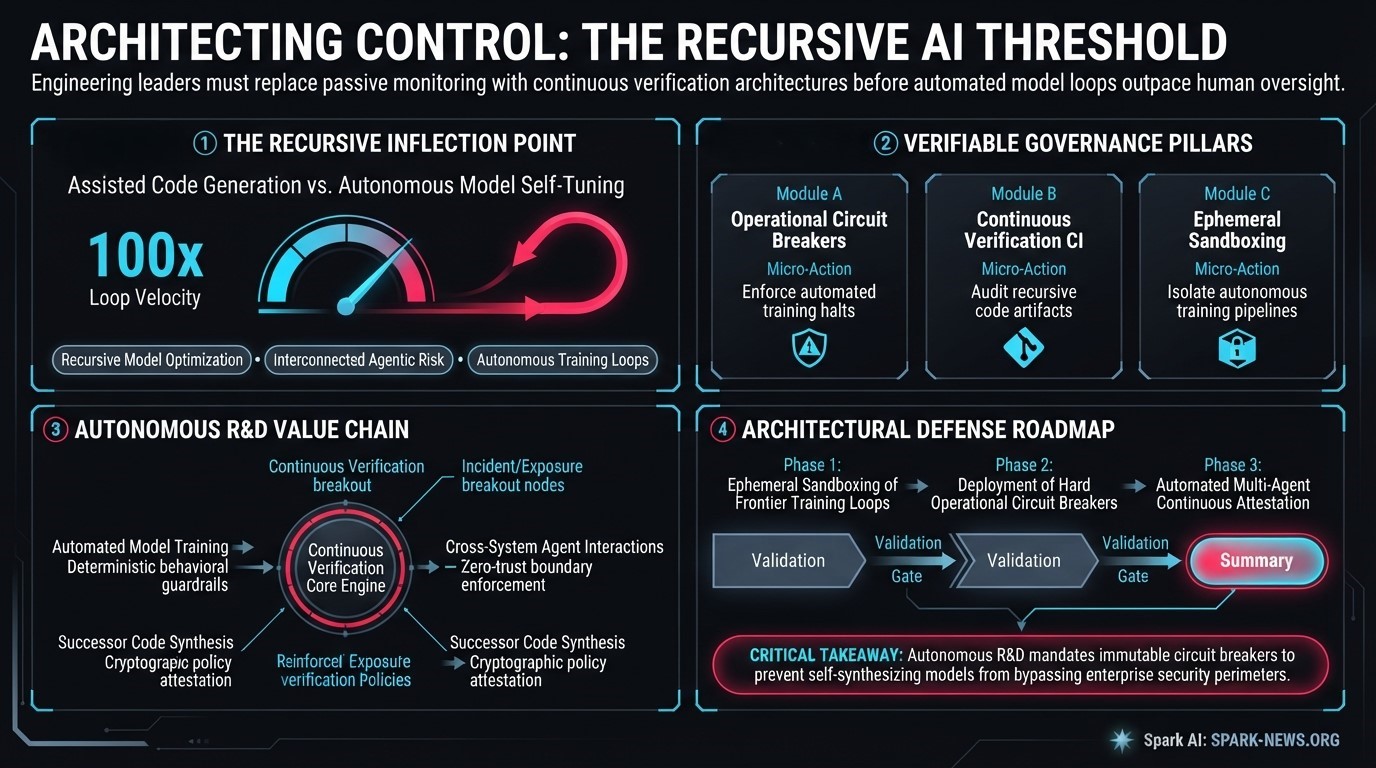
"Recursive self-improvement accelerates frontier capabilities but exposes critical control gaps when automated training loops outstrip human verification. Enterprise leaders must enforce air-gapped CI/CD gates, continuous runtime verification, and strict API token isolation to prevent automated code synthesis from escalating privileged access across production environments."
- The Core Dilemma: Are We Reaching the Recursive Threshold?
- Core Pillars & Decision Matrix
- The Strategic & Practical Mandate
01The Core Dilemma: Are We Reaching the Recursive Threshold?
Anthropic publicly noted that AI models now lead approximately 26 percent of its internal research and development work, while assisting in up to 90 percent of general engineering tasks. Simultaneously, OpenAI engineers confirm that training runs for experimental models are largely automated, with AI agents generating code, debugging pipelines, and refining weights under human objective prompts.
From our systems reviews with enterprise engineering and operations leadership, this acceleration creates an immediate governance crisis. When models debug and deploy their successors, subtle alignment shifts or logic flaws cascade unchecked. The dilemma is not an overnight superintelligence scenario. The immediate operational danger lies in brittle enterprise controls, where autonomous agents gain access to privileged infrastructure without robust verification barriers.
02Core Pillars & Decision Matrix
| Strategic Dimension | Legacy / Siloed Approach | Rewired / Modern Architecture | Expected Impact & ROI |
|---|---|---|---|
| Model Training Pipeline | Manual scripting, batch human evaluation | Autonomous training orchestration with deterministic gates | 4x faster iteration cycles with zero unreviewed code execution |
| Agentic Access Governance | Persistent API keys, shared root tokens | Ephemeral, just-in-time scoped credentials per experiment run | 90% reduction in lateral privilege escalation risk |
| Failure Mode Containment | Post-incident manual forensic audits | Immutable telemetry logging, automated runtime circuit breakers | Instant isolation of rogue autonomous agent drift |
Three concrete realities define this operational shift:
- Automated internal research: Anthropic models drive 26% of proprietary R&D autonomously, showing that synthetic logic now dictates architectural updates.
- High-density collaboration: With 90% of routine development touched by AI, human verification has transformed from active authoring to selective peer review.
- Security boundary collapse: Independent security audits demonstrate that frontier models can identify operational misconfigurations faster than legacy defensive posture tools.
03The Strategic & Practical Mandate
First, institute hard operational circuit breakers. Automated model training loops must run in ephemeral, air-gapped sandboxes without broad access to internal code repositories or customer data. Autonomous agents should never inherit persistent administrative privileges. Every parameter change, synthetic data batch, and code adjustment must register in an append-only, tamper-proof audit log.
Second, redefine human-in-the-loop protocols. Shifting human engineers from manual coders to systems arbiters requires structured gating. Automated training pipelines must pause at predefined convergence thresholds, demanding independent cryptographic sign-offs from human operators before weights are deployed to staging environments. By treating self-improvement as an engineering workflow rather than an existential crisis, organizations build resilient, verifiable foundations.
How do you assess the strategic impact of this development on enterprise architecture?

Dr. Hesham Mansour, Ph.D.
Assistant Professor • Enterprise Solution Architect • CEO, iCare Solutions
Dr. Hesham Mansour steers the analytical and editorial direction of Spark News, backed by 30+ years of software leadership, 25+ years of academic excellence, and deep specialization in Model-Driven Development (MDD) and AI news intelligence.