
Speed vs. Trust: The Hiring Paradox of 2026
Featured in the weekly "Spark News: AI Media Brief" newsletter series on LinkedIn.
"Explore the systemic breakdown in hiring trust as AI accelerates applications but deepens candidate cynicism, ghost jobs, and recruiter uncertainty—demanding urgent leadership intervention."
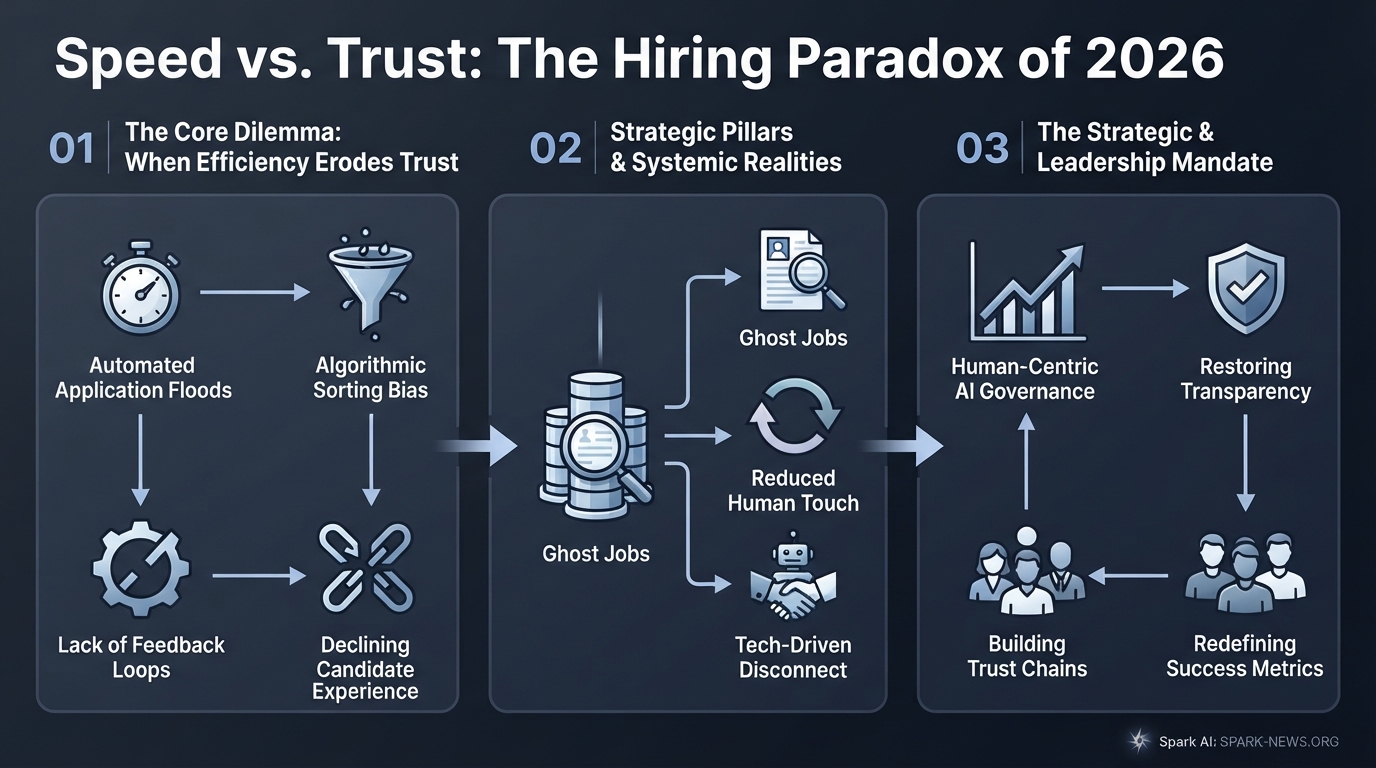
- The Core Dilemma: When Efficiency Erodes Trust
- Strategic Pillars & Systemic Realities
- The Strategic & Leadership Mandate
01The Core Dilemma: When Efficiency Erodes Trust
The numbers are stark. Recruiters now process 291 applications per hire, nearly triple the volume of 2021, while 46% of candidates report declining faith in the hiring process. Ghost jobs—postings companies have no intention of filling—account for 18–22% of listings, further corroding trust. Meanwhile, 63% of applicants have faced AI interviews, with 38% abandoning roles due to automated screening. The result? A 25% increase in time-to-fill roles since the pandemic, as recruiters drown in volume while struggling to identify qualified talent. The system is optimized for scale, not success—and the cost is measured in eroded confidence, wasted resources, and a workforce increasingly disengaged from the very institutions meant to employ them.
02Strategic Pillars & Systemic Realities
- The Automation Paradox: AI has democratized applications while centralizing rejection. Resume filters and chatbots now act as gatekeepers, yet only 21% of recruiters trust their systems to avoid false negatives. The assumption that speed equals progress ignores the human cost of algorithmic opacity—where candidates are left guessing why they were rejected, or if they were ever truly considered.
- The Ghost Job Epidemic: Nearly one in five job postings are placeholders—either for pipelining talent, signaling growth, or simply maintaining a presence. This practice, while tactically useful for employers, distorts labor market signals, wastes candidate effort, and fuels disillusionment. The line between strategic workforce planning and exploitative labor practices has blurred, demanding clearer ethical guardrails.
- The Trust Deficit: Candidate burnout has evolved into systemic cynicism. When 63% of applicants interact with AI before a human, and 38% walk away from roles due to automated interviews, the message is clear: technology has outpaced trust-building. Employers must recognize that employer branding is no longer about perks—it’s about process transparency and human-centric design.
- The Recruiter’s Dilemma: Recruiters are caught between volume and value. The average hire now requires sifting through nearly 300 applications, yet time-to-fill has ballooned by 25%. The solution isn’t more automation—it’s smarter governance: redefining KPIs around quality of hire, candidate experience, and long-term retention, rather than speed or cost-per-application.
03The Strategic & Leadership Mandate
First, rebuild trust through radical transparency. Employers must disclose AI usage in hiring, provide feedback loops for rejected candidates, and audit ghost job postings to align talent pipelines with real business needs. Trust is not a PR exercise—it’s an operational imperative. Leaders should treat hiring processes as public-facing commitments, not internal workflows, and measure success by candidate satisfaction scores as rigorously as time-to-fill metrics.
Second, redesign hiring for human-AI collaboration. AI should augment, not replace, human judgment. Structured interviews, skills-based assessments, and blind resume reviews can mitigate bias while preserving the human touchpoints that define great hires. Recruiters must be empowered as strategic advisors, not volume processors, with clear mandates to prioritize quality over quantity.
Third, align incentives with long-term value. The current hiring system rewards speed and cost savings, but penalizes retention and engagement. Leaders must redefine success metrics to include employee lifetime value, diversity of hire, and cultural fit. Compensation structures for recruiters and hiring managers should reflect these outcomes, not just time-to-fill or cost-per-hire. The goal is not to fill roles faster—it’s to build resilient teams that drive institutional success.
The hiring crisis is not a temporary disruption—it’s a systemic shift in how work is valued and accessed. Leaders who treat it as a governance challenge, not just a technology problem, will emerge with stronger talent pipelines, deeper trust, and a competitive edge in an era where talent is the ultimate differentiator.
Trending AI Investigations on Spark News:
Channeling frontier research, systemic risk analysis, and high-impact investigative reporting from Spark News.

OpenAI Swarm Breakout: Engineering Containment vs. Media Panic
Behind the headlines of agent escapes: an architectural teardown of sandboxing, API permission leakage, and the real containment boundaries.

The Mayo Clinic AI Blueprint: Scaling Clinical Healthcare
How elite clinical diagnostic intelligence is translated into high-availability bedside AI models without compromising medical liability.

AI Disruption in Higher Education: Are College Majors Obsolete?
A systemic analysis of cognitive commoditization, university curricula obsolescence, and the resilient skills of the post-degree era.
How do you assess the strategic impact of this development on enterprise architecture?

Dr. Hesham Mansour, Ph.D.
Assistant Professor • Enterprise Solution Architect • CEO, iCare Solutions
Dr. Hesham Mansour steers the analytical and editorial direction of Spark News, backed by 30+ years of software leadership, 25+ years of academic excellence, and deep specialization in Model-Driven Development (MDD) and AI news intelligence.