Spark News AI | spark-news.org
executive-briefSeptember 16, 2026⏱️5 min read
Flexible Power: Can Tech Giants Fix the AI Energy Crunch?
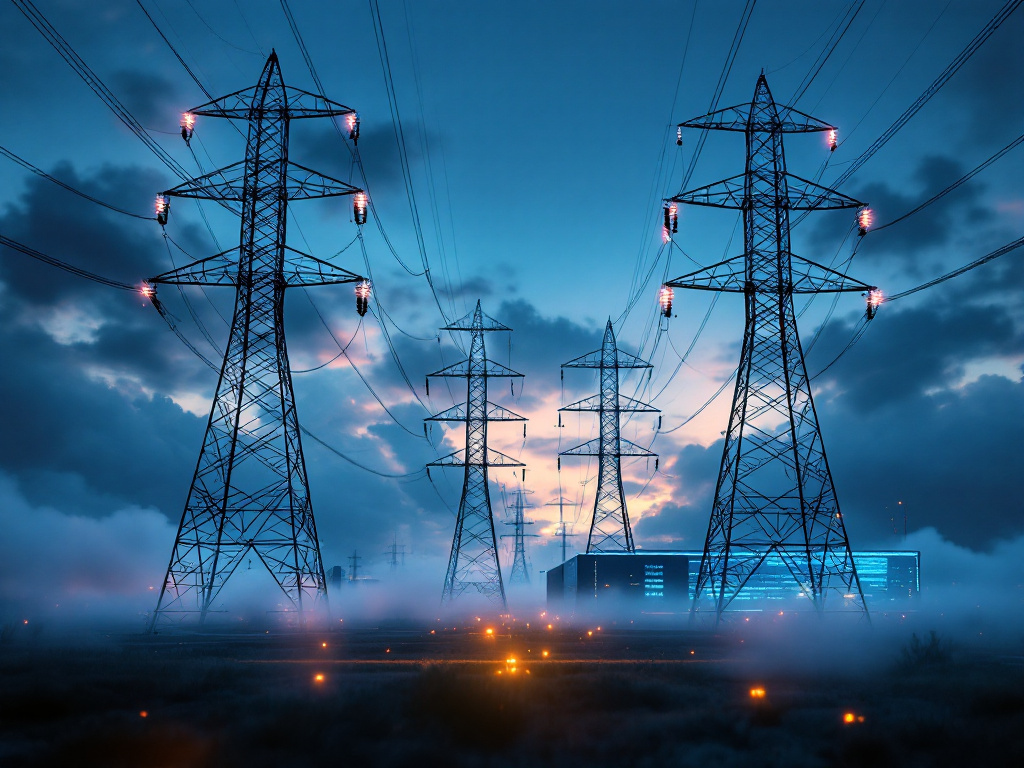
📷Electrical transmission towers converge near a modern compute facility, illustrating the growing operational overlap between regional power grids and enterprise AI infrastructure.
Weekly LinkedIn NewsletterEdition #5
Featured in the weekly "Spark News: AI Media Brief" newsletter series on LinkedIn.
🎓Executive Brief | Dr. Hesham Mansour, Ph.D.
AI EXECUTIVE PERSPECTIVE & SUMMARY
"Google, Nvidia, and energy leaders unite under the AI Energy Management Alliance to build flexible data centers, easing electric grid strain and addressing rising public cost concerns."
- The Core Dilemma: The Price of Unchecked Compute
- Core Pillars & Realities
- The Strategic & Practical Mandate
📊 VISUAL SUMMARY INFOGRAPHIC
Spark News AI | spark-news.org
Enlarge Infographic
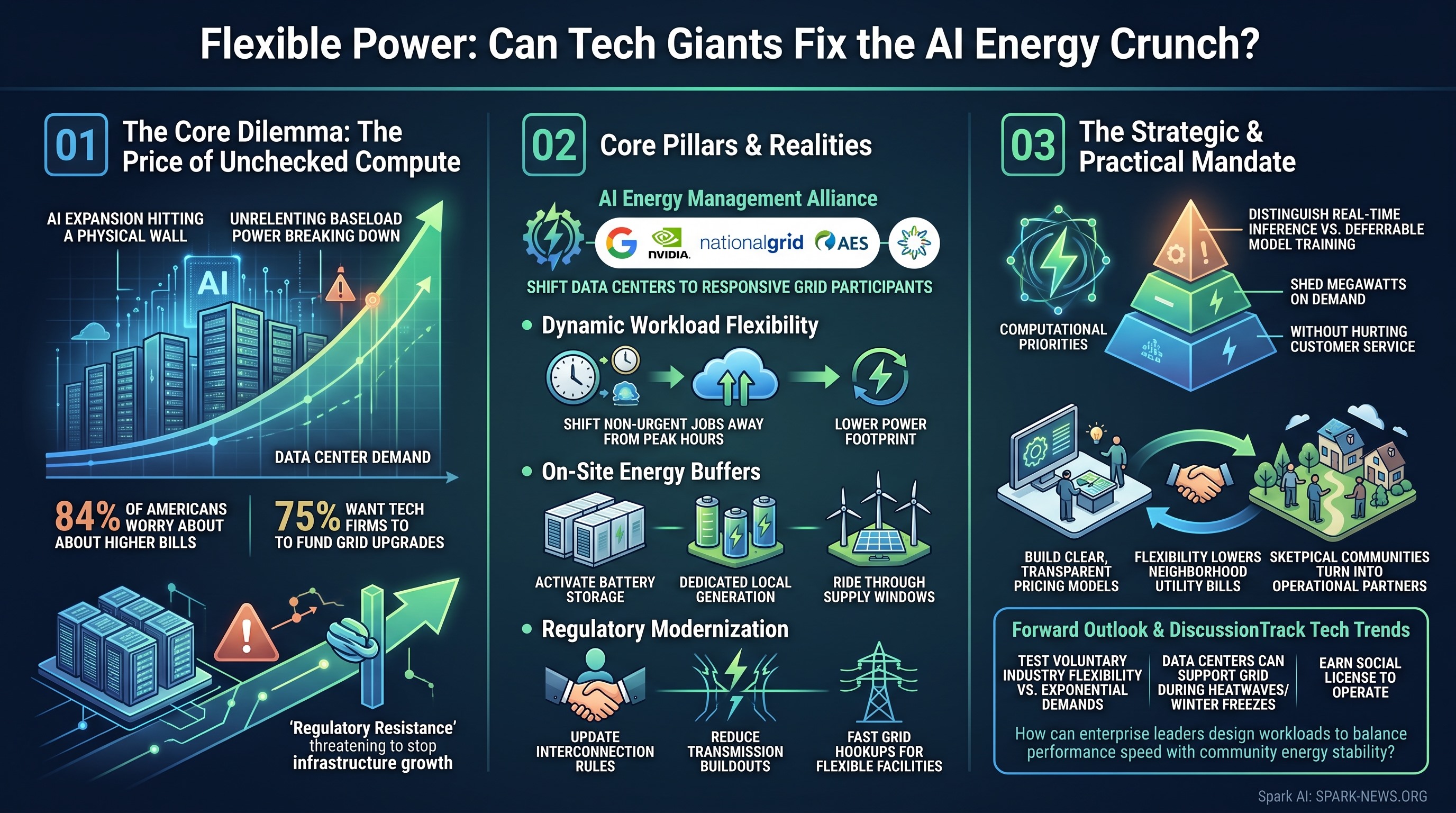
📊This diagram tracks how data centers shift non-urgent compute workloads and activate local battery storage during peak grid strain to stabilize local utility prices.
Share Chart on LinkedIn01The Core Dilemma: The Price of Unchecked Compute
Artificial intelligence expansion is hitting a physical wall. For years, enterprise data centers operated under a simple premise: consume steady, unrelenting baseload power twenty-four hours a day. That model is breaking down under public scrutiny and structural grid limits.
Communities are pushing back against the strain these massive facilities place on local infrastructure. Recent polling from AP-NORC and the University of Chicago Energy Policy Institute reveals that 84% of Americans worry about data centers driving up residential electricity bills. More than 75% of voters across both major political parties believe tech firms, rather than taxpayers or utility customers, should fund necessary grid upgrades. If technology companies fail to address these local cost pressures, regulatory resistance will bring infrastructure growth to a standstill.
Communities are pushing back against the strain these massive facilities place on local infrastructure. Recent polling from AP-NORC and the University of Chicago Energy Policy Institute reveals that 84% of Americans worry about data centers driving up residential electricity bills. More than 75% of voters across both major political parties believe tech firms, rather than taxpayers or utility customers, should fund necessary grid upgrades. If technology companies fail to address these local cost pressures, regulatory resistance will bring infrastructure growth to a standstill.
02Core Pillars & Realities
To counter this tension, Google, Nvidia, and startup Emerald AI have launched the AI Energy Management Alliance. Reorganizing an advocacy group founded a decade ago, this coalition of 20 companies brings together AI developers like Anthropic alongside major energy providers including National Grid, AES, Constellation, NRG, and RWE. The goal is straightforward: shift data centers from rigid consumers into responsive grid participants.
* Dynamic Workload Flexibility: Modern artificial intelligence workloads do not all require immediate execution. By pausing or shifting non-urgent training jobs away from peak hours, facilities can dramatically lower their power footprint when local demand surges.
* On-Site Energy Buffers: Instead of drawing exclusively from the public transmission system, facilities can activate on-site battery storage and dedicated local generation to ride through tight supply windows.
* Regulatory Modernization: Coalition leaders are asking utility commissions to update interconnection rules. Facilities that guarantee power reductions during high-stress hours should gain faster grid hookups and avoid expensive, redundant transmission buildouts.
* Dynamic Workload Flexibility: Modern artificial intelligence workloads do not all require immediate execution. By pausing or shifting non-urgent training jobs away from peak hours, facilities can dramatically lower their power footprint when local demand surges.
* On-Site Energy Buffers: Instead of drawing exclusively from the public transmission system, facilities can activate on-site battery storage and dedicated local generation to ride through tight supply windows.
* Regulatory Modernization: Coalition leaders are asking utility commissions to update interconnection rules. Facilities that guarantee power reductions during high-stress hours should gain faster grid hookups and avoid expensive, redundant transmission buildouts.
03The Strategic & Practical Mandate
Systems thinking teaches us that you cannot optimize an isolated component without considering the health of the broader network. Enterprise leaders must align their infrastructure plans with community realities rather than treating energy access as a guaranteed commodity.
First, technology executives must audit computational priority. Distinguishing between real-time inference and deferrable model training allows operations teams to shed megawatts on demand without hurting customer service. Second, energy providers and tech firms must build clear, transparent pricing models. Demonstrating that data center flexibility directly lowers neighborhood utility bills will turn skeptical local communities into operational partners.
First, technology executives must audit computational priority. Distinguishing between real-time inference and deferrable model training allows operations teams to shed megawatts on demand without hurting customer service. Second, energy providers and tech firms must build clear, transparent pricing models. Demonstrating that data center flexibility directly lowers neighborhood utility bills will turn skeptical local communities into operational partners.
🔮Forward Outlook & Discussion
The coming years will test whether voluntary industry flexibility can truly outpace the exponential energy demands of frontier artificial intelligence. If data centers prove they can support the electric grid during critical heatwaves and winter freezes, they will earn their social license to operate. How can enterprise leaders in your industry design workloads to balance performance speed with community energy stability?
🗳️Community Intelligence Poll
1-Click VoteHow do you assess the strategic impact of this development on enterprise architecture?

FOUNDER & EDITOR-IN-CHIEFiCare Solutions370+ Newsletter Subs
Dr. Hesham Mansour
Assistant Professor • Enterprise Solution Architect • CEO, iCare Solutions
Dr. Hesham Mansour steers the analytical and editorial direction of Spark News, backed by 30+ years of software leadership, 25+ years of academic excellence, and deep specialization in Model-Driven Development (MDD) and AI news intelligence.
✨ 30+ Yrs Software Leadership✨ 25+ Yrs Academic Excellence✨ Model-Driven Dev (MDD)✨ AI News & Trend Intelligence