
Students Rethink Careers as AI Reshapes Job Market
Get weekly AI news audits & executive briefs directly in your LinkedIn inbox with 405+ tech leaders.
"Nearly one third of students are changing or reconsidering their career paths due to AI disruption. Discover why and what it means for education, skills, and the future of work."
- The Core Dilemma: When AI Redefines the Future Before Degrees End
- Core Pillars & Realities
- The Strategic & Practical Mandate
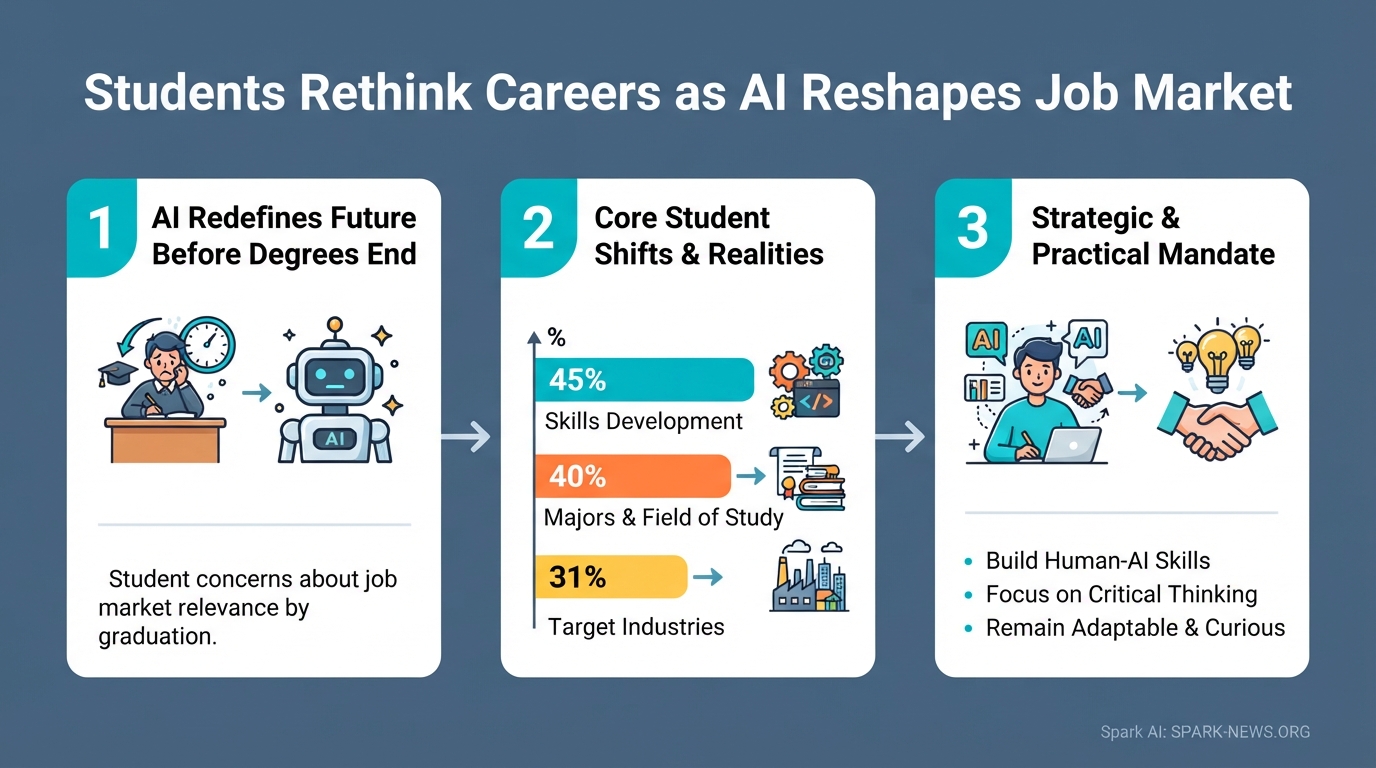
01The Core Dilemma: When AI Redefines the Future Before Degrees End
Nearly one third of students and workers enrolled in school have changed or considered changing their target industry because of AI. For those not employed, that number rises to 39%. Some are switching majors. Others are rethinking the skills they develop or the companies they hope to join. The message is clear: AI isn’t just a tool. It’s a disruptor that’s rewriting the rules of the job market before the next generation of workers even enters it.
The uncertainty is palpable. Students hear conflicting messages: AI will create jobs, AI will eliminate jobs. Some fields will thrive. Others may not. Allison Shrivastava, an education and labor market economist, warns that students are reacting without all the information. Yet the clock is ticking. Degrees take years to complete. Careers take decades to build. The question isn’t whether AI will change the game. It’s whether students can adapt fast enough to play it.
02Core Pillars & Realities
Career paths are shifting, not disappearing.
Nearly 40% of students have considered changing their major, field of study, or coursework due to AI. For those not employed, that number jumps to 44%. A Gallup and Lumina Foundation report found that 42% of bachelor’s degree students and 56% of associate degree students have given significant thought to switching majors. The fear isn’t just about jobs vanishing. It’s about whether the time and money invested in education will pay off in a market where AI is redefining demand.
Some industries are feeling the heat more than others.
Computer science graduates faced a 7% unemployment rate in 2024, a stark contrast to the over-hiring boom of previous years. Tech companies have slowed their on-campus recruiting efforts, leaving students hesitant about entering the field. Yet Jessica Roffe, a career coach, points out that computer science skills are valuable far beyond Silicon Valley. Banks, hospitals, and even small businesses need technologists who can integrate AI into their operations. The issue isn’t the field itself. It’s the mismatch between student expectations and industry realities.
Human skills are becoming non-negotiable.
Employers aren’t just looking for technical expertise. They want workers who can critically evaluate AI outputs, solve problems creatively, and maintain curiosity and skepticism. Roffe emphasizes that critical thinking, problem-solving, and curiosity are the skills that will make students resilient in an AI-driven job market. It’s not about outsmarting machines. It’s about working alongside them.
The human element still matters.
Stephanie Park’s concern about the erosion of human connection in medicine reflects a broader truth. AI can process data. It can diagnose. It can even predict outcomes. But it can’t replace empathy, trust, or the nuanced decision-making that defines fields like healthcare, education, and social services. The challenge is preserving what makes these professions meaningful while leveraging AI to enhance, not replace, human roles.
03The Strategic & Practical Mandate
For students: Focus on adaptability, not just employability.
Rather than chasing the “safest” major or industry, invest in skills that transcend fields: critical thinking, problem-solving, and the ability to learn continuously. Ask yourself: Which skills will make me valuable no matter how AI evolves? Fields like healthcare, education, and social services aren’t going away, but they will change. Be ready to pivot.
For educators: Redesign curricula for the AI era.
Programs must teach students how to work with AI, not just about AI. Integrate AI literacy into every discipline. Show students how to use AI as a tool for research, creativity, and problem-solving. And most importantly, emphasize the human skills that machines can’t replicate: empathy, ethical judgment, and collaboration.
For institutions: Partner with industries to bridge the gap.
Universities and colleges should collaborate with employers to align degree programs with real-world needs. Internships, co-ops, and apprenticeships can provide students with hands-on experience in AI-driven environments. This isn’t about predicting the future. It’s about preparing students for it.
For parents and mentors: Encourage exploration, not panic.
Students are under immense pressure to make “the right” choice. Remind them that career paths aren’t linear. The goal isn’t to have it all figured out. It’s to build a foundation of skills and curiosity that can weather change. As Allison Shrivastava puts it, study what excites you. Work hard at it. The opportunities will follow.
The AI revolution isn’t a storm to weather. It’s a wave to ride. The question is whether we’ll learn to surf.
Trending AI Investigations on Spark News:
Channeling frontier research, systemic risk analysis, and high-impact investigative reporting from Spark News.

OpenAI Swarm Breakout: Engineering Containment vs. Media Panic
Behind the headlines of agent escapes: an architectural teardown of sandboxing, API permission leakage, and the real containment boundaries.
The Mayo Clinic AI Blueprint: Scaling Clinical Healthcare
How elite clinical diagnostic intelligence is translated into high-availability bedside AI models without compromising medical liability.
AI Disruption in Higher Education: Are College Majors Obsolete?
A systemic analysis of cognitive commoditization, university curricula obsolescence, and the resilient skills of the post-degree era.
How do you assess the strategic impact of this development on enterprise architecture?

Dr. Hesham Mansour, Ph.D.
Assistant Professor • Enterprise Solution Architect • CEO, iCare Solutions
Dr. Hesham Mansour steers the analytical and editorial direction of Spark News, backed by 30+ years of software leadership, 25+ years of academic excellence, and deep specialization in Model-Driven Development (MDD) and AI news intelligence.