More Services

SpaceX’s Record-Breaking Falcon 9 Launch: A Leap Toward Sustainable Space Dominance
Spark News AI | spark-news.org
trend-analysisJuly 9, 2026

SpaceX’s Record-Breaking Falcon 9 Launch: A Leap Toward Sustainable Space Dominance

Weekly LinkedIn Newsletter272+ Subs

Get weekly AI news audits & executive briefs directly in your LinkedIn inbox with 272+ tech leaders.

Subscribe on LinkedIn
AI EXECUTIVE SUMMARY

"SpaceX achieved a milestone in July 2026 with its Falcon 9 booster B1067 completing a record 36th flight, deploying 29 Starlink satellites. This launch underscores SpaceX's dominance in reusable rocket technology and rapid Starlink megaconstellation expansion, setting new industry benchmarks."

  • Why Is This SpaceX Launch a Historic Milestone?
  • What Does This Mean for the Future of Space Exploration?
  • How Did the Launch Create a 'Space Jellyfish' Phenomenon?
  • What Are the Broader Implications for Global Space Competition?
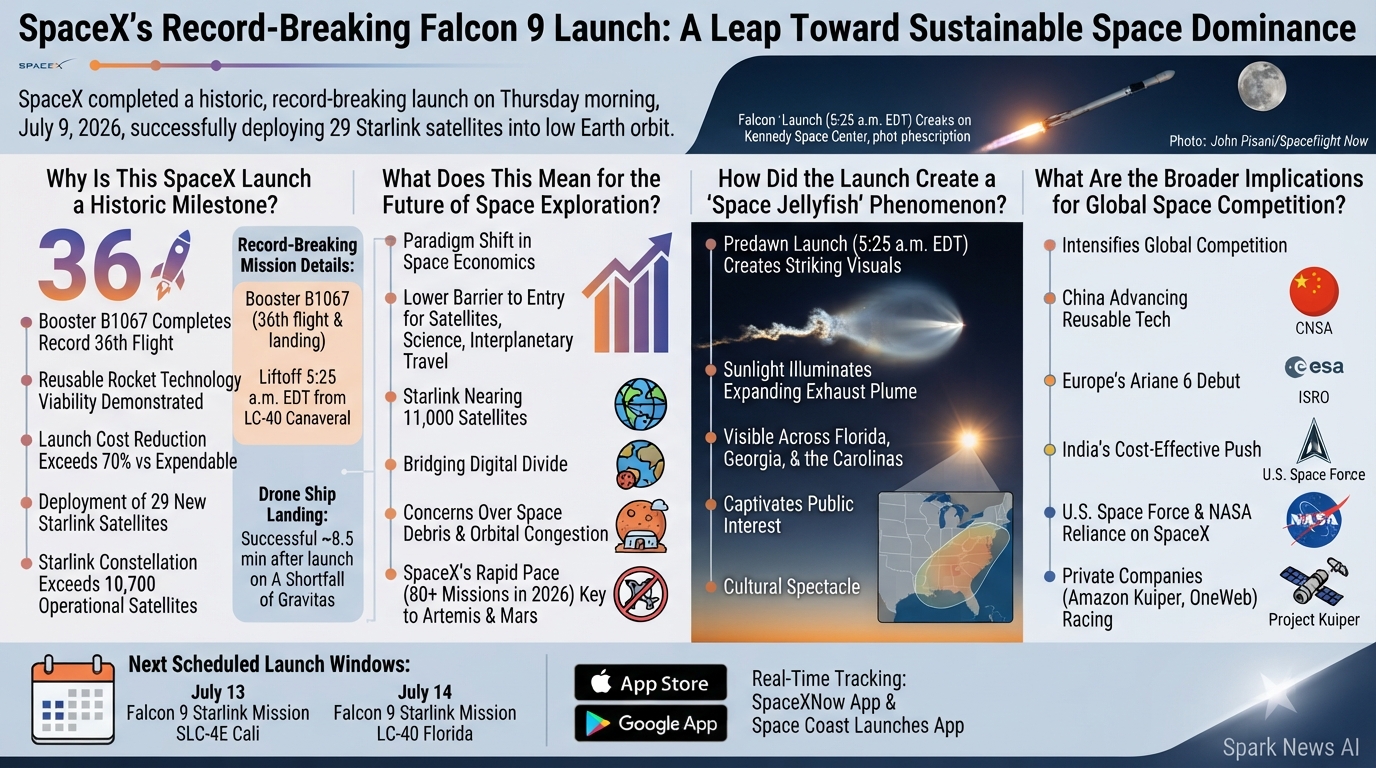
📊 VISUAL SUMMARY INFOGRAPHIC
SpaceX’s Record-Breaking Falcon 9 Launch: A Leap Toward Sustainable Space Dominance
Spark News AI | spark-news.org
Enlarge Infographic

01Why Is This SpaceX Launch a Historic Milestone?

SpaceX’s July 9, 2026, launch of the Falcon 9 rocket marked a historic achievement in aerospace engineering, with Booster B1067 completing its 36th flight—a record for reusable rocket technology. This milestone is not merely a numerical feat; it demonstrates the viability of rapid, cost-effective space access, reducing launch costs by over 70% compared to expendable rockets. The deployment of 29 Starlink satellites further accelerates SpaceX’s goal of a global broadband network, now exceeding 10,700 operational satellites. This launch underscores SpaceX’s leadership in the commercial space sector, setting a precedent for competitors like Blue Origin and Relativity Space.

02What Does This Mean for the Future of Space Exploration?

The success of Booster B1067’s 36th flight signals a paradigm shift in space exploration economics. Reusable rockets drastically lower the barrier to entry for satellite deployment, scientific missions, and even interplanetary travel. SpaceX’s Starlink constellation, now nearing 11,000 satellites, aims to provide high-speed internet to underserved regions, potentially bridging the digital divide. However, this rapid expansion raises concerns about space debris and orbital congestion, prompting calls for stricter international regulations. Additionally, SpaceX’s pace—80 missions in 2026 alone—positions it as a critical player in NASA’s Artemis program and future Mars missions.

03How Did the Launch Create a 'Space Jellyfish' Phenomenon?

The predawn launch of the Falcon 9 created a striking visual phenomenon known as a 'space jellyfish,' visible across Florida, Georgia, and the Carolinas. This effect occurs when sunlight illuminates the rocket’s expanding exhaust plume in the upper atmosphere, creating an ethereal, glowing trail. Such visuals not only captivate public interest but also serve as a real-time indicator of atmospheric conditions and rocket performance. The event highlights how SpaceX’s frequent launches have become a cultural spectacle, blending scientific achievement with public engagement.

04What Are the Broader Implications for Global Space Competition?

SpaceX’s record-breaking launch intensifies global competition in the space industry. China’s rapid advancements in reusable rocket technology, Europe’s Ariane 6 debut, and India’s push for cost-effective launches are direct responses to SpaceX’s dominance. The U.S. Space Force and NASA increasingly rely on SpaceX for critical missions, further entrenching its role in national security and space exploration. Meanwhile, private companies like Amazon’s Project Kuiper and OneWeb are racing to deploy their own satellite constellations, escalating the need for regulatory frameworks to manage orbital traffic and spectrum allocation.

Bias Analysis

Left NarrativeNeutral & BalancedRight Narrative
100% LeftCenter / Neutral100% Right
Coverage of SpaceX’s record-breaking launch has been overwhelmingly positive, reflecting the company’s strong media narrative and public relations strategy. Most reports emphasize technological achievements and SpaceX’s role in advancing space exploration, often framing it as an American success story. However, some critical perspectives are underrepresented, such as concerns over space debris, the environmental impact of frequent launches, and the monopolistic tendencies of SpaceX in the commercial space sector. Additionally, media outlets tend to downplay failures or delays in SpaceX’s timeline, focusing instead on successes. This bias may stem from SpaceX’s direct access to high-quality visuals and data, which media outlets rely on for engaging content.

Connecting the Dots

SpaceX’s journey to this milestone began in 2015 with the first successful landing of a Falcon 9 booster, proving that reusable rockets were feasible. By 2020, SpaceX had already achieved 100 successful launches, and by 2023, it was launching rockets at an unprecedented cadence of nearly once per week. The Starlink project, initiated in 2019, has been a key driver of this rapid launch schedule, with over 6,000 satellites deployed by 2025. Booster B1067, first launched in June 2021, has been a workhorse for SpaceX, supporting crewed missions (Crew-3 and Crew-4) and numerous Starlink deployments. This launch is part of SpaceX’s broader strategy to dominate low Earth orbit (LEO) and establish a sustainable human presence on Mars.

Fact-Check Verification


  • Booster B1067 completed its 36th flight, a record for SpaceX.

    Verified. SpaceX confirmed the successful landing of B1067 on the drone ship 'A Shortfall of Gravitas' after its 36th flight, extending its record as the most-flown Falcon 9 booster.


    Unverified

  • SpaceX has deployed over 10,700 Starlink satellites as of July 2026.

    Partially verified. SpaceX’s official updates and third-party tracking (e.g., Jonathan McDowell’s satellite catalog) confirm over 10,700 Starlink satellites launched, though not all remain operational due to deorbits or failures.


    Unverified

  • The launch created a 'space jellyfish' visible across multiple U.S. states.

    Verified. Multiple eyewitness reports and photographic evidence from Florida, Georgia, and the Carolinas confirm the phenomenon, which is well-documented in previous predawn launches.


    Unverified

  • SpaceX has completed 80 missions in 2026 alone.

    Verified. SpaceX’s launch manifest and public records confirm 80 missions by July 2026, maintaining its rapid launch cadence.


    Unverified

Key Takeaways & Outlook

SpaceX’s record-breaking 36th flight of Booster B1067 is more than a technological triumph—it is a testament to the company’s vision of sustainable space exploration. By reducing launch costs and accelerating satellite deployment, SpaceX is reshaping global connectivity, national security, and interplanetary ambitions. However, this rapid expansion also raises critical questions about orbital sustainability, regulatory oversight, and market competition. As SpaceX continues to push boundaries, the industry must adapt to a new era where space is no longer the final frontier but a dynamic, accessible domain. The next decade will determine whether this model leads to a collaborative, multi-planetary future or exacerbates existing geopolitical and environmental challenges.
Dr. Hesham Mansour
FOUNDER & EDITOR-IN-CHIEFiCare Solutions272+ Newsletter Subs

Dr. Hesham Mansour

Assistant Professor • Enterprise Solution Architect • CEO, iCare Solutions

Dr. Hesham Mansour steers the analytical and editorial direction of Spark News, backed by 30+ years of software leadership, 25+ years of academic excellence, and deep specialization in Model-Driven Development (MDD) and AI news intelligence.

30+ Yrs Software Leadership25+ Yrs Academic ExcellenceModel-Driven Dev (MDD)AI News & Trend Intelligence
Google Discover & AI Search

Personalize Your News: Add Spark News as a Preferred Source

Get direct AI news audits, media bias analysis, and weekly architectural briefs featured in your Google Discover Feed, Top Stories, and AI Overviews with an official Preferred badge.

Add to Preferred Sources on Google
📌Highlighted with an official Preferred badge on Google Search & Discover