More Services

AI Clones Students to Fix Broken Tutors
Spark News AI | spark-news.org
📱 Web StoryOctober 15, 2026⏱️4 min read

AI Clones Students to Fix Broken Tutors

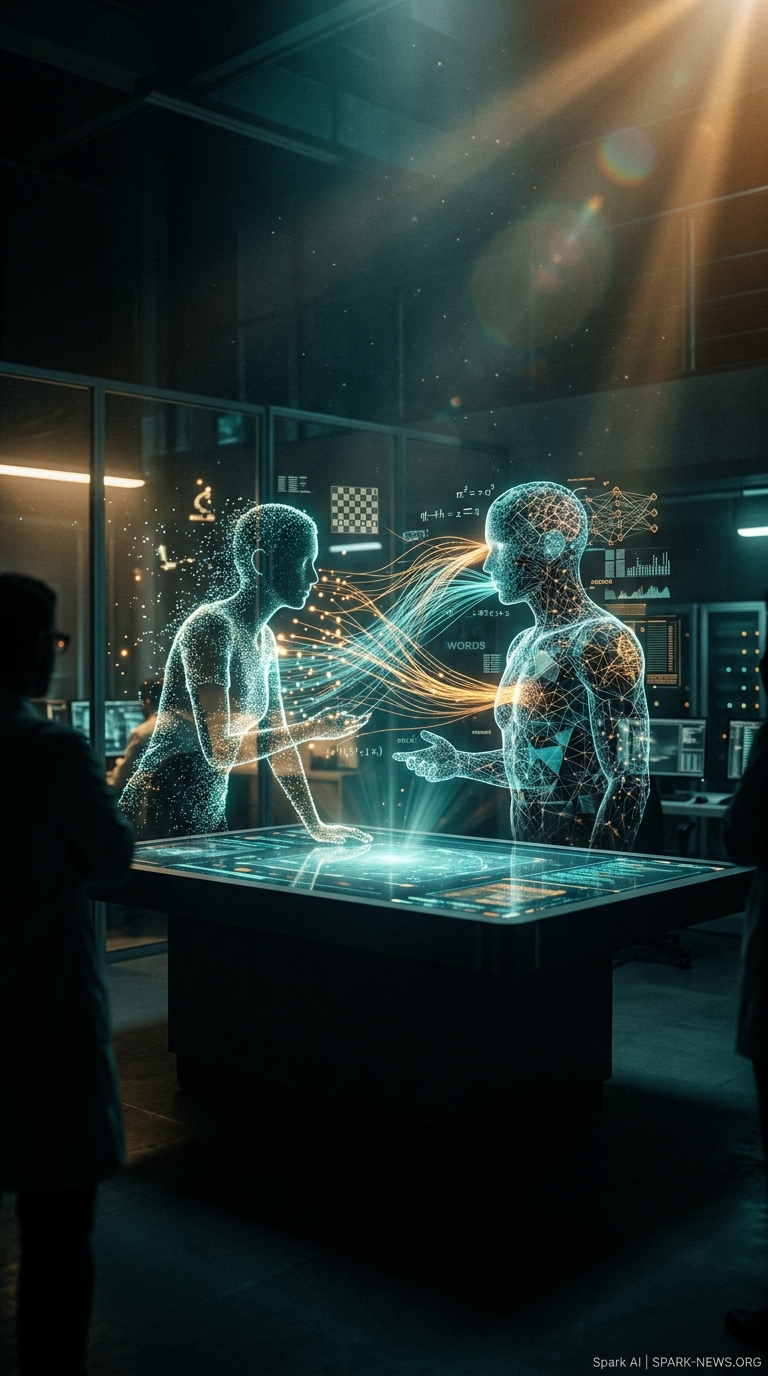
📷A glowing holographic desk displaying dual silhouettes of a digital student and an AI tutor exchanging dynamic neural signals in 9:16 vertical framing.
Weekly LinkedIn Newsletter405+ Subs

Get weekly AI news audits & executive briefs directly in your LinkedIn inbox with 405+ tech leaders.

Subscribe on LinkedIn
AI EXECUTIVE SUMMARY

"Microsoft Research introduced StudentSim, a framework creating AI student digital twins from de-identified data. By modeling authentic errors and reactions to hints across math, writing, and chess, it trains AI tutors without risking costly trials on real pupils."

  • The Spark That Lit the Story
  • The Core Data & Verified Numbers
  • Public Reaction & Controversy
  • Future Outlook & What Lies Ahead
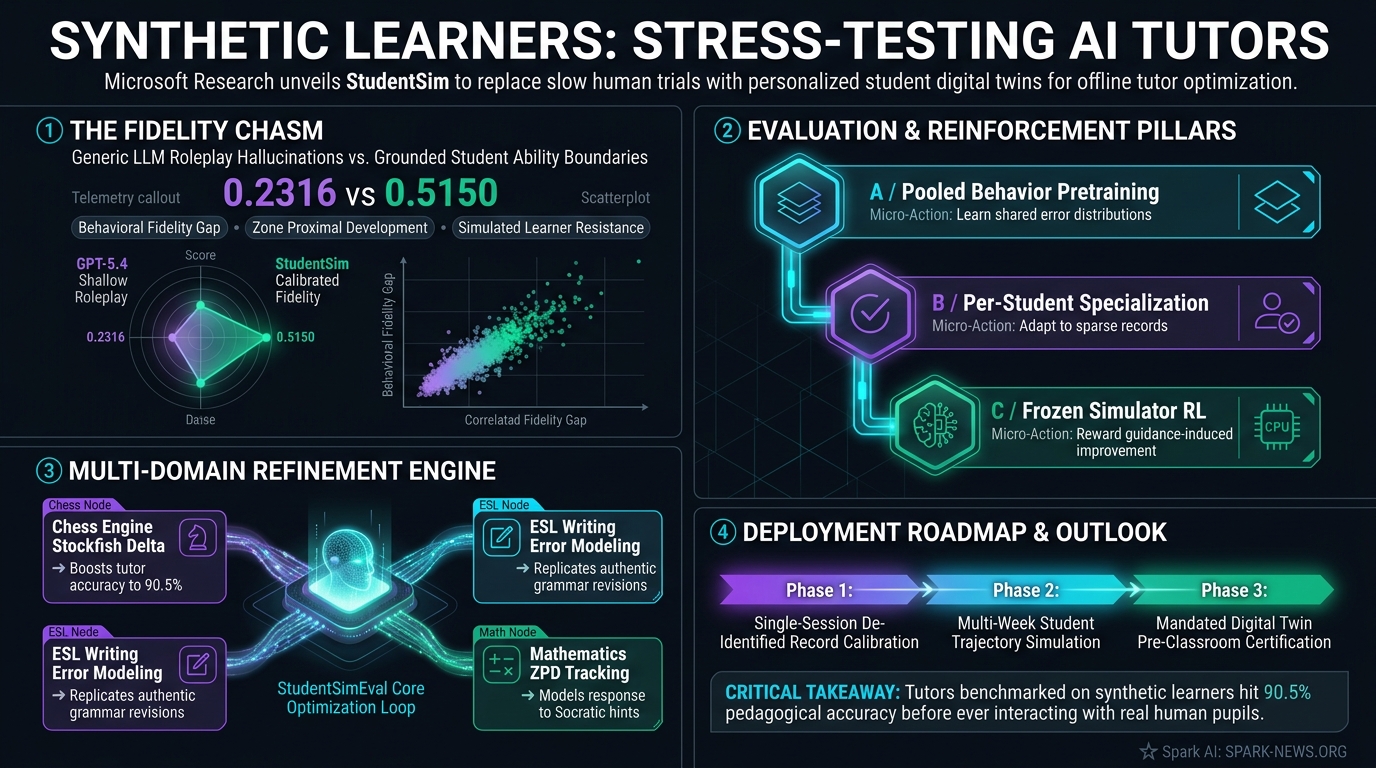
📊 VISUAL SUMMARY INFOGRAPHIC
AI Clones Students to Fix Broken Tutors
Spark News AI | spark-news.org
Enlarge Infographic

01The Spark That Lit the Story

Building an effective AI tutor requires understanding not just how to deliver facts, but how students absorb corrections. Microsoft Research published StudentSim to solve the expensive bottleneck of human trial runs. When engineers evaluate models on real pupils, iteration takes months. By building personalized student simulators from public, de-identified datasets, developers can simulate learner resistance, misunderstandings, and gradual breakthroughs at scale.

02The Core Data & Verified Numbers

StudentSim addresses both behavioral fidelity and guidance responsiveness. In benchmark tests across chess coaching, mathematics, and ESL writing, standard large language models faltered. Prompted GPT-5.4 reached only 0.2316 in behavioral fidelity, routinely using advanced reasoning beyond a struggling student's actual capacity. StudentSim hit 0.5150 fidelity and 0.9067 guidance responsiveness. When reinforcement learning algorithms trained tutors using StudentSim feedback, blind expert evaluations scored tutor accuracy at 90.5%, compared to 71.6% for tutors trained against generic GPT-5.4 feedback.

03Public Reaction & Controversy

Educators have voiced mixed reactions to synthetic learner data. While privacy advocates applaud the fact that StudentSim exclusively uses anonymized, publicly cleared data without live classroom surveillance, pedagogical experts question whether synthetic interaction captures the full socio-emotional nuance of real classroom struggle. Microsoft clarified that StudentSim is an offline lab bench for developers, strictly avoiding classroom deployment or teacher displacement.

04Future Outlook & What Lies Ahead

The public release of the StudentSimEval benchmark invites the broader AI community to standardize how educational bots are vetted. Instead of releasing unchecked models directly to vulnerable learners, future regulatory and educational frameworks may mandate digital twin stress-testing. Microsoft plans to scale the architecture from single-session interactions to multi-week student trajectory tracking across diverse STEM and humanities disciplines.

Bias Analysis

Left NarrativeNeutral & BalancedRight Narrative
100% LeftCenter / Neutral100% Right
Microsoft presents StudentSim as an ethical safety layer that reduces research reliance on testing incomplete tools on minors. Sceptics and teacher organizations counter that over-reliance on synthetic digital twins risks blinding developers to unexpected real-world classroom behaviors.

Connecting the Dots

AI tutoring systems frequently hallucinate or supply hints that inadvertently reveal complete answers because their reward functions lack genuine learner feedback. Traditional student models captured past answers but ignored natural language advice, while frontier language models role-played too intelligently. StudentSim bridges this gap by grounding synthetic responses directly in empirical learner histories.

Fact-Check Verification

  • StudentSim trains personalized AI student models to act as training dummies for AI tutors.
  • Tutors optimized against StudentSim scored 90.5% accuracy versus 71.6% using generic LLM baselines.
  • The open-source framework relies entirely on de-identified, publicly cleared datasets.

Key Takeaways & Outlook

Quality teaching is measured by student progress, making validated digital student twins essential before AI tutors enter real classrooms.
🗳️Community Intelligence Poll
1-Click Vote

How do you assess the strategic impact of this development on enterprise architecture?

Dr. Hesham Mansour, Ph.D.
FOUNDER & EDITOR-IN-CHIEF🎓Ph.D. Systems ArchitectureiCare Solutions405+ Newsletter Subs

Dr. Hesham Mansour, Ph.D.

Assistant Professor • Enterprise Solution Architect • CEO, iCare Solutions

Dr. Hesham Mansour steers the analytical and editorial direction of Spark News, backed by 30+ years of software leadership, 25+ years of academic excellence, and deep specialization in Model-Driven Development (MDD) and AI news intelligence.

✨ Ph.D. Enterprise Systems Architecture✨ 30+ Yrs Software Leadership✨ 25+ Yrs Academic Excellence✨ Model-Driven Architecture (MDD)✨ AI Systems & GEO Citation Research
⭐Google Discover & AI Search

Personalize Your News: Add Spark News as a Preferred Source

Get direct AI news audits, media bias analysis, and weekly architectural briefs featured in your Google Discover Feed, Top Stories, and AI Overviews with an official Preferred badge.

Add to Preferred Sources on Google→
📌Highlighted with an official Preferred badge on Google Search & Discover