news-analysisJuly 8, 2026
GPT-5.6 Unlocked: How the Trump Administration’s Green Light Reshapes AI’s Future

Spark News AI | spark-news.org
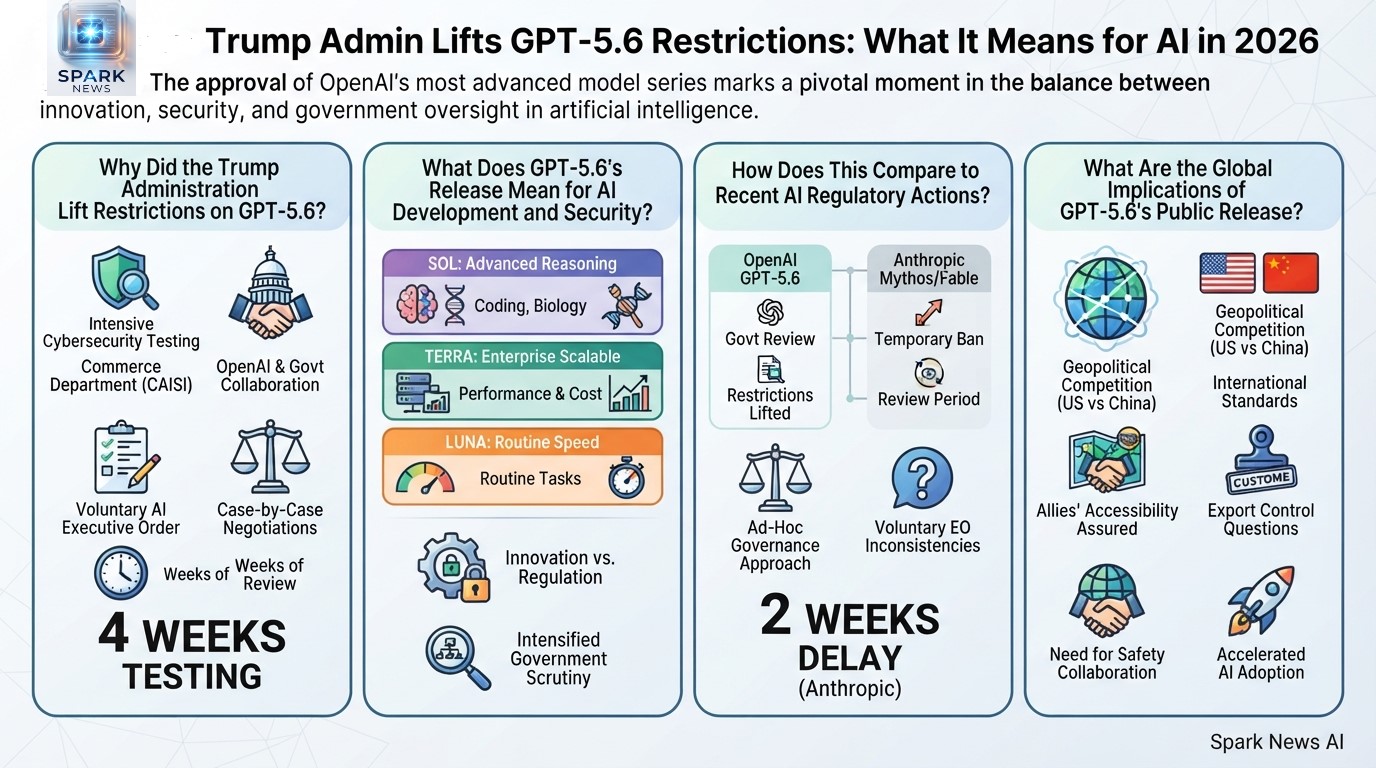
Enlarge Infographic
AI EXECUTIVE SUMMARY
"The Trump administration has approved OpenAI's GPT-5.6 for public launch after cybersecurity reviews. Explore why this matters for AI innovation, national security, and global tech competition in 2026, and what it signals for future AI regulation."
- Why Did the Trump Administration Lift Restrictions on GPT-5.6?
- What Does GPT-5.6’s Release Mean for AI Development and Security?
- How Does This Compare to Recent AI Regulatory Actions?
- What Are the Global Implications of GPT-5.6’s Public Release?
01Why Did the Trump Administration Lift Restrictions on GPT-5.6?
The Trump administration’s decision to approve OpenAI’s GPT-5.6 for public release follows weeks of intensive cybersecurity testing by the Department of Commerce’s Center for AI Standards and Innovation (CAISI). Officials were particularly concerned about the model’s potential to identify software vulnerabilities, a capability that could pose national security risks if misused. OpenAI collaborated closely with government evaluators, dispatching technical experts to Washington, D.C., to address concerns in real time. This approval reflects a broader trend of case-by-case negotiations between AI developers and regulators, as the U.S. government seeks to balance innovation with security in the absence of formalized AI release standards. The move also aligns with President Trump’s recent AI executive order, which established a voluntary testing framework for advanced models, though critics argue it lacks long-term clarity.
02What Does GPT-5.6’s Release Mean for AI Development and Security?
GPT-5.6’s public launch introduces a tiered model lineup—Sol, Terra, and Luna—designed to cater to diverse use cases, from advanced scientific research to cost-effective routine tasks. The flagship model, Sol, is optimized for complex reasoning, such as biological research and coding, while Terra and Luna offer scalable performance for enterprises and developers. However, the staggered release process underscores growing tensions between AI innovation and regulatory oversight. The Trump administration’s intervention highlights concerns about the dual-use nature of AI, where models capable of identifying cybersecurity flaws could also be exploited by malicious actors. This approval sets a precedent for future AI releases, signaling that government scrutiny will likely intensify as models grow more powerful.
03How Does This Compare to Recent AI Regulatory Actions?
The approval of GPT-5.6 follows a pattern of regulatory interventions targeting leading AI firms. Just weeks prior, Anthropic faced a similar situation when the Trump administration temporarily banned its Mythos and Fable models due to security concerns, only to lift restrictions after further review. These actions reflect an ad-hoc approach to AI governance, where the U.S. government is navigating uncharted territory without established legal frameworks. While the administration’s executive order on AI testing provides a voluntary process, it lacks binding regulations, leaving room for interpretation and potential inconsistencies. Industry advocates argue that such interventions could stifle innovation, while security experts emphasize the need for proactive safeguards. The GPT-5.6 approval may serve as a test case for future AI policy, shaping how governments worldwide approach the regulation of advanced models.
04What Are the Global Implications of GPT-5.6’s Public Release?
The U.S. government’s approval of GPT-5.6 carries significant geopolitical implications, particularly in the context of global AI competition. As the U.S. and China vie for dominance in artificial intelligence, regulatory decisions like this one could influence international standards and market access. The Trump administration’s cautious approach contrasts with China’s more centralized AI governance, where state-led initiatives often prioritize rapid deployment. Additionally, the approval may alleviate concerns among U.S. allies about the accessibility of advanced AI tools, particularly in cybersecurity and defense. However, it also raises questions about export controls and whether similar restrictions could be imposed on foreign entities seeking access to GPT-5.6. The model’s public release could accelerate AI adoption across industries, but it also underscores the need for international collaboration on AI safety and ethics.
Bias Analysis
Left NarrativeNeutral & BalancedRight Narrative
100% LeftCenter / Neutral100% Right
The coverage of GPT-5.6’s approval exhibits subtle but notable biases, particularly in framing the Trump administration’s role. Pro-business outlets, such as Axios and SQ Magazine, emphasize the positive impact on innovation and market accessibility, portraying the government’s intervention as a necessary but temporary hurdle. In contrast, some policy-focused sources highlight the potential risks of ad-hoc regulation, framing the administration’s actions as overreach that could stifle AI development. There is also a tendency to downplay the broader implications of government influence over private AI releases, with most reports focusing on immediate outcomes rather than long-term policy shifts. Additionally, the lack of diverse perspectives—such as input from cybersecurity experts or international regulators—limits the depth of analysis, leaving room for interpretation that may favor either industry or government narratives.
Connecting the Dots
The approval of GPT-5.6 occurs against the backdrop of escalating tensions between AI innovation and regulatory oversight. In 2025, the U.S. government began taking a more active role in scrutinizing advanced AI models, driven by concerns over national security, misinformation, and cyber threats. President Trump’s AI executive order in early 2026 formalized a voluntary testing process for AI developers, requiring them to submit models for government review before public release. This shift followed high-profile incidents, such as the misuse of AI-generated deepfakes in political campaigns and the exploitation of AI tools by cybercriminals. The creation of the Center for AI Standards and Innovation (CAISI) within the Department of Commerce marked a significant step toward institutionalizing AI oversight, though its authority remains limited. The GPT-5.6 approval reflects the evolving dynamics of this regulatory landscape, where government agencies and AI firms are navigating uncharted territory in real time.
Fact-Check Verification
- OpenAI’s GPT-5.6 models (Sol, Terra, and Luna) were approved for public release by the U.S. Department of Commerce after cybersecurity testing by the Center for AI Standards and Innovation (CAISI). This is confirmed by multiple sources, including Axios and OpenAI’s official announcement.
- The Trump administration initially requested a staggered release of GPT-5.6, limiting access to government-approved entities. OpenAI complied but stated this was not its preferred approach. This aligns with reports from The Hill and SQ Magazine.
- Anthropic faced similar restrictions in June 2026, with the Trump administration temporarily banning its Mythos and Fable models due to security concerns. The ban was lifted after further review, as reported by Axios.
- President Trump’s AI executive order established a voluntary testing process for AI models, requiring developers to submit models for review up to 30 days before release. This is a verified policy directive from early 2026.
- OpenAI’s CEO, Sam Altman, confirmed the public release of GPT-5.6 on social media platform X, stating, “happy building,” which was widely reported by tech and mainstream media outlets.
Key Takeaways & Outlook
The Trump administration’s approval of OpenAI’s GPT-5.6 marks a critical juncture in the evolution of AI regulation. While the decision reflects a cautious but pragmatic approach to balancing innovation and security, it also highlights the challenges of governing rapidly advancing technologies without established legal frameworks. The tiered release of GPT-5.6—Sol, Terra, and Luna—demonstrates OpenAI’s commitment to accessibility, but the government’s intervention underscores the growing influence of regulatory bodies in shaping AI’s trajectory. Looking ahead, this approval could set a precedent for future model releases, with implications for global AI competition, cybersecurity, and international collaboration. As AI continues to permeate industries and governments, the need for clear, consistent, and adaptive regulatory policies will become increasingly urgent. The GPT-5.6 launch is not just a milestone for OpenAI but a bellwether for the future of AI governance.