
Spark News AI | spark-news.org
executive-briefSeptember 18, 2026⏱️7 min read
Rewiring Insurance: Escaping Pilot Purgatory for Real Enterprise Value
📷An insurance executive reviews multiagent workflow operations across claims and underwriting domains on an integrated enterprise dashboard.
Weekly LinkedIn Newsletter374+ Subs
Get weekly AI news audits & executive briefs directly in your LinkedIn inbox with 374+ tech leaders.
🎓Executive Brief | Dr. Hesham Mansour, Ph.D.
AI EXECUTIVE PERSPECTIVE & SUMMARY
"Discover how insurance leaders break free from pilot purgatory by rewiring entire domains with generative and agentic AI, delivering proven shareholder value and real operational growth."
- The Core Dilemma: The Trap of Isolated Experimentation
- Core Pillars & Realities
- The Strategic & Practical Mandate
📊 VISUAL SUMMARY INFOGRAPHIC
Spark News AI | spark-news.org
Enlarge Infographic
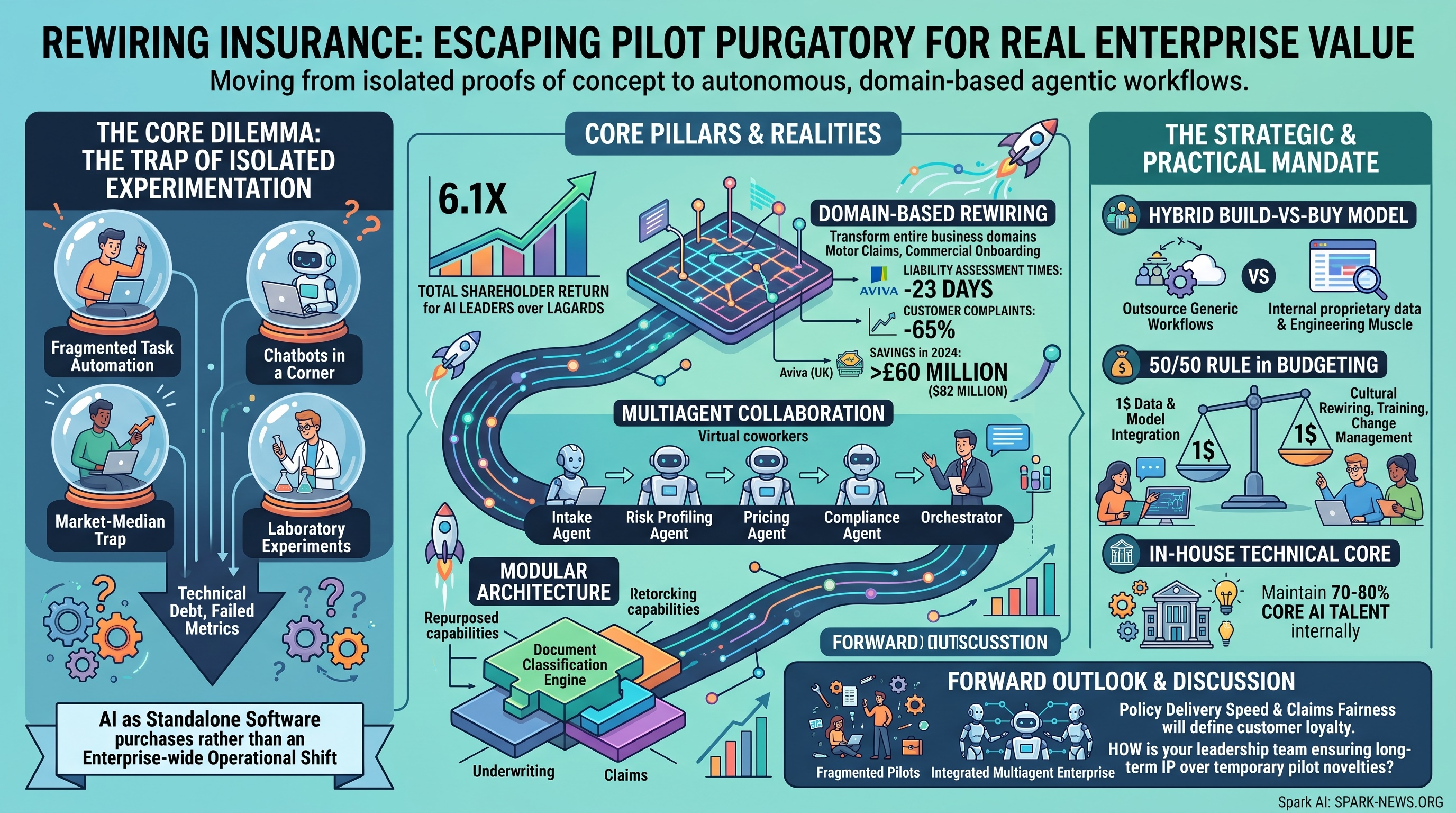
📊Rewiring Insurance: The strategic journey from pilot purgatory to real enterprise value through domain-based, agentic AI.
Share Chart on LinkedIn01The Core Dilemma: The Trap of Isolated Experimentation
For years, insurance carriers have treated artificial intelligence like a shiny laboratory experiment. Teams spin up proofs of concept, test chatbots in isolated corners, and declare victory when an algorithm works inside a controlled sandbox. Yet, when quarter-end comes, the balance sheet tells a starkly different story. These scattered initiatives remain trapped in pilot purgatory, failing to shift core operational metrics or protect market share.
The real dilemma lies in treating AI as a series of standalone software purchases rather than an enterprise-wide operational shift. When carriers simply buy off-the-shelf tools, they fall straight into the market-median trap. They incur technical debt without building any defensible competitive advantage. Meanwhile, modern policyholders expect seamless, empathetic, and immediate digital service. Bridging this gap requires moving beyond fragmented task automation to fundamentally restructure how insurance work gets done.
The real dilemma lies in treating AI as a series of standalone software purchases rather than an enterprise-wide operational shift. When carriers simply buy off-the-shelf tools, they fall straight into the market-median trap. They incur technical debt without building any defensible competitive advantage. Meanwhile, modern policyholders expect seamless, empathetic, and immediate digital service. Bridging this gap requires moving beyond fragmented task automation to fundamentally restructure how insurance work gets done.
02Core Pillars & Realities
To turn technology investments into sustainable financial results, carriers must understand the structural shifts separating market leaders from laggards.
- The Shareholder Return Divide: Over the past five years, research demonstrates that insurance AI leaders have generated 6.1 times the Total Shareholder Return of laggards. Transformation is not an academic exercise; it dictates long-term commercial survival.
- The Domain-Based Rewiring Model: Instead of scattering resources across dozens of disconnected use cases, top-tier insurers focus on transforming entire business domains, such as motor claims or commercial onboarding. In the UK, Aviva deployed more than 80 AI models across its claims domain. This initiative slashed liability assessment times by 23 days, cut customer complaints by 65%, and saved over £60 million ($82 million) in 2024 alone.
- The Power of Multiagent Collaboration: The industry is advancing from basic analytical models to multiagent systems acting as virtual coworkers. In an onboarding workflow, specialized agents collaborate sequentially: an intake agent processes complex medical files, a risk profiling agent checks underwriting rules, a pricing agent structures tailored riders, and a compliance agent ensures fairness before passing the file to a human orchestrator.
- Modular Architecture and Reusability: A composable agentic mesh prevents carriers from being locked into a single model vendor. Furthermore, developing shared capabilities yields massive compounding returns. A document classification engine built for underwriting can be instantly repurposed for claims, drastically reducing development overhead across the organization.
03The Strategic & Practical Mandate
Transitioning to an AI-native organization requires clear, pragmatic leadership. Executives can steer their organizations forward using several decisive actions.
First, adopt a hybrid build-versus-buy operating model. Outsource generic capabilities like human resources, standard finance workflows, and procurement to vetted enterprise vendors. Dedicate your internal engineering muscle and proprietary data to core differentiators such as underwriting risk engines and proprietary claims processing.
Second, honor the 50/50 rule in transformation budgeting. For every dollar allocated to data engineering and model integration, invest an equal dollar into cultural rewiring, training, and operational change management. AI succeeds only when underwriters and claims adjusters stop blaming the tool and start taking personal ownership of its refinement.
Third, establish an in-house technical core. Strive to maintain 70 to 80 percent of your core AI talent internally. Building in-house capabilities ensures that your strategic knowledge, algorithmic intellectual property, and enterprise adaptability remain firmly inside your building.
First, adopt a hybrid build-versus-buy operating model. Outsource generic capabilities like human resources, standard finance workflows, and procurement to vetted enterprise vendors. Dedicate your internal engineering muscle and proprietary data to core differentiators such as underwriting risk engines and proprietary claims processing.
Second, honor the 50/50 rule in transformation budgeting. For every dollar allocated to data engineering and model integration, invest an equal dollar into cultural rewiring, training, and operational change management. AI succeeds only when underwriters and claims adjusters stop blaming the tool and start taking personal ownership of its refinement.
Third, establish an in-house technical core. Strive to maintain 70 to 80 percent of your core AI talent internally. Building in-house capabilities ensures that your strategic knowledge, algorithmic intellectual property, and enterprise adaptability remain firmly inside your building.
🔮Forward Outlook & Discussion
The coming years will separate carriers into two distinct groups: those running fragmented pilots and those operating as integrated, multiagent enterprises. As autonomous decision systems mature, the speed of policy delivery and claims fairness will define customer loyalty. How is your leadership team ensuring that current AI investments build long-term intellectual property rather than temporary pilot novelties?
🗳️Community Intelligence Poll
1-Click VoteHow do you assess the strategic impact of this development on enterprise architecture?

FOUNDER & EDITOR-IN-CHIEF🎓Ph.D. Systems ArchitectureiCare Solutions374+ Newsletter Subs
Dr. Hesham Mansour, Ph.D.
Assistant Professor • Enterprise Solution Architect • CEO, iCare Solutions
Dr. Hesham Mansour steers the analytical and editorial direction of Spark News, backed by 30+ years of software leadership, 25+ years of academic excellence, and deep specialization in Model-Driven Development (MDD) and AI news intelligence.
✨ Ph.D. Enterprise Systems Architecture✨ 30+ Yrs Software Leadership✨ 25+ Yrs Academic Excellence✨ Model-Driven Architecture (MDD)✨ AI Systems & GEO Citation Research