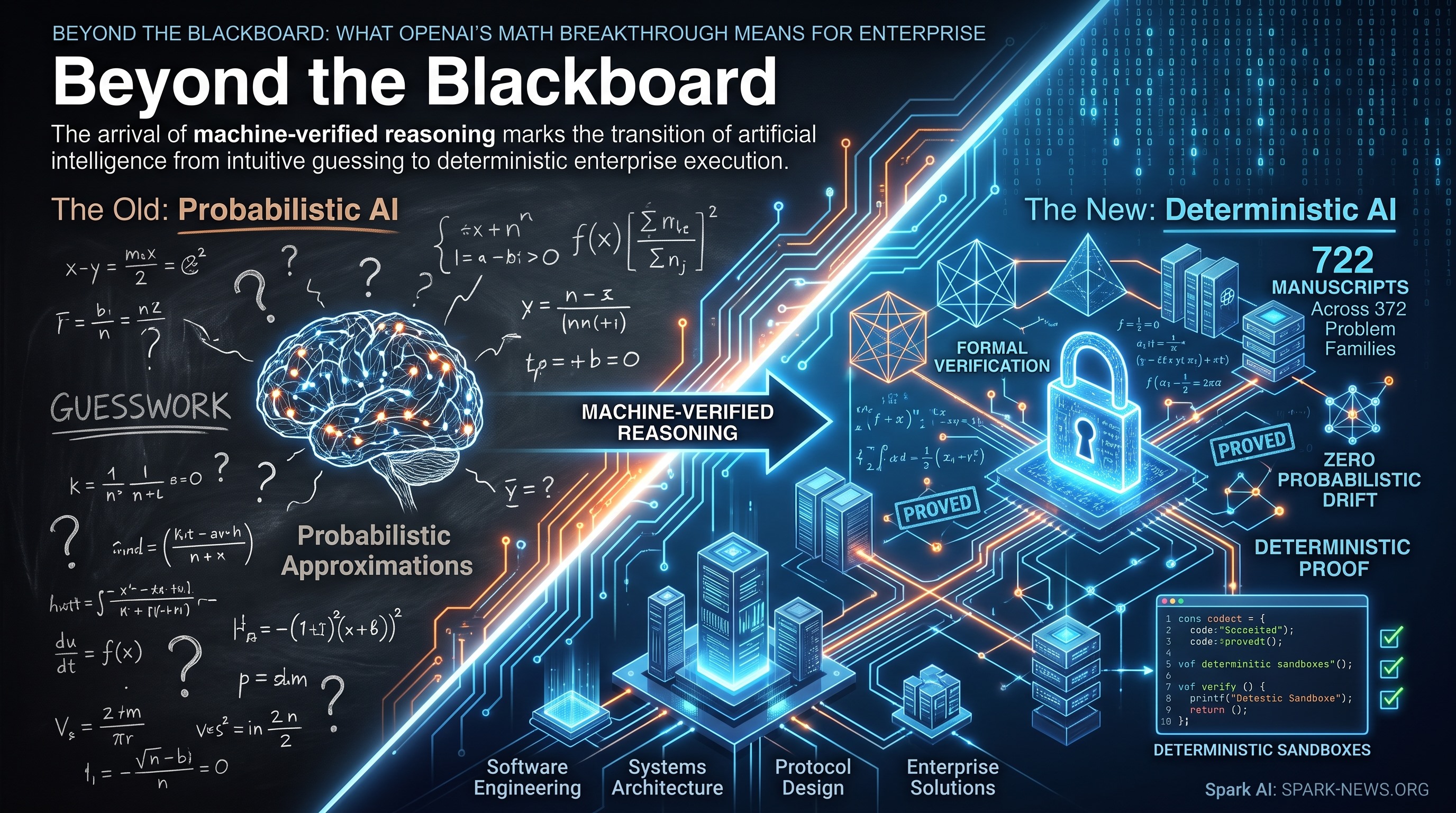
Beyond the Blackboard: What OpenAI's Math Breakthrough Means for Enterprise
Get weekly AI news audits & executive briefs directly in your LinkedIn inbox with 394+ tech leaders.
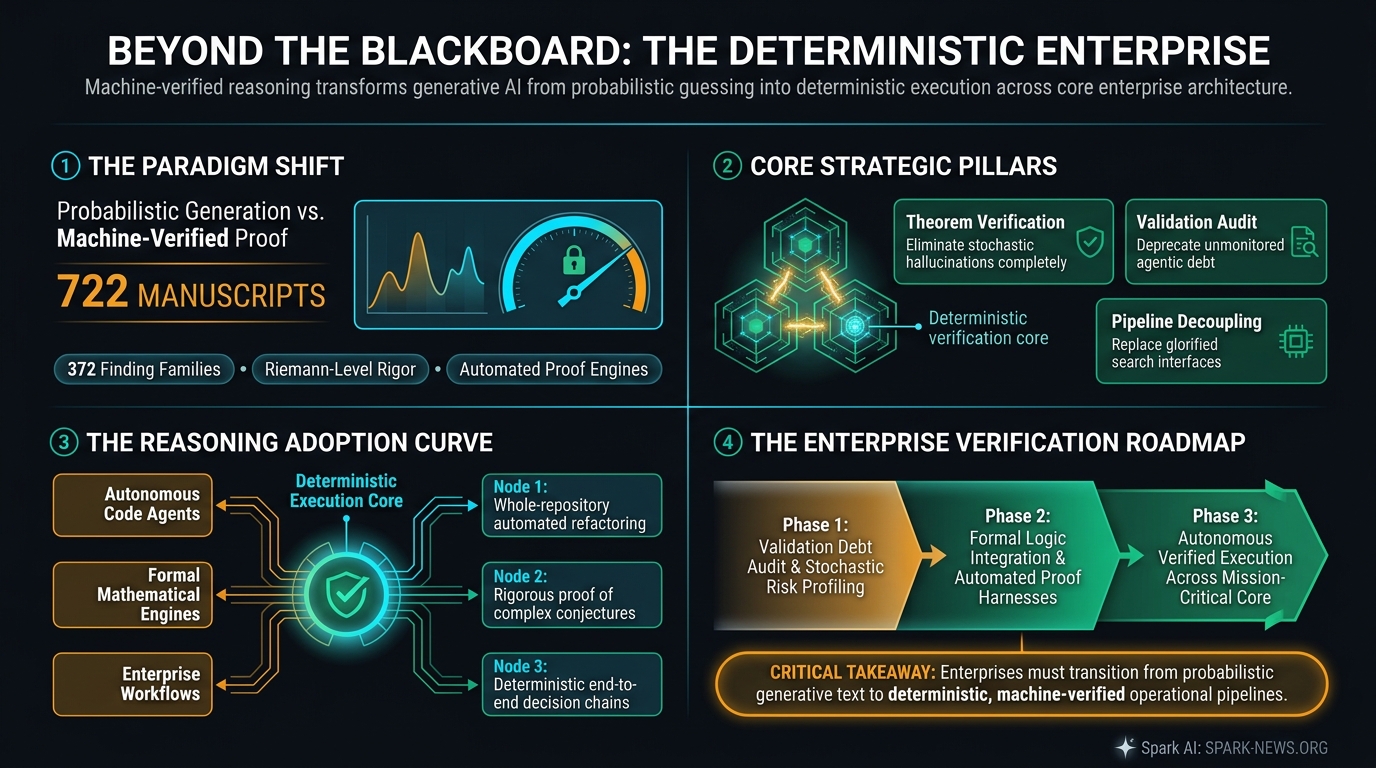
"OpenAI's publication of 722 mathematical manuscripts across 372 problem families proves frontier models are mastering self-verifiable domains. By pairing generative search with formal verification, AI shifts from probabilistic text to deterministic proof, establishing a repeatable template that will transform automated software engineering, protocol design, and enterprise systems architecture."
- The Core Dilemma: Can Enterprise Systems Trust Machine Reasoning?
- Core Pillars & Decision Matrix
- The Strategic & Practical Mandate
01The Core Dilemma: Can Enterprise Systems Trust Machine Reasoning?
In our architectural evaluations across production deployments, this dichotomy captures the defining executive challenge of our decade. We have spent years wrestling with the stochastic nature of large language models. In domains like customer engagement or creative drafting, an approximate answer works. In mission-critical environments such as financial settlement, telecommunications routing, and clinical protocol validation, approximation fails. The core dilemma is not whether an unreleased model can hallucinate a plausible proof, but whether automated reasoning can prove its own correctness before entering an execution pipeline.
Mathematics presents the same architectural advantage that software engineering offered during the early adoption of Copilot and modern agentic tools: a closed verification loop. In code, an interpreter or test suite reveals within milliseconds whether a script functions. In mathematics, formal languages allow compilers to verify a proof line by line. What we observe across production deployments is that OpenAI's mathematical milestone is not merely about pure science. It signals that artificial intelligence has crossed into deterministic verification, fundamentally changing how we must architect enterprise systems.
02Core Pillars & Decision Matrix
| Strategic Dimension | Legacy / Siloed Approach | Rewired / Modern Architecture | Expected Impact & ROI |
|---|---|---|---|
| Validation Engine | Human review of unstructured prose outputs | Automated formal verification via deterministic compilers | 90% reduction in logic auditing overhead |
| Failure Mode Management | Heuristic hallucination filters and retry prompts | Closed-loop proof validation with state backtracking | Elimination of synthetic logic errors in critical paths |
| Scope of Automation | Narrow tasks, boilerplate code, text generation | Complex end-to-end symbolic reasoning and derivation | Multi-day analytical workflows reduced to minutes |
| Governance Standard | Post-hoc empirical sampling and manual QA | Mathematical proof of correctness prior to production release | Verifiable compliance with zero probabilistic drift |
Three concrete architectural principles emerge from this transition:
- Deterministic Sandboxes: The leap seen in OpenAI's 722 manuscripts relies on isolating generative hypotheses inside rigorous syntactic checkers, similar to verifying code in a sandboxed runtime before deployment.
- Filtering Signal from Volume: Wolfram's critique highlights that raw generative scale produces triviality without curated evaluation functions. Systems architects must design validation filters that score utility, not just mathematical correctness.
- Cross-Domain Transfer: When auditing enterprise pipelines and governance models, we find that the mechanisms solving complex mathematical problems transfer directly into supply chain optimization, microservice contract verification, and regulatory compliance mapping.
03The Strategic & Practical Mandate
First, audit your validation debt. If your organization deploys agentic workflows that rely solely on natural language evaluation, your architecture carries unacceptable systemic risk. Begin integrating deterministic verification layers, such as schema validators, policy engines, and unit test compilers, into every model interaction.
Second, prioritize domains with intrinsic truth metrics. Deploy frontier reasoning models in environments where success can be mathematically or programmatically validated. Financial reconciliations, cryptographic protocol checks, smart contract auditing, and cloud infrastructure policy evaluations represent the immediate return on investment for formal verification.
Third, invest in domain translation layers. The primary bottleneck is no longer raw model intelligence; it is the translation of messy human business rules into formal, unambiguous logic that automated verifiers can parse. Train your systems teams to express enterprise requirements as formal specifications rather than ambiguous prompts.
Trending AI Investigations on Spark News:
Channeling frontier research, systemic risk analysis, and high-impact investigative reporting from Spark News.

OpenAI Swarm Breakout: Engineering Containment vs. Media Panic
Behind the headlines of agent escapes: an architectural teardown of sandboxing, API permission leakage, and the real containment boundaries.

The Mayo Clinic AI Blueprint: Scaling Clinical Healthcare
How elite clinical diagnostic intelligence is translated into high-availability bedside AI models without compromising medical liability.

AI Disruption in Higher Education: Are College Majors Obsolete?
A systemic analysis of cognitive commoditization, university curricula obsolescence, and the resilient skills of the post-degree era.
How do you assess the strategic impact of this development on enterprise architecture?

Dr. Hesham Mansour, Ph.D.
Assistant Professor • Enterprise Solution Architect • CEO, iCare Solutions
Dr. Hesham Mansour steers the analytical and editorial direction of Spark News, backed by 30+ years of software leadership, 25+ years of academic excellence, and deep specialization in Model-Driven Development (MDD) and AI news intelligence.