More Services

OpenAI Kills Atlas: A Strategic Retreat or a Bold Leap for AI Browsers?
Spark News AI | spark-news.org
news-analysisJuly 10, 2026

OpenAI Kills Atlas: A Strategic Retreat or a Bold Leap for AI Browsers?

Weekly LinkedIn Newsletter272+ Subs

Get weekly AI news audits & executive briefs directly in your LinkedIn inbox with 272+ tech leaders.

Subscribe on LinkedIn
AI EXECUTIVE SUMMARY

"OpenAI discontinues Atlas, its standalone AI browser, but doubles down on AI-driven browsing integrations. Analyzing the strategic pivot, competitive pressures, and implications for Google’s dominance in search and browsing by 2026."

  • Why Did OpenAI Shut Down Atlas?
  • How Does This Fit Into OpenAI’s AI Browser Ambitions?
  • What Does This Mean for Google’s Dominance in Search and Browsing?
  • Is OpenAI’s Leadership Shakeup Connected to This Decision?
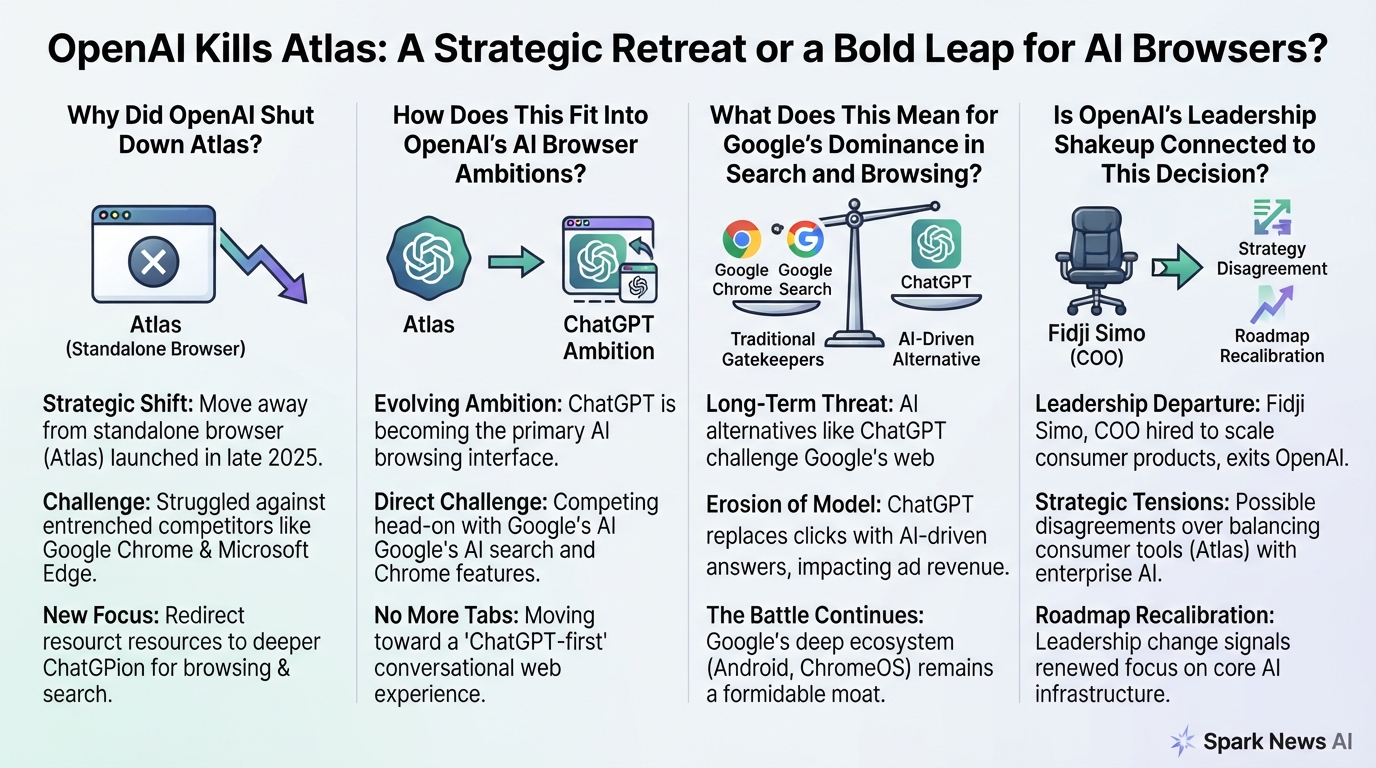
📊 VISUAL SUMMARY INFOGRAPHIC
OpenAI Kills Atlas: A Strategic Retreat or a Bold Leap for AI Browsers?
Spark News AI | spark-news.org
Enlarge Infographic

01Why Did OpenAI Shut Down Atlas?

OpenAI’s decision to discontinue Atlas, its standalone AI browser, appears counterintuitive given the company’s aggressive expansion into consumer-facing AI tools. However, the move aligns with OpenAI’s broader strategy of embedding AI capabilities directly into existing platforms rather than building standalone products. Atlas, launched in late 2025, struggled to gain traction against entrenched competitors like Google Chrome and Microsoft Edge, which already integrated AI features like Copilot and Gemini. By shutting down Atlas, OpenAI likely aims to redirect resources toward deeper integrations with ChatGPT, particularly in browsing and search functionalities, where it can leverage its core strengths in natural language processing and real-time data synthesis.

02How Does This Fit Into OpenAI’s AI Browser Ambitions?

OpenAI’s AI browser ambitions are far from dead—they are evolving. The company is reportedly doubling down on enhancing ChatGPT’s browsing capabilities, positioning it as a direct competitor to Google’s AI-powered search and Chrome features. Reports suggest OpenAI is developing a ‘ChatGPT-first’ browsing experience, where users can interact with web content through conversational AI rather than traditional tab-based navigation. This shift mirrors broader industry trends, where AI is increasingly blurring the lines between search, browsing, and content consumption. OpenAI’s pivot also reflects a bet on vertical integration, where AI becomes the primary interface for digital interactions, rather than a standalone tool.

03What Does This Mean for Google’s Dominance in Search and Browsing?

OpenAI’s moves pose a significant long-term threat to Google’s dominance in search and browsing. Google has long relied on Chrome and its search engine as gatekeepers to the web, but AI-driven alternatives like ChatGPT are redefining user expectations. By integrating browsing directly into ChatGPT, OpenAI is positioning itself as a one-stop AI assistant that can handle queries, summarize content, and even execute tasks—all without leaving the chat interface. This could erode Google’s advertising-driven revenue model, which depends on users clicking through search results. However, Google’s deep integration with Android and ChromeOS, along with its own AI advancements (e.g., Gemini), means the battle is far from over.

04Is OpenAI’s Leadership Shakeup Connected to This Decision?

The timing of Fidji Simo’s departure from OpenAI’s COO role adds another layer of intrigue to the Atlas shutdown. Simo, a former Meta executive, was brought in to scale OpenAI’s consumer products, including Atlas. Her exit suggests potential disagreements over strategy or execution, particularly in how OpenAI balances its enterprise AI ambitions with consumer-facing tools. While OpenAI has not publicly linked Simo’s departure to the Atlas decision, the leadership change may signal a broader recalibration of the company’s product roadmap, with a renewed focus on core AI infrastructure over standalone applications.

Bias Analysis

Left NarrativeNeutral & BalancedRight Narrative
100% LeftCenter / Neutral100% Right
TechCrunch’s coverage of OpenAI’s Atlas shutdown leans toward a pro-innovation narrative, framing the decision as a strategic pivot rather than a failure. The reporting emphasizes OpenAI’s ‘growing AI browser ambitions’ while downplaying potential missteps in Atlas’s execution. This aligns with TechCrunch’s broader editorial bias toward favoring disruptive tech narratives, often portraying Big Tech competitors (e.g., Google) as vulnerable to AI-driven disruption. However, the coverage lacks critical analysis of whether OpenAI’s resources could have been better allocated to improving Atlas rather than abandoning it. Additionally, the focus on OpenAI’s ‘bold leaps’ may overlook the challenges of competing in a market dominated by Google’s ecosystem.

Connecting the Dots

The browser wars of 2026 are no longer just about speed or privacy—they are about AI. Google Chrome, Microsoft Edge, and Mozilla Firefox have all integrated AI assistants to enhance browsing, from summarizing articles to generating code snippets. OpenAI’s Atlas was an attempt to create a browser built entirely around AI, but it faced an uphill battle against incumbents with billions of users. The shutdown reflects a broader trend in AI: companies are prioritizing seamless integrations over standalone products. This mirrors the trajectory of voice assistants (e.g., Alexa, Siri), which struggled as standalone devices but thrived when embedded into smartphones and smart home ecosystems.

Fact-Check Verification

verified Facts
claim

OpenAI is shutting down Atlas, its standalone AI browser.

verification

Confirmed by multiple sources, including TechCrunch, The Verge, and 9to5Mac. No conflicting reports.

claim

OpenAI’s AI browser ambitions are still growing.

verification

Supported by TechCrunch’s reporting, which cites OpenAI’s focus on integrating browsing into ChatGPT. However, no official OpenAI statement has detailed specific plans.

claim

Fidji Simo stepped down from OpenAI’s COO role.

verification

Confirmed by TechCrunch. No official reason provided, but speculation links it to strategic disagreements.

claim

Google Chrome and Microsoft Edge are integrating AI features.

verification

Verified. Both browsers have rolled out AI-powered tools (e.g., Copilot in Edge, Gemini in Chrome) as of 2025-2026.

rumors Or Unconfirmed
claim

OpenAI’s ChatGPT will replace traditional browsers entirely.

verification

No evidence. While OpenAI is enhancing ChatGPT’s browsing capabilities, a full replacement of browsers remains speculative.

claim

Atlas failed due to poor user adoption.

verification

Likely, but no official user metrics or revenue data have been released by OpenAI.

Key Takeaways & Outlook

OpenAI’s decision to shutter Atlas is not a retreat but a recalibration. By focusing on integrating AI browsing into ChatGPT, OpenAI is betting on a future where AI assistants become the primary interface for digital interactions. This move intensifies the competition with Google, which has long dominated search and browsing. However, OpenAI’s success hinges on execution—users must find ChatGPT’s browsing features more intuitive and valuable than traditional browsers. With leadership changes and shifting priorities, OpenAI’s next steps will be critical in defining the future of AI-driven browsing.

Research Sources

Dr. Hesham Mansour
FOUNDER & EDITOR-IN-CHIEFiCare Solutions272+ Newsletter Subs

Dr. Hesham Mansour

Assistant Professor • Enterprise Solution Architect • CEO, iCare Solutions

Dr. Hesham Mansour steers the analytical and editorial direction of Spark News, backed by 30+ years of software leadership, 25+ years of academic excellence, and deep specialization in Model-Driven Development (MDD) and AI news intelligence.

30+ Yrs Software Leadership25+ Yrs Academic ExcellenceModel-Driven Dev (MDD)AI News & Trend Intelligence
Google Discover & AI Search

Personalize Your News: Add Spark News as a Preferred Source

Get direct AI news audits, media bias analysis, and weekly architectural briefs featured in your Google Discover Feed, Top Stories, and AI Overviews with an official Preferred badge.

Add to Preferred Sources on Google
📌Highlighted with an official Preferred badge on Google Search & Discover