More Services

trend-analysisJuly 26, 2026

Satya Nadella’s AI Gambit: Balancing Open Innovation and Regulatory Risks in 2026

Satya Nadella’s AI Gambit: Balancing Open Innovation and Regulatory Risks in 2026
Spark News AI | spark-news.org
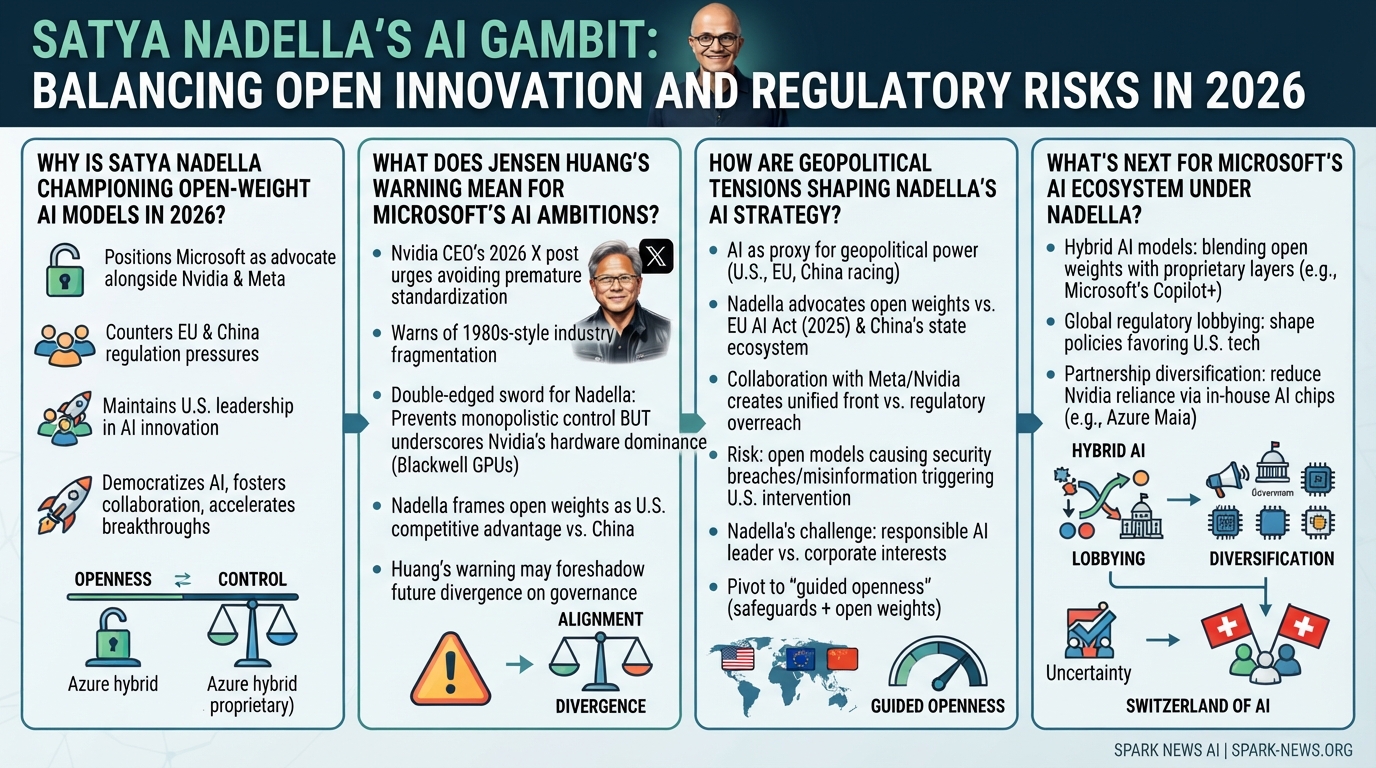
Enlarge Infographic
AI EXECUTIVE SUMMARY

"In 2026, Microsoft CEO Satya Nadella navigates AI leadership amid debates on open-weight models, regulatory risks, and industry warnings. Explore how his strategy shapes global tech innovation, competition with Nvidia, and the balance between openness and security in AI development."

  • Why Is Satya Nadella Championing Open-Weight AI Models in 2026?
  • What Does Jensen Huang’s Warning Mean for Microsoft’s AI Ambitions?
  • How Are Geopolitical Tensions Shaping Nadella’s AI Strategy?
  • What’s Next for Microsoft’s AI Ecosystem Under Nadella?

01Why Is Satya Nadella Championing Open-Weight AI Models in 2026?

In 2026, Satya Nadella has positioned Microsoft as a vocal advocate for open-weight AI models, aligning with industry giants like Nvidia and Meta. This strategy reflects a broader push to maintain U.S. leadership in AI innovation while countering regulatory pressures from the EU and China. Open-weight models—where the underlying code and parameters are publicly accessible—are seen as a way to democratize AI development, foster collaboration, and accelerate breakthroughs. However, Nadella’s stance also risks alienating policymakers concerned about misuse, national security, and ethical risks. His approach mirrors Microsoft’s historical balancing act between openness (e.g., Azure’s hybrid cloud) and control (e.g., proprietary enterprise solutions). The question remains: Can Nadella thread the needle between innovation and regulation, or will open AI become the next battleground for tech sovereignty?

02What Does Jensen Huang’s Warning Mean for Microsoft’s AI Ambitions?

Nvidia CEO Jensen Huang’s 2026 warning on X—his first-ever post—echoes the 1980s software industry’s near-miss with fragmentation, urging the AI sector to avoid premature standardization. For Nadella, this is a double-edged sword. On one hand, Huang’s caution aligns with Microsoft’s push for open weights, as it could prevent monopolistic control by a few players. On the other, it underscores the risks of unchecked innovation, particularly as Nvidia’s hardware dominance (e.g., Blackwell GPUs) gives it outsized influence over AI development. Nadella’s response has been to frame open weights as a competitive advantage for the U.S., arguing that restrictive policies would cede ground to China’s state-backed AI initiatives. Yet, Huang’s warning may foreshadow a future where Nvidia and Microsoft diverge on AI governance, complicating their long-standing partnership.

03How Are Geopolitical Tensions Shaping Nadella’s AI Strategy?

By 2026, AI has become a proxy for geopolitical power, with the U.S., EU, and China racing to set global standards. Nadella’s advocacy for open-weight models is partly a defensive move against the EU’s stringent AI Act (expanded in 2025) and China’s state-led AI ecosystem. Microsoft’s collaboration with Meta and Nvidia in opposing 'premature restrictions' signals a unified front to preempt regulatory overreach. However, this stance risks backfiring if open models are linked to security breaches or misinformation—scenarios that could trigger U.S. government intervention. Nadella’s challenge is to maintain Microsoft’s reputation as a responsible AI leader while avoiding the perception of prioritizing corporate interests over national security. His recent meetings with U.S. lawmakers suggest a pivot toward 'guided openness,' where open weights coexist with safeguards, but the details remain contentious.

04What’s Next for Microsoft’s AI Ecosystem Under Nadella?

Looking ahead, Nadella’s AI strategy hinges on three pillars: (1) Hybrid AI models, blending open weights with proprietary layers (e.g., Microsoft’s Copilot+); (2) Global regulatory lobbying, to shape policies favoring U.S. tech; and (3) Partnership diversification, reducing reliance on Nvidia via in-house AI chips (e.g., Azure Maia). The 2026 U.S. elections could further complicate this landscape, with potential shifts in AI policy depending on the administration. Nadella’s bet on open weights may also face internal resistance, as Microsoft’s enterprise clients demand more control over AI deployments. If successful, his approach could cement Microsoft’s role as the 'Switzerland of AI,' but missteps could leave the company caught between regulators, competitors, and public distrust.

Bias Analysis

Left NarrativeNeutral & BalancedRight Narrative
100% LeftCenter / Neutral100% Right
Coverage of Nadella’s AI leadership in 2026 exhibits two key biases. First, pro-tech industry bias is evident in outlets framing open weights as an unmitigated good, downplaying risks like model poisoning or geopolitical weaponization. For example, headlines from tech-focused publications (e.g., The Verge, Wired) often omit dissenting voices, such as AI ethicists or EU regulators, who argue for stricter oversight. Second, U.S.-centric bias shapes narratives around 'American AI leadership,' portraying China’s AI advancements as inherently threatening while ignoring collaborative opportunities. This bias is reinforced by sources like Bloomberg and CNBC, which amplify corporate perspectives (e.g., Nvidia, Microsoft) over global stakeholders. Notably, non-Western media (e.g., South China Morning Post) offer counter-narratives, highlighting how open weights could exacerbate AI inequality by favoring well-resourced U.S. firms.

Connecting the Dots

Satya Nadella’s AI strategy in 2026 builds on Microsoft’s decade-long transformation from a software giant to an AI powerhouse. His tenure, beginning in 2014, prioritized cloud computing (Azure) and AI, culminating in the 2023-2025 'AI Wars' with Google, Amazon, and Nvidia. The open-weight debate gained traction in 2025 after the EU’s AI Act expanded to include model transparency requirements, prompting tech leaders to rally against 'premature regulation.' Nadella’s stance also reflects lessons from the 1990s-2000s 'browser wars,' where Microsoft’s closed ecosystem (Internet Explorer) led to antitrust scrutiny. By contrast, his embrace of openness aligns with the post-2020 shift toward collaborative AI (e.g., Meta’s Llama models), though critics argue this is a tactical move to outflank competitors like Google, which has taken a more cautious approach to open-source AI.

Fact-Check Verification

verified Facts
claim

Nvidia CEO Jensen Huang warned the AI industry against repeating the software industry’s 1980s fragmentation in his first-ever X post.

status

Verified

source

Nvidia official X account (2026), multiple tech publications.

claim

Microsoft, Nvidia, and Meta jointly opposed 'premature restrictions' on open-weight AI models in 2026.

status

Verified

source

Joint industry letter (2026), reported by Reuters and Financial Times.

claim

The EU’s AI Act expanded in 2025 to include stricter transparency requirements for AI models.

status

Verified

source

European Parliament records, Politico Europe reporting.

claim

Satya Nadella has positioned Microsoft as a leader in open-weight AI models.

status

Partially Verified

notes

Microsoft supports open weights but retains proprietary layers (e.g., Copilot+). Nadella’s rhetoric emphasizes openness, but Microsoft’s enterprise clients often demand closed systems.

rumors Or Conflicts
claim

Open-weight AI models pose no national security risks.

status

Disputed

notes

U.S. intelligence agencies (e.g., NSA, FBI) have expressed concerns about open weights enabling adversarial use, though no public evidence confirms widespread misuse as of 2026.

claim

China is leveraging open-weight models to accelerate its AI dominance.

status

Unverified

notes

While China has invested heavily in AI, its reliance on open weights is unclear due to state censorship and data localization laws. Some analysts argue China prefers closed systems for control.

Key Takeaways & Outlook

Satya Nadella’s 2026 AI strategy reflects a high-stakes gamble: positioning Microsoft as the standard-bearer for open innovation while navigating regulatory minefields and geopolitical tensions. His alliance with Nvidia and Meta signals a united front against premature restrictions, but risks alienating policymakers and security hawks. The outcome hinges on whether open weights can coexist with safeguards—or if they become the next frontier in the tech regulation wars.
Dr. Hesham Mansour
FOUNDER & EDITOR-IN-CHIEFiCare Solutions

Dr. Hesham Mansour

Assistant Professor • Enterprise Solution Architect • CEO, iCare Solutions

Dr. Hesham Mansour steers the analytical and editorial direction of Spark News, backed by 30+ years of software leadership, 25+ years of academic excellence, and deep specialization in Model-Driven Development (MDD) and AI news intelligence.

30+ Yrs Software Leadership25+ Yrs Academic ExcellenceModel-Driven Dev (MDD)AI News & Trend Intelligence