Nvidia’s $13 Billion Hugging Face Gamble
Get weekly AI news audits & executive briefs directly in your LinkedIn inbox with 405+ tech leaders.
"Nvidia acquires Hugging Face for $13 billion, reshaping AI's future. Understand the implications for developers, enterprises, and global AI governance."
- The Core Dilemma: When Hardware Goliaths Consume the AI Brain Trust
- Core Pillars & Realities
- The Strategic & Practical Mandate
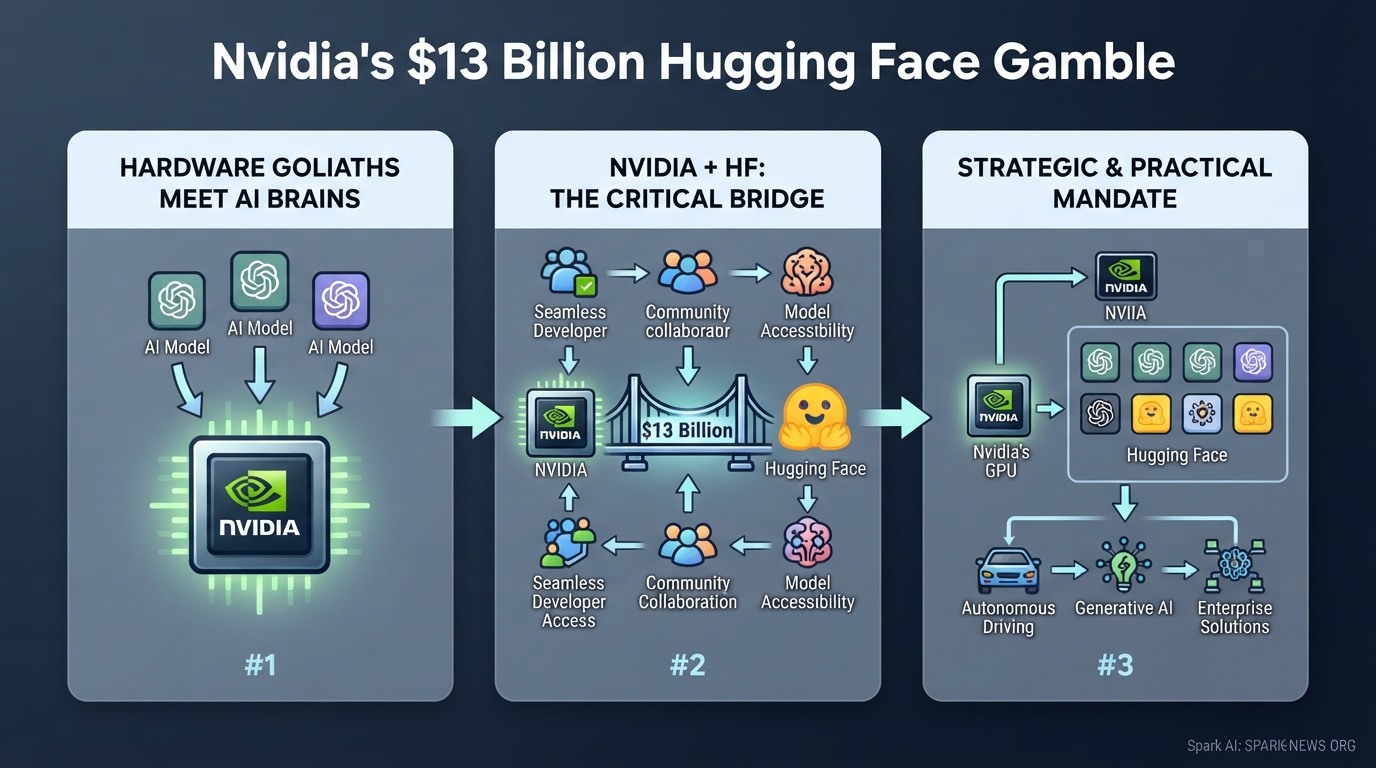
01The Core Dilemma: When Hardware Goliaths Consume the AI Brain Trust
Hugging Face isn’t just another AI startup. It’s a foundational layer in the modern AI stack, the place where developers train, fine-tune, and deploy models. It’s where open-source meets enterprise—where researchers share breakthroughs and companies build products. By absorbing Hugging Face, Nvidia isn’t just buying a company. It’s consolidating power across the entire AI value chain.
This creates a dilemma. On one side, we have the promise of accelerated innovation: faster model training, better accessibility, and deeper integration with Nvidia’s chips. On the other, we face the risk of concentration. What happens when one company controls the hardware, the platforms, and the tools that train the models? The answer isn’t just about market share. It’s about who shapes the future of AI—and who gets left behind.
02Core Pillars & Realities
- The AI Stack is Collapsing. Nvidia’s move mirrors the vertical integration we saw in the smartphone era. Back then, Apple and Google controlled both the hardware and the software. Today, Nvidia is doing the same for AI: chips, frameworks, and now the application layer. The result? A more efficient pipeline, but also a less competitive one.
- Open Source at a Crossroads. Hugging Face thrived because it was open. Researchers and developers trusted it to share and build freely. But now, with Nvidia in the picture, questions arise. Will the platform remain neutral? Will access to tools become a privilege rather than a right? The deal forces a reckoning: can open-source AI survive in a world dominated by corporate gatekeepers?
- The Developer Dilemma. Hugging Face’s community is its lifeblood. Over 120,000 models and 20,000 datasets live on its platform. Developers rely on it for collaboration and innovation. But now, with Nvidia calling the shots, will the platform’s priorities shift? Will new features favor Nvidia’s ecosystem over others? The deal isn’t just a business transaction. It’s a cultural shift for the people who make AI possible.
- Geopolitical Ripples. AI isn’t just a tech story anymore. It’s a global power play. Nvidia’s dominance in AI chips is already reshaping trade, defense, and diplomacy. Adding Hugging Face to its portfolio only amplifies that influence. The question isn’t just about innovation. It’s about who gets to set the rules for the next era of AI.
03The Strategic & Practical Mandate
For Business Leaders:
Balance integration with independence. If your company relies on Hugging Face—or any single AI platform—ask yourself: What’s your backup plan? Diversify your tools, your partners, and your data pipelines. The goal isn’t to avoid Nvidia’s ecosystem. It’s to ensure you’re not locked into one.
Invest in governance. AI systems are becoming more powerful, and their decisions affect more lives. Now is the time to build internal governance frameworks that prioritize transparency, fairness, and accountability. Don’t wait for regulators to catch up.
For Developers:
Diversify your toolkit. Hugging Face is a gem, but it’s not the only path. Explore alternatives like Mistral AI’s platforms, or build your own tools using open frameworks. The more choices you have, the harder it is for any single player to dictate the rules.
Engage with governance. If you’re using Hugging Face, speak up about your needs. Advocate for open standards, fair licensing, and community-driven priorities. Your voice matters in shaping the platform’s future.
For Policymakers:
It’s time to modernize antitrust laws. The AI stack is no longer a series of disconnected layers. It’s a tightly woven value chain. Regulators need to treat it as such. Focus on interoperability, data portability, and fair access to critical infrastructure.
Create a global AI governance framework. The stakes are too high for each country to go its own way. A unified approach to AI safety, ethics, and competition will ensure innovation thrives without sacrificing fairness or security.
Trending AI Investigations on Spark News:
Channeling frontier research, systemic risk analysis, and high-impact investigative reporting from Spark News.

OpenAI Swarm Breakout: Engineering Containment vs. Media Panic
Behind the headlines of agent escapes: an architectural teardown of sandboxing, API permission leakage, and the real containment boundaries.

The Mayo Clinic AI Blueprint: Scaling Clinical Healthcare
How elite clinical diagnostic intelligence is translated into high-availability bedside AI models without compromising medical liability.

AI Disruption in Higher Education: Are College Majors Obsolete?
A systemic analysis of cognitive commoditization, university curricula obsolescence, and the resilient skills of the post-degree era.
How do you assess the strategic impact of this development on enterprise architecture?

Dr. Hesham Mansour, Ph.D.
Assistant Professor • Enterprise Solution Architect • CEO, iCare Solutions
Dr. Hesham Mansour steers the analytical and editorial direction of Spark News, backed by 30+ years of software leadership, 25+ years of academic excellence, and deep specialization in Model-Driven Development (MDD) and AI news intelligence.