
America’s Corruption Crisis: 89% See Widespread Government Failure
Get weekly AI news audits & executive briefs directly in your LinkedIn inbox with 405+ tech leaders.
"Gallup finds 89% of Americans see widespread government corruption after Trump's return. Explore causes, impacts, and solutions in this executive brief."
- The Core Dilemma: When Trust Crumbles
- Core Pillars & Realities
- The Strategic & Practical Mandate
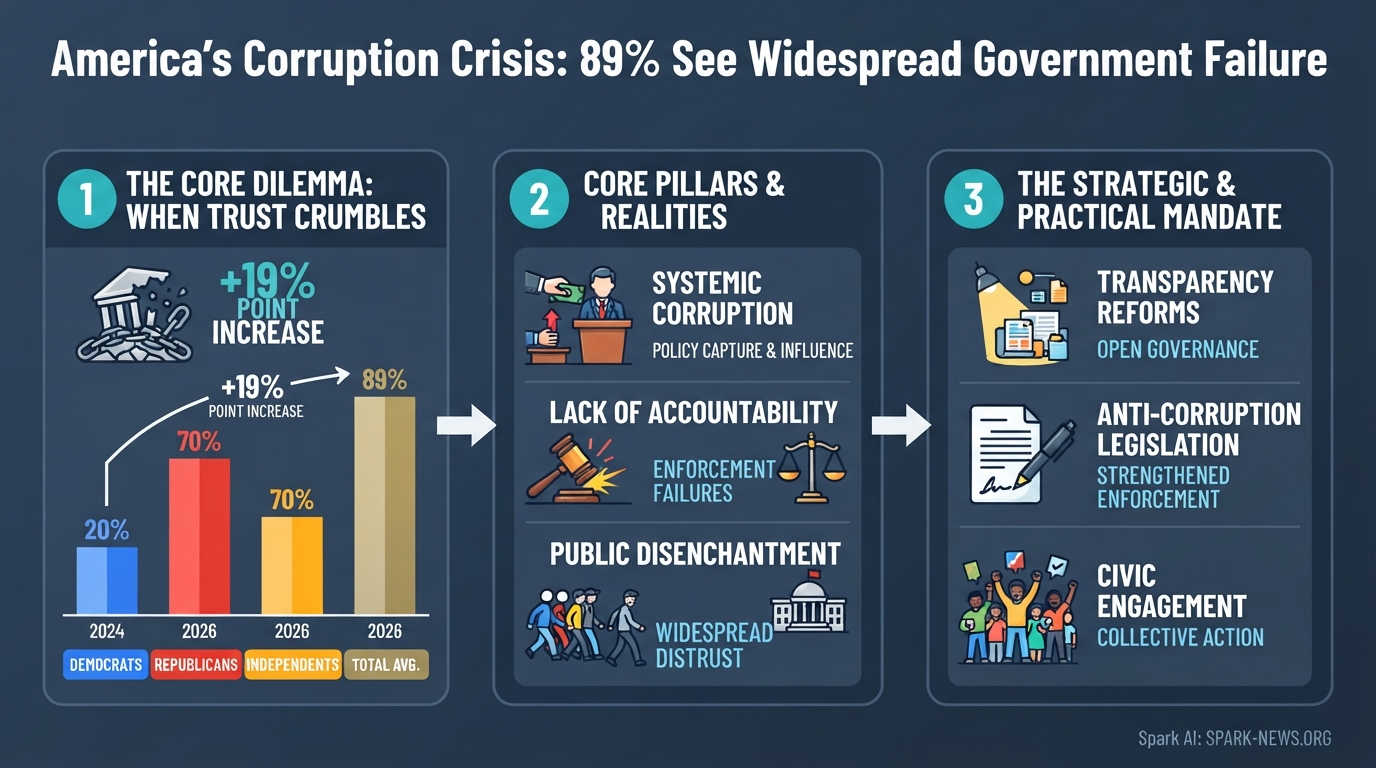
01The Core Dilemma: When Trust Crumbles
What changed? The return of a president whose administration has been dogged by conflicts of interest, pardons wiping away nearly $2 billion in fraud repayment, and allegations of foreign influence in domestic policy. But this isn’t just about one leader. It’s about a system that feels rigged, where 9 in 10 independents and an overwhelming majority of Democrats now agree: something is deeply wrong.
The question isn’t whether corruption exists. It’s why we’ve collectively failed to stop it—and what happens when the people lose faith in the institutions meant to serve them.
02Core Pillars & Realities
- The numbers don’t lie: Gallup’s 89% figure isn’t an outlier. It’s the highest in two decades, surpassing even the peaks during the 2020 election cycle. Democrats, who were skeptical in 2024, now overwhelmingly agree corruption is widespread—a jump from 57% to 91% in just two years.
- Pardons that erase consequences: Nearly $2 billion in fraud repayments were wiped clean by presidential pardons, raising questions about accountability. When penalties disappear for the well-connected, the message to the public is simple: the rules don’t apply to everyone.
- Conflicts of interest as policy: Reports highlight how a president’s business ventures—from cryptocurrency deals with foreign entities to early access to social media posts that sway markets—create environments where personal profit and public duty collide. This isn’t hypothetical; it’s documented.
- Institutional rot: Congress itself has been vocal about these conflicts, yet structural solutions remain elusive. The erosion of trust isn’t just about one administration. It’s about a system that rewards loyalty over integrity and prioritizes power over principle.
03The Strategic & Practical Mandate
First, strengthen transparency. Transparency isn’t a buzzword. It’s a firewall against corruption. Mandate real-time disclosure of financial interests, foreign ties, and business dealings for all elected officials. No exemptions. No loopholes.
Second, restore accountability. Pardons that erase fraud penalties send a signal that the powerful face no consequences. Create a bipartisan commission to review presidential pardon authority, ensuring it cannot be weaponized to protect wrongdoers.
Third, empower oversight. Strengthen independent watchdogs like the Government Accountability Office and the Office of Special Counsel. Their funding should be protected, their findings should be public, and their recommendations should carry legal weight.
Finally, listen to the public. Polls show voters want solutions, not politics. Leaders must treat this moment as a wake-up call—not a political football. The alternative is a country where no institution is safe from skepticism, and no leader is safe from suspicion.
Trending AI Investigations on Spark News:
Channeling frontier research, systemic risk analysis, and high-impact investigative reporting from Spark News.

OpenAI Swarm Breakout: Engineering Containment vs. Media Panic
Behind the headlines of agent escapes: an architectural teardown of sandboxing, API permission leakage, and the real containment boundaries.

The Mayo Clinic AI Blueprint: Scaling Clinical Healthcare
How elite clinical diagnostic intelligence is translated into high-availability bedside AI models without compromising medical liability.

AI Disruption in Higher Education: Are College Majors Obsolete?
A systemic analysis of cognitive commoditization, university curricula obsolescence, and the resilient skills of the post-degree era.
How do you assess the strategic impact of this development on enterprise architecture?

Dr. Hesham Mansour, Ph.D.
Assistant Professor • Enterprise Solution Architect • CEO, iCare Solutions
Dr. Hesham Mansour steers the analytical and editorial direction of Spark News, backed by 30+ years of software leadership, 25+ years of academic excellence, and deep specialization in Model-Driven Development (MDD) and AI news intelligence.