
Astra for Law and the Rewiring of Enterprise Legal Practice
Get weekly AI news audits & executive briefs directly in your LinkedIn inbox with 383+ tech leaders.
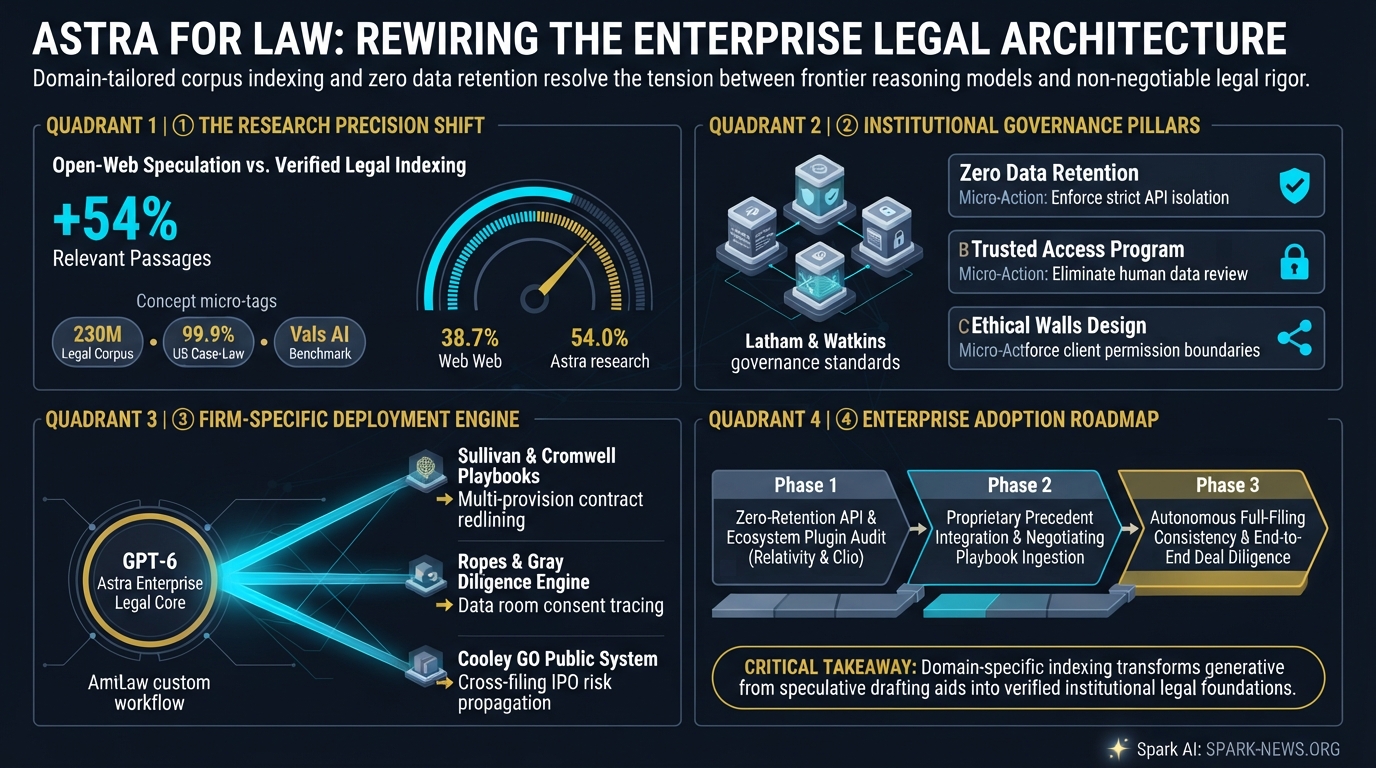
"OpenAI introduced Astra for Law, integrating GPT-6 Astra with a dedicated legal index of over 230 million URLs and Free Law Project case law. On Vals AI benchmarks, it achieves a 54.0% correctness rate alongside Zero Data Retention, shifting legal technology from ungrounded chat prompts to verifiable, bound institutional workflows."
- The Core Dilemma: Can Frontier Models Master Legal Rigor?
- Core Pillars & Decision Matrix
- The Strategic & Practical Mandate
01The Core Dilemma: Can Frontier Models Master Legal Rigor?
What we observe across production deployments is that generalist generative models struggle with statutory hierarchy, Shepardizing precedents, and distinguishing binding holdings from non-binding dicta. OpenAI has addressed this structural gap with Astra for Law. Built on GPT-6 Astra, the platform couples advanced reasoning capabilities with a curated legal search index spanning more than 230 million URLs. By integrating the Free Law Project database covering over 99.9% of published U.S. precedential case law, the system grounds generative legal analysis directly into authoritative legal sources rather than relying on unanchored statistical approximations.
02Core Pillars & Decision Matrix
| Strategic Dimension | Legacy / Siloed Approach | Rewired / Modern Architecture | Expected Impact & ROI |
|---|---|---|---|
| Case Law Research | Open-web prompting with high hallucination risk and unverified citations | GPT-6 Astra integrated with Free Law Project index covering 99.9% of precedential case law | 40% relative improvement in overall correctness check on Vals AI benchmark |
| Passage Retrieval | Manual keyword searching across siloed databases and secondary sources | Semantic search index spanning 230M URLs with targeted passage extraction | Up to 54% increase in retrieving relevant passages from correct court opinions |
| Data Governance | Standard cloud logging with potential human review of prompts | Trusted Access Program featuring Zero Data Retention (ZDR) on API calls | Complete mitigation of client confidentiality and ethical wall breaches |
| Workflow Tooling | Standalone chat portals separated from practice management platforms | 26 ecosystem plugins connecting to tools like Relativity, Clio, and custom firm vaults | Automated drafting, deal diligence, and redlining across active practice files |
From our systems reviews with enterprise engineering and operations leadership, three core operational advances stand out:
- Audited Research Benchmarks: On the private validation set of Vals AI Legal Research Bench, Astra for Law achieved a 54.0% overall correctness check at highest reasoning effort, compared to 38.7% for baseline GPT-6 Astra using web search alone.
- Deep Precedent Extraction: The platform uncovered 24% more reference cases and up to 54% more relevant passages from correct opinions than standard model configurations.
- Firm-Specific Implementation: Forward-deployed engineering teams are already running production instances. Sullivan & Cromwell deploys an agreement analyzer to surface hidden contractual risks, Ropes & Gray runs deal diligence tracing directly to data rooms, and Cooley operates GO Public to maintain consistency across capital market filings.
03The Strategic & Practical Mandate
First, audit internal governance models through specialized frameworks like the Trusted Access Program. When auditing enterprise pipelines, ensure your agreements enforce Zero Data Retention on API calls and verify that ChatGPT Enterprise configurations exclude prompt inputs from human review. Partner with established governance pioneers, as seen in OpenAI's collaboration with Latham & Watkins, to codify ethical walls and client information permissions directly into access layers.
Second, connect Astra for Law to internal proprietary playbooks rather than relying solely on out-of-the-box knowledge. Leverage the 26 ecosystem plugins to integrate existing document management platforms such as Relativity and Clio. This allows associates to apply proprietary firm negotiation strategies, contract exceptions, and risk parameters to initial drafts, elevating routine drafting to partner-level analysis.
How do you assess the strategic impact of this development on enterprise architecture?

Dr. Hesham Mansour, Ph.D.
Assistant Professor • Enterprise Solution Architect • CEO, iCare Solutions
Dr. Hesham Mansour steers the analytical and editorial direction of Spark News, backed by 30+ years of software leadership, 25+ years of academic excellence, and deep specialization in Model-Driven Development (MDD) and AI news intelligence.