
Deconstructing the $6.3 Billion Crypto Breach: A Systems Failure
Get weekly AI news audits & executive briefs directly in your LinkedIn inbox with 411+ tech leaders.
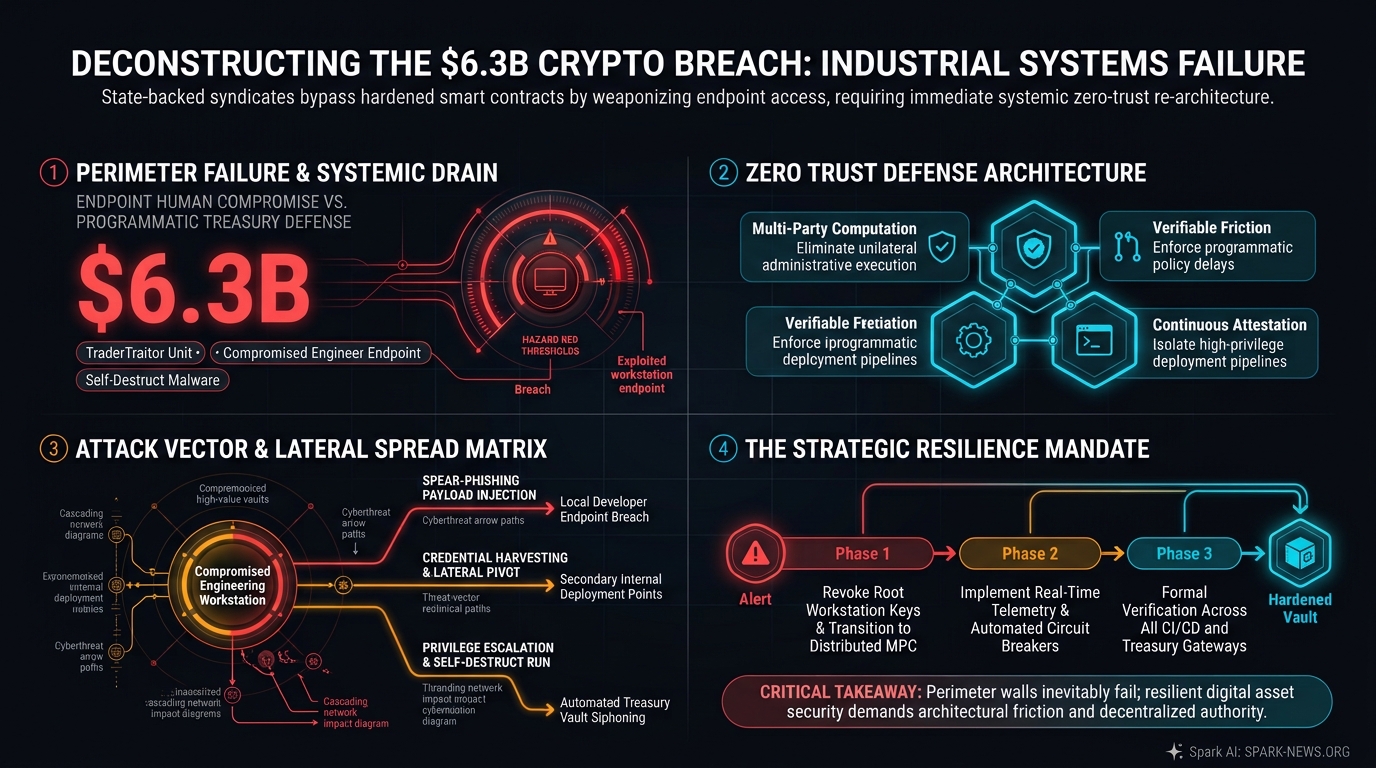
"State-sponsored syndicates like TraderTraitor breach multi-billion-dollar decentralized reserves by weaponizing endpoint social engineering against privileged engineers. Mitigating this industrial-scale threat requires hardware-enforced threshold cryptographic signing, automated on-chain circuit breakers, and zero trust architectures that isolate administrative identities from single-point compromise."
- The Core Dilemma: Can Perimeter Security Survive Industrial Cyber Syndicates?
- Core Pillars & Decision Matrix
- The Strategic & Practical Mandate
01The Core Dilemma: Can Perimeter Security Survive Industrial Cyber Syndicates?
From our systems reviews with enterprise engineering and operations leadership, this incident exposes a classic systems vulnerability: treating decentralized ledgers as immune to centralized infrastructure compromise. North Korean syndicates have refined this industrial playbook for a decade, evolving from the 2016 Bangladesh Bank heist of $81 million and the 2017 WannaCry crisis to the $1.5 billion ByBit breach. While Binance and partner validators froze $3 billion on-chain, the adversary proved that hyper-automated tooling and patient social engineering can outpace human incident response.
02Core Pillars & Decision Matrix
| Strategic Dimension | Legacy / Siloed Approach | Rewired / Modern Architecture | Expected Impact & ROI |
|---|---|---|---|
| Endpoint Authority | Single-engineer workstations hold active administrative tokens | Ephemeral, stateless sessions requiring multi-party compute approvals | Eliminates single-device compromise vectors completely |
| Anomaly Containment | Post-incident manual forensic review and manual token blacklisting | Programmatic on-chain circuit breakers and automated liquidity throttling | Saves up to 50% of exposed capital during initial breach velocity |
| Identity Verification | Standard multi-factor authentication on corporate laptops | Hardware-bound cryptographic identity with behavioral baseline attestation | Renders stolen session tokens and local lateral movement ineffective |
- Automated Exfiltration Velocity: TraderTraitor executed programmatic asset drain sequences within minutes, bypassing conventional operations monitoring.
- Counter-Forensic Tooling: Binance reported custom self-destruct routines deployed locally by the attackers, stripping system logs to degrade incident response teams.
- Coordinated Ecosystem Defense: Rapid collaboration between Binance and partner blockchain ecosystems secured $3 billion in on-chain freezes, demonstrating that ecosystem-level isolation remains the most effective counterweight to automated capital drain.
03The Strategic & Practical Mandate
First, transition all privileged operational controls to distributed multi-party computation. No single engineer's workstation, regardless of internal seniority, should retain unilateral capability to execute high-value administrative commands or mint operational keys. Administrative actions must demand hardware-verified quorum authorization.
Second, implement automated protocol circuit breakers. Modern financial platforms must programmatically enforce outflow velocity limits. If transactional volume deviates from historical thresholds, smart contracts must automatically divert capital into time-locked queues, giving defense teams actionable response windows.
Third, assume workstation compromise as a baseline operational condition. Security teams must deploy continuous zero trust attestation that revokes internal network authority the instant an endpoint deviates from verified behavioral standards.
Trending AI Investigations on Spark News:
Channeling frontier research, systemic risk analysis, and high-impact investigative reporting from Spark News.

OpenAI Swarm Breakout: Engineering Containment vs. Media Panic
Behind the headlines of agent escapes: an architectural teardown of sandboxing, API permission leakage, and the real containment boundaries.

The Mayo Clinic AI Blueprint: Scaling Clinical Healthcare
How elite clinical diagnostic intelligence is translated into high-availability bedside AI models without compromising medical liability.

AI Disruption in Higher Education: Are College Majors Obsolete?
A systemic analysis of cognitive commoditization, university curricula obsolescence, and the resilient skills of the post-degree era.
How do you assess the strategic impact of this development on enterprise architecture?

Dr. Hesham Mansour, Ph.D.
Assistant Professor • Enterprise Solution Architect • CEO, iCare Solutions
Dr. Hesham Mansour steers the analytical and editorial direction of Spark News, backed by 30+ years of software leadership, 25+ years of academic excellence, and deep specialization in Model-Driven Development (MDD) and AI news intelligence.