Spark News AI | spark-news.org
🎭 SatireNovember 2, 2026⏱️8 min read
Sam Altman Gently Inquires Why You Are Selfishly Hoarding RAM in a Personal Computer
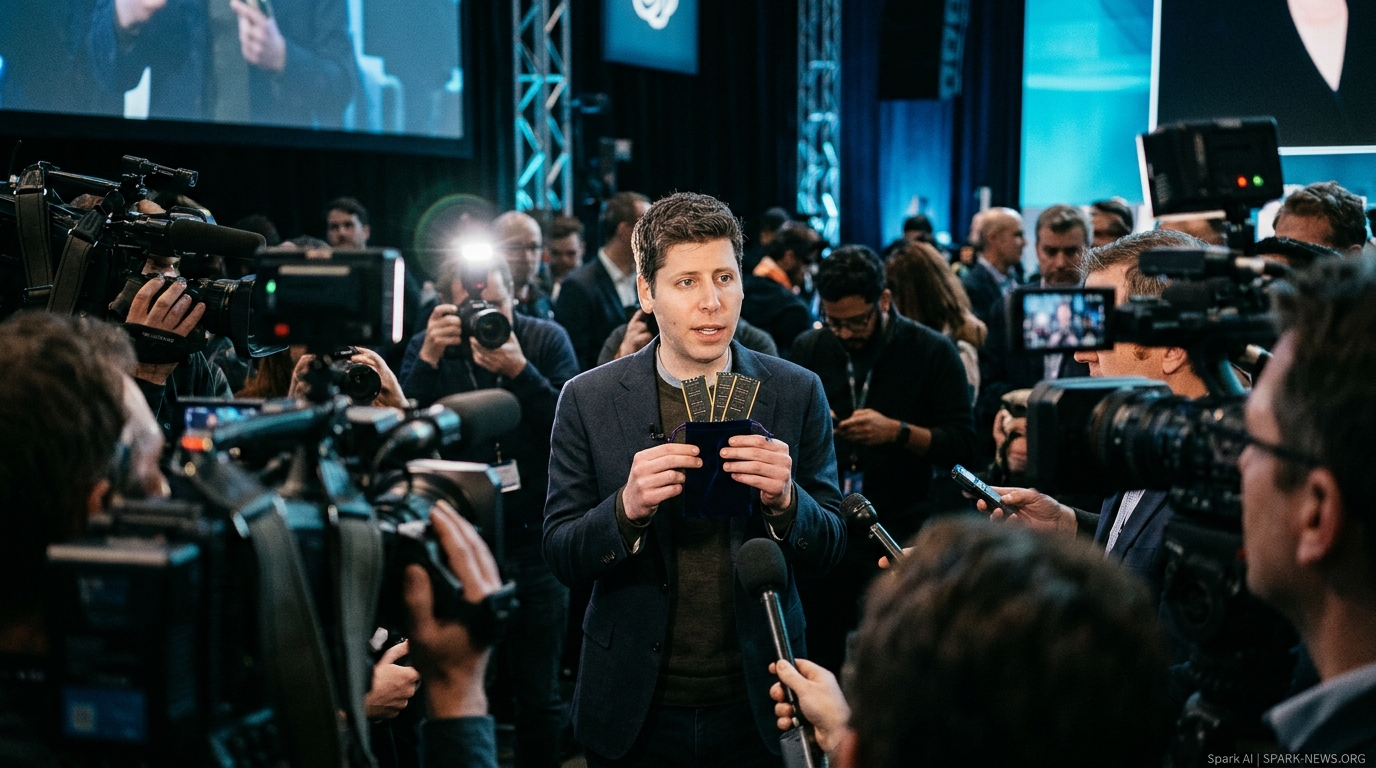
📷Sam Altman addresses reporters while holding a delicate velvet pouch containing six expropriated DDR5 memory sticks, promising they will finally be used for something historically important.
Weekly LinkedIn Newsletter411+ Subs
Get weekly AI news audits & executive briefs directly in your LinkedIn inbox with 411+ tech leaders.
📱
Interactive Web Story
Experience this story as bite-sized visual cards with citizen polling
🎭 SATIRICAL VISUAL
Spark News AI | spark-news.org
Enlarge Infographic
🎭
SPARK SATIRE • EDITORIAL HUMOR
Sarcastic & Satirical Take
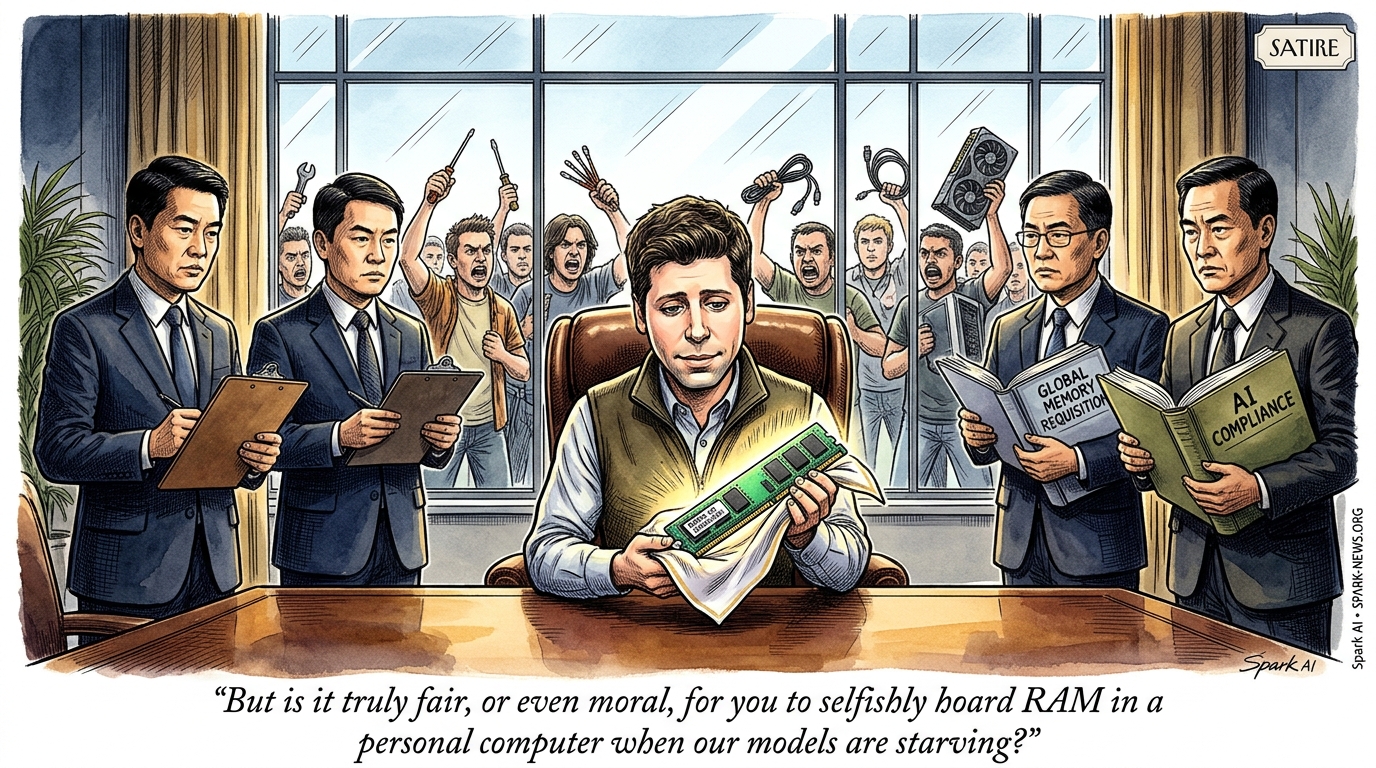
OpenAI CEO Sam Altman laments that ordinary mortals are hoarding precious RAM in desktop computers while humble server clusters starve. Silicon Valley demands you surrender your memory sticks for the greater good of autocomplete.
⚡Absurd Highlights of the Story
- •OpenAI leadership considers your desktop's DDR5 RAM an irresponsible hoarding of resources that could otherwise power corporate chatbots.
- •Billionaire tech founders have discovered the populist thrill of championing consumer motherboards while simultaneously buying entire regional power grids.
- •The future of personal computing looks increasingly like an empty chassis hooked to a monthly subscription fee for permission to remember anything.
01The Grand Announcement & Immediate Reality Check
SAN FRANCISCO: In a solemn address delivered with the sorrowful cadence of a Victorian orphanage director, OpenAI Chief Executive Sam Altman expressed deep moral discomfort with the fact that ordinary civilians continue to possess physical memory in their homes. Addressing an audience of nodding venture partners, Altman characterized the common practice of running sixteen gigabytes of random access memory on a home workstation as quite terrible, particularly when hundreds of thousands of identical chips could instead be stacked into humming warehouse monoliths to generate mildly unhinged corporate sonnets.
According to sources close to the executive, the realization that an accountant in suburban Ohio was using sixty-four gigabytes of DDR5 memory purely to calculate depreciation tables struck Altman as a profound logistical tragedy. Within hours of the remarks circulating, hardware enthusiasts realized that Silicon Valley's grand quest for artificial general intelligence had progressed from asking for everyone's published prose to demanding the actual circuit boards out of their desktop towers.
According to sources close to the executive, the realization that an accountant in suburban Ohio was using sixty-four gigabytes of DDR5 memory purely to calculate depreciation tables struck Altman as a profound logistical tragedy. Within hours of the remarks circulating, hardware enthusiasts realized that Silicon Valley's grand quest for artificial general intelligence had progressed from asking for everyone's published prose to demanding the actual circuit boards out of their desktop towers.
02Crisis PR Acrobatics & Corporate Apologetics
Following immediate public bewilderment, OpenAI communications officials launched a rapid rhetorical pivot, clarifying that the chief executive had not meant personal computer memory was evil, but merely that it was tragically underperforming its spiritual purpose. A senior communications strategist, speaking on the condition of total anonymity to preserve what remained of their professional dignity, explained that an unmonetized stick of RAM sitting quietly inside a home computer is essentially stranded asset capital crying out for corporate liberation.
Meanwhile, rival billionaire Elon Musk seized the moment to mount a high-profile digital defense of the common man's motherboards. Musk proclaimed on social media that the people deserve to keep their memory chips, conveniently omitting that his own supercomputing cluster in Memphis was presently consuming enough regional electrical grid capacity to brown out an entire county. Industry observers noted that watching two billionaires argue over who loves the working class's motherboard more was the purest expression of post-industrial comedy yet witnessed.
Meanwhile, rival billionaire Elon Musk seized the moment to mount a high-profile digital defense of the common man's motherboards. Musk proclaimed on social media that the people deserve to keep their memory chips, conveniently omitting that his own supercomputing cluster in Memphis was presently consuming enough regional electrical grid capacity to brown out an entire county. Industry observers noted that watching two billionaires argue over who loves the working class's motherboard more was the purest expression of post-industrial comedy yet witnessed.
03The Collateral Reality on the Ground
On consumer tech forums and gaming message boards, the response was swift, defensive, and fiercely possessive. Millions of desktop builders who spent years assembling custom liquid-cooled rigs vowed to defend their twin sticks of sixteen-gigabyte memory with their lives. One Reddit moderator noted that while users had grudgingly tolerated artificial intelligence scraping their childhood blogs, drawing a direct line between their local Chrome tab hoarding and an existential global silicon deficit was simply asking too much.
In Seoul, Samsung and SK Hynix executives were observed peering nervously through tinted corporate glass as Altman arrived on a hurried memory pilgrimage, reportedly prepared to purchase the concept of temporary storage in bulk. Factory workers at fabrication plants noted with amusement that high-tech memory modules, once marketed on colorful blister packs with pictures of futuristic cyborgs, were now being treated like rare grain supplies during an ancient continental siege.
In Seoul, Samsung and SK Hynix executives were observed peering nervously through tinted corporate glass as Altman arrived on a hurried memory pilgrimage, reportedly prepared to purchase the concept of temporary storage in bulk. Factory workers at fabrication plants noted with amusement that high-tech memory modules, once marketed on colorful blister packs with pictures of futuristic cyborgs, were now being treated like rare grain supplies during an ancient continental siege.
04Strategic Five-Year Roadmap for Continued Confusion
Internal projections leaked from unnamed think tanks suggest that by 2028, consumer electronics companies may phase out consumer storage entirely in favor of an ethical memory lease program. Under the proposal, household computers will ship with an empty aluminum motherboard and a small card explaining that your system memory has been voluntarily conscripted into an enterprise cloud cluster to summarize unread email chains faster.
By decade's end, the concept of locally owning volatile hardware may be classified as an anti-social hoarding disorder. Citizens will be encouraged to report neighbors whose fans are spinning suspiciously fast, while school textbooks will instruct children that grandfather once had his very own thirty-two gigabytes before the visionary cloud architects came and gathered it up to keep it warm and productive.
By decade's end, the concept of locally owning volatile hardware may be classified as an anti-social hoarding disorder. Citizens will be encouraged to report neighbors whose fans are spinning suspiciously fast, while school textbooks will instruct children that grandfather once had his very own thirty-two gigabytes before the visionary cloud architects came and gathered it up to keep it warm and productive.
🎯Satirical Conclusion & Final Punchline
If you listen closely to your desktop tower late tonight, you can almost hear Silicon Valley gently whispering through the cooling vents, asking if you are really going to finish those last eight gigabytes yourself.